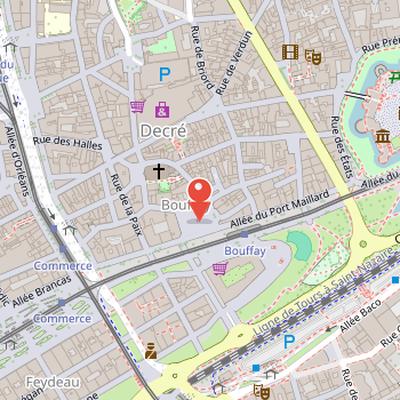
Place du Bouffay is a paved square located in the Bouffay district, the oldest part of Nantes’ city center. It serves Rue du Bouffay, Rue de la Bâclerie, Rue des Échevins, and Rue de l’Ancienne-Monnaie, and is part of the pedestrian zone. In the Middle Ages, it was the main square of the city and was formerly the courtyard of the comtal château du Bouffay, whose first fortifications date from the 13th century and which stood on the west side of the square.
The square was bordered on the south by the rampart of the ancient medieval city along the Loire, which was demolished between 1766 and 1780. Access was formerly provided by a quay, now called allée de la Tremperie. Public executions were held there until the Revolution, including the beheading of Henri de Talleyrand-Périgord in 1626 and the execution of actors of the Conspiration de Pontcallec in 1720. Eighteenth-century urban works changed its appearance, and classical-style buildings from the late 18th century now stand on its west, north, and east sides.
Nearby Objects
-
 Château du Bouffay 60 m away
 -
 Église Sainte-Croix 100 m away
 -
 Convent of the Carmelites 250 m away
 -
 Château des ducs de Bretagne 350 m away
 -
 Basilique Saint-Nicolas 350 m away
Location and Access
Place du Bouffay is located in the Bouffay district, the oldest in the city center. It serves Rue du Bouffay, Rue de la Baclterie, Rue des Echevins, and Rue de l'Ancienne-Monnaie. The square is paved and forms part of the pedestrian zone of Bouffay.
From Castle Courtyard to Public Square
Place du Bouffay was once the courtyard of the comtal castle called chateau du Bouffay, whose first fortifications date back to the 13th century. The castle stood on the west side of the square, and the site was bordered on the south by the rampart of the ancient medieval city along the Loire. This rampart was demolished between 1766 and 1780, and the area was accessed by a quay, now known as allee de la Tremperie.
In the Middle Ages, the site served as the main square of the city. After the chateau des ducs de Bretagne was built from the 15th century, chateau du Bouffay became the center of municipal and judicial institutions. The former courtyard of chateau du Bouffay was later transformed into a public square, while the castle itself lasted until the 18th century.
The square also had a marked judicial function. Public executions were held there until the Revolution. Among those executed were Henri de Talleyrand-Perigord in 1626 and the actors of the Conspiration de Pontcallec in 1720. These events underline the long association of the site with civic authority and punishment.
18th-Century Reorganization of the Square
Urban works in the 18th century completely changed the appearance of place du Bouffay. In 1761, architect Jean-Baptiste Ceineray drew up the first plan for reorganizing the square, and his proposal required the destruction of buildings that did not fit the intended alignment. A new plan was drafted in 1772 for construction along quai Flesselles. This plan called for the Hôtel des Monnaies de Nantes to be demolished and rebuilt with a main facade facing the square, and for a Presidial to be erected to the west on the former castle site, with its main facade turned toward the quays. The main building on the north side was planned as a residential building, and it was built according to Ceineray's recommendations. Classical style buildings from the late 18th century now stand on the west, north, and east sides of the square, and the buildings on the east and west sides were completed after Ceineray's death while still respecting his design characteristics. The continuous quays along the Loire, projected by Ceineray, were finished in front of the square in 1817. The Hôtel des Monnaies de Nantes and the prison tower were still standing in 1818, and money was minted at the Hôtel des Monnaies until 1820. The old Hôtel des Monnaies, located at the southeast corner of the square, had been destroyed in the 18th century. René Laennec lived at number 5 place du Bouffay from 1788 to 1793.
Market Area and Renovation History
Historique is presently a pedestrian and commercial area. It hosted a covered market until 2010, when renovations of cours Franklin-Roosevelt required the removal of the 1878 metallic canopies used as market halls in Historique. These metallic canopies were later restored identically. Municipal authorities decided to assess until 2018 whether market activities should be reinstalled in Historique.