Place des Quinconces is a main square in the city center of Bordeaux, France. Created at the beginning of the 19th century on the site of the Château Trompette, it covers 12 hectares and is the largest square in France, as well as one of the largest in Europe. The square is composed of an esplanade that slopes gently toward the Garonne River and is bordered to the north and south by tree plantations. At both ends, it is decorated by the Girondins Monument and two rostral columns.
The square hosts a range of events, including concerts, fairs, carnivals, and the Foire aux Plaisirs funfair, as well as the Autumn Brocante Fair, the Spring Brocante Fair, and the Arlette Gruss Circus. It also includes the Quinconces station of the Bordeaux tramway network and is served by the Quinconces stop, described as the most important public transport interchange in Bordeaux. The square was developed from 1810 to 1828 and has carried several names, including Place Louis-XVI and Place Louis-Philippe, before taking its current name after the Revolution of 1848.
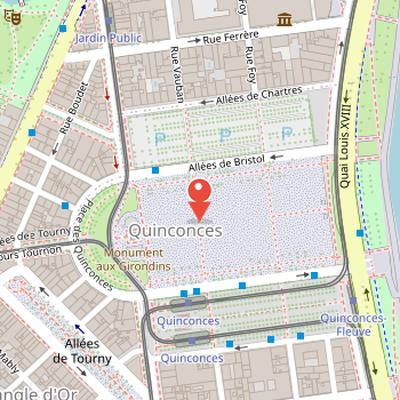
Nearby Objects
-
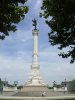 Monument aux Girondins 90 m away
 -
 CAPC musée d'art contemporain de Bordeaux 300 m away
 -
 Grand Théâtre de Bordeaux 350 m away
 -
 Hôtel Saige 350 m away
 -
 Place de la Comédie 350 m away
City Square and Event Space
Place des Quinconces is a main square in the city center of Bordeaux, France. Because of its large area, it is used to host carnivals and fairs. Its role as a spacious public square gives it an important place in the citys urban life and public events.
Design and Uses of Place des Quinconces
Created at the beginning of the 19th century on the site of the Chateau Trompette, Place des Quinconces is a major public space in Bordeaux. It is composed of an esplanade that slopes gently towards the Garonne River and is bordered to the north and south by tree plantations. At both ends, it is decorated by the Girondins Monument and two rostral columns.
With an area of 12 hectares, it is the largest square in France and one of the largest squares in Europe. Its size and open layout make it suitable for large public events. The square hosts concerts and fairs, including the Foire aux Plaisirs funfair, the Autumn Brocante Fair, the Spring Brocante Fair, and the Arlette Gruss Circus.
Place des Quinconces also has an important transport role. It hosts the Quinconces station of the Bordeaux tramway network and is served by the Quinconces stop, described as the most important public transport interchange in Bordeaux.
From Fortress Site to Public Square
Place des Quinconces was developed between 1810 and 1828 on the site of Château Trompette. The fortress had been built under Charles VII to contain a rebellious city, and it was named after the Tropeyte stream that crossed the neighborhood. During the reign of Louis XIV, Vauban improved the fortress, but it lost its role during the 18th century. After the fortress was transferred to the city in 1816 under King Louis XVIII, demolition began and the area was gradually transformed into the present square. The place was first named Place Louis-XVI in 1818, then renamed Place Louis-Philippe in 1830, before taking its current name after the Revolution of 1848.
From Fountain Plans to the Girondins Monument
In 1850, the city decided to build a fountain on Place des Quinconces and launched a competition for the project. Frédéric Bartholdi, then 23 years old, won with a monumental design inspired by the Apollo basin in Versailles, but the municipal council did not approve it. In 1883, it was instead decided to construct a monument to the Girondins and the Republic in the center of the square. The main element, a 43-meter column with surrounding basins, was completed in 1902.
The place later became the setting for several major public events. It hosted the International Maritime Exhibition from May to November 1907, and in 1920 it held the Fete des Vendanges with a temporary open-air theater. During World War II, the square was used by the German Hafenkommandantur as port headquarters installations, under the defense code Bo32. Remains from this period still survive, including armored doors facing the Allees de Bristol and a Type 608 blockhouse coded 32/3 at the intersection with Quai Louis-XVIII.
The Girondins monument was also directly affected by the occupation. Between November 11 and 18, 1942, German occupiers removed the bronze seahorses and groups from the basins for metal collection. The sculptures were found in Angers in 1945 and reinstalled in 1983. The city received 33,000 francs as compensation for the metal collection efforts.
Public Events and Memorial Uses
Since 1854, Place des Quinconces has hosted the Foire aux Plaisirs, a twice-yearly funfair held in the autumn and spring for three-week periods. The square also has a commemorative role: in 1989, a plaque was installed to honor nine Girondin deputies, including Francois Bergoeing, Henri Boyer-Fonfrede, Jean-Francois Ducos, Armand Gensonne, Marguerite-Elie Guadet, Jacques Lacaze, Jean-Antoine Lafargue de Grangeneuve, and Pierre Victurnien Vergniaud. The site has also been used for major cultural and entertainment events, including a Pink Floyd concert in 1994 during the group's final tour. Each January, the Arlette Gruss circus sets up its tent on the place as the starting point for its 11-month nationwide tour. In 2003, the Quinconces station became a major public transport hub, with three tram lines and multiple bus and coach lines serving the area.
Monuments and Layout of Place des Quinconces
Place des Quinconces is described as a large esplanade sloping gently toward the Garonne, with promenades planted around it. Among its notable monuments are the white marble statues of Montaigne and Montesquieu, created by the sculptor Dominique Fortuné Maggesi and installed in 1858. The square also contains the Monument aux Girondins, a major commemorative ensemble raised between 1894 and 1902 to honor Girondin deputies who were victims of the Terror and to celebrate the Republic.
The Monument aux Girondins developed from the Gloria victis project presented in 1887 by sculptor Alphonse Dumilatre and architect Henri Deverin. The project was later revised with architect Victor Rich, who added basins. The monument consists of a wide pedestal flanked by two basins adorned with horses and bronze groups. Above this rises a 43 meter column topped by a liberty statue at a height of 54 meters. The bronze green statue represents freedom breaking its chains.
Also facing the Garonne are two rostral columns, each 21 meters high, constructed by Pierre-Alexandre Poitevin in 1829. Together, these elements give the site a combination of landscaped open space, literary and political commemoration, and large scale urban monumentality.
Rostral Columns of Place des Quinconces
The rostral columns at Place des Quinconces are a notable feature of Bâtiments remarquables et lieux de memoire. They are decorated at one third of their height with four galley prows, each extended by rostra formed of two bundles of three swords, a design by Florent Bonino. Their shafts carry finely sculpted decorations copied from Capitoline Museum models, and the columns symbolize Roman naval victory over Carthage and naval mastery. The column capitals support circular edicules with domes bearing two statues originally made of terracotta by the painter and sculptor Monsau. These were later replaced by cast iron copies. One statue represents Commerce, symbolized by Mercury, while the other symbolizes Navigation, identified as Artemis holding an oar. Poitevin also added Mercury's caduceus and a guiding star as attributes of Commerce and Navigation.