Rue Duguesclin is a long street in Lyon, measuring 2,800 metres and crossing the 6th and 3rd arrondissements entirely before ending in the 7th arrondissement. It starts at Boulevard des Belges and ends on Rue Rachais. In common usage and in the telephone directory, the street name is written as one word, Duguesclin, while cartographers write it as two words, Du Guesclin.
The street was created gradually in the nineteenth century from what was then Cours Franklin Roosevelt, formerly Cours Morand, and was urbanized after 1850. It received its current name in 1852 along its entire length. Avenue Vauban became part of the street in 1854, and the last section beyond Rue Moncey was created in 1865. Rue Duguesclin is named after Bertrand du Guesclin, who lived from 1320 to 1380 and was Constable of France. The section between Rue de Sèze and Cours Franklin Roosevelt marks the boundary of the historic center of Lyon. Its built environment includes post-early 19th-century buildings, later high-rise buildings, a square, and the stone City Hall of the 3rd arrondissement.
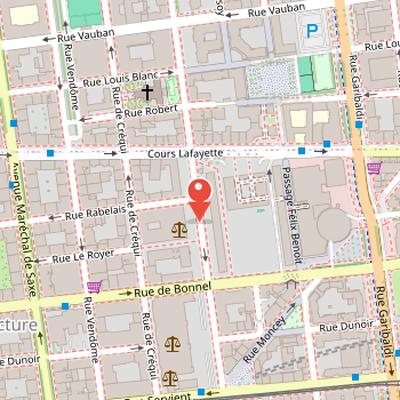
Nearby Objects
-
 Rue de Créqui 120 m away
 -
 Halles de Lyon-Paul Bocuse 150 m away
 -
 Chapelle Sainte-Croix de Lyon 200 m away
 -
 Auditorium Maurice-Ravel 350 m away
 -
 Bourse du Travail 350 m away
Route and naming of Rue Duguesclin
Rue Duguesclin is a long street in Lyon, extending for 2,800 meters. It starts at Boulevard des Belges and ends on Rue Rachais. The street crosses the 6th and 3rd arrondissements entirely and ends in the 7th arrondissement of Lyon. Its name is written as one word, Duguesclin, by Lyon inhabitants and in the telephone directory, while cartographers write it as two words, Du Guesclin.
History of Rue Duguesclin
Rue Duguesclin was created gradually in the nineteenth century from Cours Franklin Roosevelt, which was then named Cours Morand. The street was urbanized after 1850, and it took its current name in 1852 along its entire length. Its development continued in stages: Avenue Vauban became part of Rue Duguesclin in 1854, and the last section, beyond Rue Moncey, was created in 1865. The current Rue Batonnier-Jacquier was officially part of Rue Duguesclin until 28 May 1934 or 1954, and it lies between Rue du Beguin and Rue du Repos.
The street is named after Bertrand du Guesclin, who lived from 1320 to 1380 and was Constable of France. A section between Rue de Seze and Cours Franklin Roosevelt marks the boundary of the historic center of Lyon. Rue Duguesclin also has documented social and political associations: restaurant Fredouillere, located at number 169 in the 1850s and 1860s, held many political meetings.
Built Character and Land Uses on Rue Duguesclin
Rue Duguesclin is described through a sequence of built forms that change along its course. Near the beginning, it is lined by post-early 19th century buildings with a maximum of ten floors, together with rounded reliefs. After the Rue Cuvier, there are 12-floor buildings and a square. Farther on, after the Rue Rabelais, the street includes buildings arranged around various courts, as well as an underground car park topped by a garden. After the Rue Servient, the stone City Hall of the 3rd arrondissement appears, marked by capitals and a clock. Beyond La Part-Dieu, the buildings become more recent and smaller.
The street also contains a notable set of institutions and commercial uses. These include the headquarters of the bank Saint Olive, built in 1809, as well as the new Palais de Justice de Lyon. Rue Duguesclin also contains the Odyssey bookshop, restaurants, companies, shops, the OPAC, law firms, doctors' offices, and a police station. Taken together, these facts show a street that combines administrative, judicial, commercial, and professional functions with a varied architectural fabric.