Chapelle Sainte-Croix de Lyon is a Roman Catholic church in the 6th arrondissement of Lyon, north of Cours Lafayette at Rue de Créqui No. 147. It is dedicated to the Holy Cross and is also known as Kapelle Sainte-Croix, Chapelle expiatoire, Croix glorieuse, Monument des Brotteaux, and Crypte des Brotteaux. It should not be confused with the parish church Sainte-Croix in the 2nd arrondissement. The chapel is sometimes marked as a memorial on city maps and holds regular church services.
The site is linked to the execution of 2,000 Lyon citizens after the suppression of the Lyon uprising against the French Revolution in 1793. A Holy Cross Chapel in the form of a pyramid was built in 1819 in the Brotteaux quarter by architect Claude Cochet, then replaced in 1886 by a road construction. From 1898, architect Paul Pascalon rebuilt the chapel at its current location, and it was consecrated in 1906. Built in a neo-Byzantine style with a dome and crypt, the church contains sparse furnishings, plaques naming the victims, and the remains kept in the crypt.
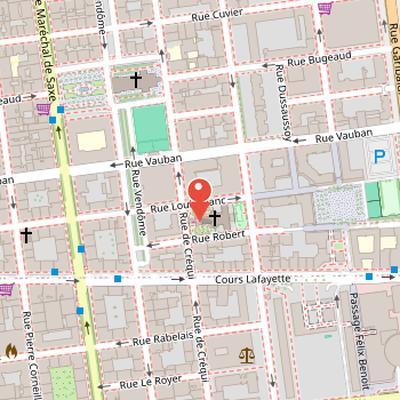
Nearby Objects
-
 Rue de Créqui 120 m away
 -
 Rue Duguesclin 200 m away
 -
 Église Saint-Pothin 250 m away
 -
 Lycée Édouard-Herriot 250 m away
 -
 Halles de Lyon-Paul Bocuse 300 m away
Identity and Location
The Chapelle Sainte-Croix de Lyon is a Roman Catholic church in the 6th arrondissement of Lyon. It is also known by several other names, including Kapelle Sainte-Croix, Chapelle expiatoire, Croix glorieuse, Monument des Brotteaux, and Crypte des Brotteaux. It should not be confused with the parish church Sainte-Croix in the 2nd arrondissement.
Location and Dedication
The Chapelle Sainte-Croix de Lyon stands north of Cours Lafayette at 147 Rue de Crequi. It is dedicated to the Holy Cross. On city maps, it is sometimes marked as a memorial monument, reflecting its presence in the urban landscape. The chapel also continues to hold regular church services, indicating an ongoing religious use alongside its mapped civic presence.
History of the Holy Cross Chapel
The history of the Chapelle Sainte-Croix de Lyon is linked to the memory of the suppression of the Lyon uprising of 1793, after which 2,000 Lyon citizens were executed by Collot d Herbois and Fouche. In 1819, a Holy Cross Chapel in the form of a pyramid was built in the Lyon quarter of Les Brotteaux by the architect Claude Cochet (1760 to 1835). This chapel was later replaced in 1886 by the construction of a road. From 1898, architect Paul Pascalon (1838 to 1914) rebuilt the chapel at its current location, where it was consecrated in 1906. The Capuchin monks who cared for the site lived in a small monastery building at the east choir, and in 1979 they were replaced by the Sisters of the Famille Missionnaire de Notre Dame, founded by Lucien-Marie Dorne.
Architectural Form and Memorial Function
Chapelle Sainte-Croix de Lyon was built in a neo-Byzantine style and includes a dome and a crypt. Its interior was furnished sparsely, giving the building a restrained appearance. The chapel also served a memorial purpose: plaques in the church display the names of 2000 victims, and the remains of these victims were arranged to be kept in the crypt. Among the names commemorated, Louis Francois Perrin de Precy is listed foremost. He is identified on the plaques as a military leader who defended the city during a 63-day siege by revolutionary troops.