Auditorium Maurice-Ravel is an auditorium in the Part-Dieu district of Lyon, located on Place Charles-de-Gaulle. Named after the composer Maurice Ravel, it was designed by architects Charles Delfante and Henri Pottier, with assistance from acoustician Léon Conturie. The auditorium is built in prestressed concrete and its interior is shaped like a Saint-Jacques shell.
The building was created in response to the absence of a symphonic hall in Lyon’s musical life. The city’s earlier venue had to rely on Salle Rameau, and the initiative for a new facility was supported by Robert Proton de la Chapelle, musicologist and deputy to mayor Louis Pradel. The municipal council approved the project, and the auditorium was inaugurated after more than three years of construction. It serves as the residence hall for the Orchestre national de Lyon. The inaugural concert featured Serge Baudo conducting the orchestra, with works by Berlioz and Ravel, and the opening weekend also included choirs, recitals, and symphonic concerts.
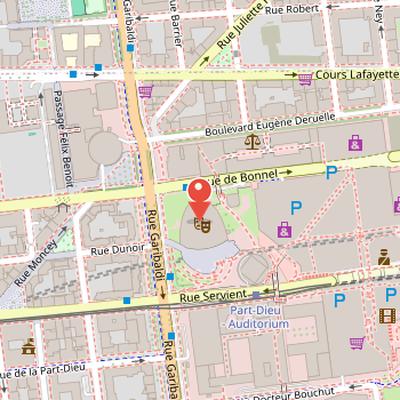
Nearby Objects
-
 Tour Part-Dieu 90 m away
 -
 Rue Garibaldi 200 m away
 -
 Les casernes de la Part-Dieu 250 m away
 -
 Westfield La Part-Dieu 250 m away
 -
 Halles de Lyon-Paul Bocuse 250 m away
Auditorium Maurice-Ravel in Lyon
The Auditorium Maurice-Ravel is located in the quartier de la Part-Dieu in Lyon. It was designed by the architects Delfante and Pottier and was inaugurated on an unspecified date. The building serves as the residence hall for the Orchestre national de Lyon, giving it a direct connection to the city's orchestral life. Its position in Part-Dieu places it within one of Lyon's urban districts, while its function as a residence hall highlights its role in supporting musical activity.
Location
The Auditorium Maurice-Ravel is situated on Place Charles-de-Gaulle. This location places the building within a named public square, making its setting an identifiable part of the urban landscape. The available information concerns its situation rather than its architecture, history, or usage, but it confirms the auditorium's presence in a specific civic space.
Creation and Early History
Auditorium Maurice-Ravel was created in response to a lack of suitable symphonic space for Historique, which had been founded in 1903 but had to perform at salle Rameau. Robert Proton de la Chapelle, a musicologist and deputy to mayor Louis Pradel, wanted a new facility, and the municipal council decided to build it. After more than three years of construction, the building was inaugurated, with its concrete structure completed at the end of the work. The construction used nearly 40,000 tons of concrete and more than 800 tons of steel.
The auditorium later underwent a renovation between 1993 and 2002, with work aimed at reducing echo and increasing reverberation duration. For forty years, until 2015, it was the largest symphonic concert hall in France. Its inaugural concert featured the Orchestre national de Lyon conducted by Serge Baudo, with a program that included Berlioz's Symphonie fantastique and two works by Ravel. Pianist Pierre-Laurent Aimard appeared as soloist in Ravel's Concerto in G, and the inaugural weekend also included choirs, recitals, and symphonic concerts.
Name and Dedication
The auditorium is named after the composer Maurice Ravel. This naming reflects his cultural importance, and he is described as a master of orchestration. The association with Ravel also places the auditorium within a commemorative context, as the centenary of his birth took place in 1975.
Architecture and Recognition
Auditorium Maurice-Ravel was designed by architects Charles Delfante and Henri Pottier, with assistance from acoustician Leon Conturie. The building is constructed in prestressed concrete, like many of the surrounding buildings. Its overall form is shaped like a Saint-Jacques shell, giving it a distinctive profile within its urban setting. On the ground floor, an atrium contains shops and exhibition spaces, while the auditorium hall with its stage is located on the first floor. In 2012, the auditorium received the label Architecture contemporaine remarquable. It has also become a symbol of brutalist style.
The Concert Hall Organ
The auditorium's organ was originally built by Aristide Cavaillie-Coll for the 1878 Exposition Universelle in Paris, where it was located at the Palais du Trocadero. It was reconstructed at the Palais de Chaillot in 1939 by Victor Gonzalez and Fernand Gonzalez, then installed in Lyon by Georges Danion in 1977. The instrument has 82 stops on 121 ranks and pipes. It was the only large concert hall organ in France until 2016, which contributed to its notable status.