Rue de Créqui is a long, straight street in Lyon that runs north to south across the 1st, 3rd and 7th arrondissements. It begins north of Parc de la Tête-d'Or, a few meters upstream from Boulevard des Belges, and ends at Grande Rue de la Guillotière in the 7th arrondissement. Along its route, it passes near Place Guichard and the Bourse du travail in the 3rd arrondissement. Street name plaques may include or omit the particle “de”.
The street was created between the Restoration and the end of the Second Empire. It was first opened up to Cours Lafayette in the early 19th century, belonged to the 3rd arrondissement in 1860, and was finally completed by its eastern part around 1875. At that time, its northern section already bore its current name. Rue de Créqui ended at the monument to the victims of the Siege of Lyon, which was then larger than it is today. Its extension was approved by the Municipal Council on 11 June 1879. The site of the later war memorial had previously been a vacant lot. An expiatory chapel was also built there from 1815, resumed in 1817, and the first mass was celebrated in 1819. In 1885, Jean Dumas, a draftsman, lived on the street.
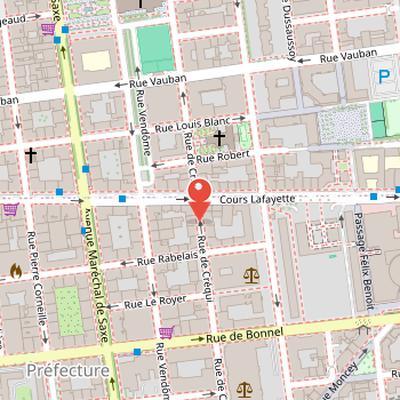
Nearby Objects
-
 Chapelle Sainte-Croix de Lyon 120 m away
 -
 Rue Duguesclin 120 m away
 -
 Halles de Lyon-Paul Bocuse 250 m away
 -
 Lycée Édouard-Herriot 350 m away
 -
 Église Saint-Pothin 350 m away
Route and Urban Position
Rue de Crequi is a long, straight street in Lyon that runs from north to south. It crosses three arrondissements: the 1st, 3rd, and 7th. The street begins north of Parc de la Tete-d'Or, a few meters upstream from Boulevard des Belges, and ends at Grande Rue de la Guillotiere in the 7th arrondissement. Along its course, it passes near Place Guichard and the Bourse du travail in the 3rd arrondissement. Street name plaques for Rue de Crequi may include or exclude the particle de.
Development of rue de Crequi
Rue de Crequi was formed during the period between the Restoration and the end of the Second Empire. In the early 19th century, it was initially opened up to Cours Lafayette, and in 1860 it formed part of the 3rd arrondissement. The street was finally completed on its eastern side around 1875, when the northern section was already known by its current name. At that time, it ended at the monument of the victims of the Siege of Lyon, which was then larger than it is today.
The extension of the street was approved by the Municipal Council on 11 June 1879. A later point of interest on the street was the site of the war memorial, which had previously been a vacant lot. Earlier still, an expiatory chapel had been built there by the Comte d'Artois starting in 1815, with construction resumed in 1817 and the first mass celebrated on 29 May 1819. In 1885, the draftsman Jean Dumas lived on rue de Crequi.
Architecture and Urban Composition
Rue de Crequi is lined mainly with 20th century buildings, although the constructions become older near cours Franklin Roosevelt. At the beginning of the street, two large buildings face boulevard des Belges. Near rue Royer, administrative buildings of various sizes are grouped together, while several stores decorated with frescoes were also present in the 20th century. Beyond rue Mazenod, older houses appear, and beyond rue Rancy the street includes green spaces and a playground. Farther on, beyond avenue Felix-Faure, there is a petanque ground.
The street also includes several notable monuments and religious buildings. These include the Bourse du Travail and buildings mainly built in the 19th century, among them the eglise de la Redemption, the eglise Saint-Pothin, the Anglican church, the memorial des martyrs de Lyon, the chapel Sainte-Croix, and the eglise Saint Louis. In terms of present use, rue de Crequi mostly contains law offices, a library, some restaurants, and Croix Rouge Lyonnaise.