The Bourse du Travail in Lyon was designed in 1929 by architect Charles Meysson and opened in 1934, with the inauguration held in 1935 after Mayor Édouard Herriot refused L’Internationale. Originally serving as a place of revolutionary activism, it gradually hosted theatre plays intended to build worker and anti-partisan culture. Before its construction, workers and unions met at the former Théâtre des Variétés.
The building includes the Albert Thomas hall, named after the founder of Revue Syndicaliste and Information Ouvrière et Sociale and the first director of the International Labour Office in Geneva. This hall originally served union meetings and later became a site of major social struggles in the region from 1936 to 1968. Today, the hall has 1,920 seats and hosts concerts, one-man shows, dance performances, and seminars. The complex also contains 55 syndicate offices across four floors, meeting rooms, congress rooms, an archive room, a legal consultation room, and a secretariat with a waiting room and library. It is owned by the city and managed by a board representing the trade unions CGT, CFDT, and FSU.
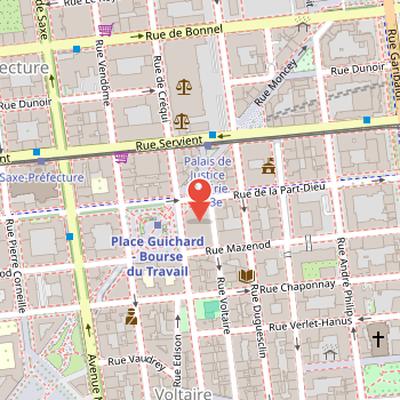
Nearby Objects
-
 Place Guichard 70 m away
 -
 Avenue de Saxe 200 m away
 -
 Rue Garibaldi 300 m away
 -
 Rue Duguesclin 350 m away
 -
 Bahadourian 400 m away
Location and Function
The Bourse du Travail in Lyon is a Salle de spectacles located in Lyon. Its identification as a performance venue places it within the citys public cultural spaces, where it serves as a site for spectacles and related events. The available information is limited, but it establishes the building primarily through its function and urban setting rather than through architectural detail or historical development.
From Labor Hall to Performance Venue
The Bourse du Travail in Lyon was designed in 1929 by architect Charles Meysson and opened in 1934, with the inauguration taking place in 1935 after Mayor Edouard Herriot refused the song L Internationale. Before its construction, workers and unions met at the former Theatre des Varietes. The building was initially a place of revolutionary activism in Lyon, and it gradually hosted theater plays intended to create worker and anti-partisan culture.
A major feature of the building is the Albert Thomas hall, originally used for workers and unions meetings. The hall is named after Albert Thomas, founder of Revue Syndicaliste and Information Ouvriere et Sociale, and the first director of the International Labour Office in Geneva. From 1936 to 1968, it hosted major social struggles in the region. These included metalworkers strikes in 1938, building workers and tram workers struggles, including in 1958, as well as strikes by civil servants in 1953 and postal workers. In 1968, it also saw numerous public meetings, sometimes too large for the hall.
Later, Mayor Louis Pradel led the municipal council in changing the hall use away from union meetings, while acknowledging that it had not been designed for entertainment. Unions retained a right of first refusal for their meetings in the hall. Today, the hall has a capacity of 1920 seats and hosts concerts, one-man shows, dance performances, and seminars. The facade also features a large mosaic depicting Mayor Edouard Herriot with a pipe.
Facilities and Union Use
The Bourse du Travail in Lyon comprises 55 syndicate offices spread across four floors. Its facilities include five meeting rooms with capacities ranging from 40 to 112 seats, as well as two congress rooms for 300 and 350 people. The building also contains an archive room, a caretaker's residence, a legal consultation room, and a secretariat with a waiting room and library. It is used by many union members and workers for information, assistance, advice, and the defense of labor rights. The building is owned by the city and provided to trade unions, while its management is handled by a board of directors representing the housed trade unions CGT, CFDT, and FSU.