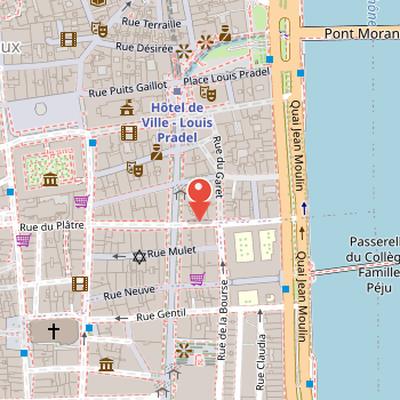
Rue du Bât-d'Argent is a street in the Terreaux quarter of Lyon, France. It borders the collège-lycée Ampère and begins perpendicular to rue du Président-Édouard-Herriot before ending at quai Jean-Moulin. Rue Commarmot also ends on this street.
The street dates to the end of the Middle Ages and was initially named rue du Pet Étroit, attested in 1350; another source gives the names rue du Pas Étroit or Étrée. The section between rue du Garet and the quai was opened in 1551. Its history reflects both everyday urban activity and cultural life: nine weaving looms were still present there in 1827, and most saddle manufacturers and sellers in the city were located on the street in the 18th century. The street was also associated with residents and visitors such as Antoine Coysevox, André-Marie Ampère and his spouse, Stendhal, Jean-Pierre Crolle, and François Nolin. In 1793, the Club des Jacobins met in the northern part of the street, while Café Casati, at number 8 near the rue de la République intersection, served as a meeting place for poets, writers, and painters before its destruction in 1894.
Nearby Objects
-
 Rue de l'Arbre-Sec 80 m away
 -
 Chapelle de la Trinité 90 m away
 -
 Grand Théâtre de Lyon 200 m away
 -
 Place de la Comédie 200 m away
 -
 Opéra Nouvel 200 m away
Location of Rue du BAt-dArgent
Rue du BAt-dArgent is located in the quartier des Terreaux in Lyon, France. It also borders the college-lycee Ampere. These details place the street within a central urban setting and identify its immediate relation to an educational institution.
Street Alignment and Connections
Rue du Bat-d'Argent begins perpendicular to rue du President-Edouard-Herriot and continues until it reaches quai Jean-Moulin. Its layout also receives rue Commarmot, which ends on the street. These junctions define the street as a connecting route within the local urban network, linking one main street to the quay while serving as a termination point for an adjoining street.
Historical Development of rue du BAt-d'Argent
Rue du BAt-d'Argent was created at the end of the Middle Ages. It was initially named rue du Pet Etroit, a name attested in 1350, and another source gives the forms rue du Pas Etroit or Etree. A section of the street between rue du Garet and the quai was opened in 1551. In 1793, the Club des Jacobins held meetings in the northern part of the rue. The street also retained an artisanal presence, with nine weaving looms still present there in 1827.
Historic Residents and Social Life
Rue du Baat-d'Argent is recorded as having had a varied social and professional life. In the 18th century, most of the city's saddle manufacturers and sellers were located here, indicating a concentration of trade on the street. It was also home to several historic residents, including sculptor Antoine Coysevox in the 17th century, painters Jean-Pierre Crolle and Francois Nolin in the 18th century, Andre-Marie Ampere and his spouse in 1800, Stendhal in 1837, and Alphonse Daudet.
The street was also associated with a local confectionery tradition: papillote was created here by a pastry apprentice whose boss was named Papillot. According to the account, Papillot sent delicacies wrapped in love letters to his fiancee, giving the confection its origin story.
At number 8, on the corner with rue de la Republique, stood the restaurant Cafe Casati during the 1870s and 1880s. It became a meeting place for Lyon poets and writers, including Louisa Siefert, the Barthelemy brothers, Clair, Jean and Alexandre Tisseur, Victor de Laprade, and Josephin Soulary. Painters Paul Chenavard and Joseph Guichard also accompanied them there. Cafe Casati was destroyed in 1894 during the assassination of Sadi Carnot amid anti-Italian riots.
The rue also included a communication vault near the quai end, located between a college and a house at the north corner of the street. The college and the house were linked by the college's game room, which became Club Central in 1793. The communication vault was later demolished.
Architectural Features and Historic Elements
The current street begins with a very wide section lined with four-story buildings constructed at the end of the 19th century. A 17th-century house still remains at the intersection with rue de la Bourse. At number 2, on the corner with rue du President-Edouard-Herriot, there was once a Virgin and Child sculpture by Coysevox from 1676-77. Considered a baroque masterpiece, this sculpture has been preserved in the church Saint-Nizier since 1771.