Opéra Nouvel is an opera house in Lyon, France, located at Place de la Comédie opposite the city hall. The building was originally constructed in 1831 under the name Grand Théâtre by Antoine-Marie Chenavard and Jean-Marie Pollet, replacing an earlier Grand Théâtre designed by Jacques-Germain Soufflot, which had been destroyed in 1826. The earlier theatre had been built between 1753 and 1756 on the gardens of the Lyon city hall and was supervised by Michelle Poncet, director of the Académie royale de musique de Lyon.
In 1986, a competition was held to update the building to current standards, and Jean Nouvel and associates won the project. The opera was totally restructured and enlarged between 1989 and 1993, with inauguration in 1993. The architectural project received the Équerre d'argent prize from Moniteur in 1993. Today, the building houses a performance hall mainly used by the Opéra national de Lyon and serves as the residence location of its ballet.
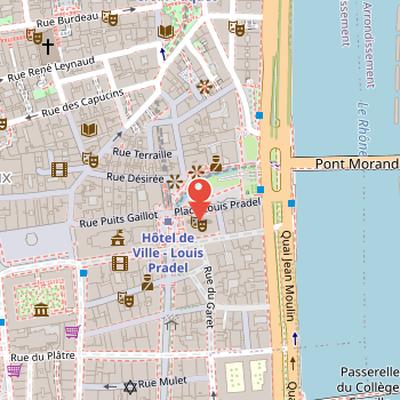
Nearby Objects
-
 Grand Théâtre de Lyon 20 m away
 -
 Place de la Comédie 40 m away
 -
 Place Louis-Pradel 60 m away
 -
 Rue de l'Arbre-Sec 160 m away
 -
 Rue du Bât-d'Argent 200 m away
Architecture and Role of the Op?ra Nouvel
The Op?ra Nouvel is an opera house in Lyon, France, located at place de la Com?die opposite the city hall. It was originally built in 1831 under the name Grand Th??tre by Antoine-Marie Chenavard and Jean-Marie Pollet, replacing an earlier Grand Th??tre inaugurated in 1756 by architect Jacques-Germain Soufflot and destroyed in 1826. The name Grand Th??tre has therefore referred both to the Soufflot building and to the later building before it was renamed Op?ra de Lyon.
Between 1989 and 1993, the building was totally restructured and enlarged by Jean Nouvel. This architectural project won the Equerre d'argent prize from Moniteur in 1993. The result is a performance hall mainly used by the Op?ra national de Lyon. It hosts operas, ballets, and concerts, and also serves as the residence location of the ballet of the Op?ra de Lyon.
The institution has an annual budget of approximately 35 million euros. This budget is subsidized by the city of Lyon, the Rh?ne department, the Auvergne-Rh?ne-Alpes region, and the State. In 2011, the average age of spectators was 47 years.
History and Reconstruction of the Opera House
The site began as a first performance hall called the Grand Theatre, built on the gardens of the Lyon city hall between 1753 and 1756. It was designed by Jacques-Germain Soufflot and supervised by Michelle Poncet, who was director of the Academy royale de musique de Lyon during the construction. The building was inaugurated on an unspecified date and later destroyed in 1826. It was rebuilt in 1831 by Antoine-Marie Chenavard and Jean-Marie Pollet. In the early 20th century, it was directed by Leimistin Broussan from 1902 to 1906.
A competition was organized in 1986 to update the standards of the building, and the project was won by Jean Nouvel and associates, including Jean Nouvel and Emmanuel Blamont. Construction began in 1989 and ended in 1993 with the inauguration of the opera.
Faade Sculpture and Later Renovation
The reconstruction of the Grand Theatre began in 1828 under Antoine-Marie Chenavard and Jean-Marie Pollet. The building was inaugurated before the completion of its facade decorations and before the installation of eight statues of muses. In 1862, the city commissioned these eight statues from four sculptors, Guillaume Bonnet, Jean-Marie Bonnassieux, Joseph-Hugues Fabisch, and Francois Felix Roubaud, each of whom made two muses. The architects had followed classical rules requiring an even number of columns, which prevented the creation of a ninth muse, Uranie. The statues were installed in 1863 after a silicatisation treatment intended to make them inalterable, but the statue of Terpsichore later lost its right arm onto the square. In 1896, the city hall removed all the statues because of their poor condition and then lost track of them. A municipal council discussion in 1910 led to plans for exact copies, and in 1911 the statues were cast in cast iron to reduce costs and reinstalled.
After Jean Nouvel's renovation, four facades and the public foyer of the Chenavard and Pollet theatre remained, with the foyer classified as historic. The opera house has 18 floors, including five below ground and five in the glass roof above ground, and it includes underground levels. Beyond its architectural history, the building's parvis arcades have also been used as a public space: since the 1990s, breakdancing practitioners have regularly practiced there, and the dance company Pockemon Crew began its activities in these arcades before becoming resident at the amphitheater in 2003, the same year it won its first World Champion title.