Le Grand Théâtre de Lyon was a theatre building commissioned by the Consulat and built by Jacques-Germain Soufflot on the former site of the gardens of the Hôtel de ville de Lyon. The works lasted from 1754 to 1756, during a period marked by public opposition to the concentration of important buildings, the building’s excentric location, the removal of green space, and the placement of a theatre near a religious building. The municipality validated Soufflot’s plans, and the foundational stone was laid during the construction process. The façade was made by Antoine Michel Perrache following Soufflot’s instructions in May 1755, while Perrache also created the sculptures, bas-reliefs, ornaments, and festoons. The hall’s decorations and machinery were handled by painter and architect Morand. The building was solemnly inaugurated on October 9, 1755, with a prologue in free verse titled Le Réveil d’Apollon. Its hall had excellent acoustics and a capacity of about 2,000 people. It hosted opera-comique works, Beaumarchais’ comedies, and Voltaire’s tragedies. The building was destroyed by a fire in 1826. The name Grand Théâtre refers to the building that replaced it in 1831, now known as the Opéra de Lyon.
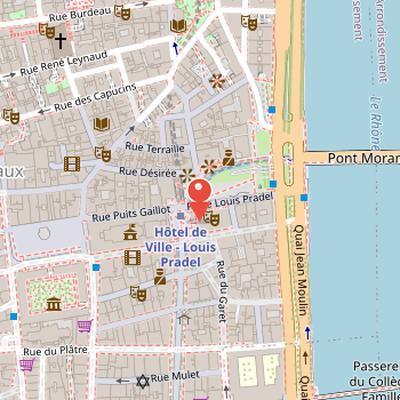
Nearby Objects
-
 Opéra Nouvel 20 m away
 -
 Place de la Comédie 20 m away
 -
 Place Louis-Pradel 80 m away
 -
 Rue de l'Arbre-Sec 140 m away
 -
 Rue du Bât-d'Argent 200 m away
Construction, Site, and Later History
Le Grand Theatre de Lyon was commissioned by the Consulat and built by Jacques-Germain Soufflot on the former site of the gardens of the Hotel de ville de Lyon. It was inaugurated in 1756. The original building was destroyed by a fire in 1826. The name Grand Theatre later came to refer to the building that replaced it in 1831, which is known today as the Opera de Lyon.
Construction, Opening, and Early Use
The works for the Grand Theatre de Lyon were carried out from 1754 to 1756, after the municipality validated the plans of Jacques-Germain Soufflot. The construction took two years and included the laying of the foundation stone. In May 1755, Antoine Michel Perrache, following Soufflot's instructions, completed the facade, and he also produced the sculptures, bas-reliefs, ornaments, and festoons. The decorations and machinery in the hall were handled by the painter and architect Morand.
The building was solemnly inaugurated on October 9, 1755, with a prologue in free verse titled Le Reveil d'Apollon. Its early performances included Britannicus by Jean Racine, in which Mademoiselle Clairon interpreted Agrippine in the presence of Jacques-Germain Soufflot, as well as L'Orphelin de la Chine by Voltaire, where she played Idame. The theatre also hosted opera-comique works, Beaumarchais' comedies, and Voltaire's tragedies.
The project quickly faced popular opposition, linked to the concentration of important buildings, its eccentric location, the removal of green space, and the placement of the theatre near a religious building. Inside, the hall was noted for excellent acoustics and a capacity of about 2,000 people.
Rebuilding After the Fire
In 1825, the city decided to repurchase the Grand Theatre and planned an expansion, but the building was destroyed by fire in 1826. To maintain performances, a temporary hall was built on Place des Terreaux by the architects Frage and Falconnet. This wooden and brick theater was completed in three months and delivered on June 1, 1827. It served as a performance venue until July 1828. The damaged Grand Theatre was later replaced in 1831 by a new neo-classical opera designed by Antoine-Marie Chenavard and Jean-Marie Pollet.
Architecture and Interior Design
The Grand Theatre de Lyon is described as an elliptically shaped building with a facade inspired by Italian classical style. The architect took inspiration from the Teatro Olimpico by Palladio in Vicenza. The facade is topped by a wide cornice and a balustrade, and above it stands the sculpture Apollo with two Genii, attributed to Antoine Michel Perrache, which dedicates the building to the god Apollo. Soufflot introduced an architectural innovation by creating the first non-elongated theater hall in France. The hall is oval and originally had three tiers of boxes and an orchestra level. After various successes, a fourth tier of boxes was added in 1788. The stage is slightly inclined toward the audience, with machinery located in the basement.