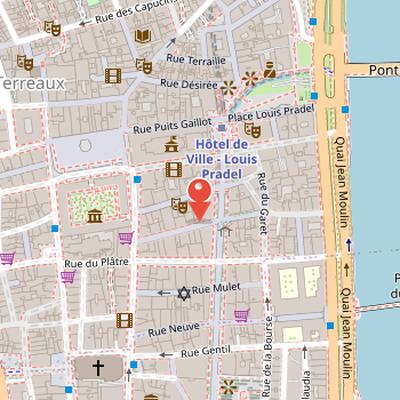
Rue de l'Arbre-Sec is a street in the quartier des Terreaux in the 1st arrondissement of Lyon, France. It lies in a dense and ancient urban fabric between Place des Terreaux and the Opéra, at the foot of the Croix-Rousse hill. The street begins perpendicular to rue du Président-Édouard-Herriot, extends to quai Jean-Moulin, and crosses rue de la République. Rue Commarmot begins on this street.
The street is associated with a lively commercial and social environment, with many restaurants and bouchons, including Le Cercle Rouge and Le Connétable. It is also known for numerous gay-friendly establishments and is one of the main places of homosexual life in Lyon.
Its name is said to derive from the myth of the Arbre Sec mentioned in Marco Polo’s stories, although it is also linked to the presence of a dead tree, perhaps shown on a shop sign. An 1745 Almanach de Lyon noted a shriveled and very dry tree at the street’s end. The street has a documented urban history, including drainage, leveling, and crossing works decided in 1518. In earlier centuries, it was inhabited by silk workers and other artisans, and several notable residents are recorded, including Louise Labé’s family, Bernard Salomon, Barthélémy Vignon, and Prosper Mourand.
Nearby Objects
-
 Rue du Bât-d'Argent 80 m away
 -
 Place de la Comédie 130 m away
 -
 Grand Théâtre de Lyon 140 m away
 -
 Palais Saint-Pierre 160 m away
 -
 Opéra Nouvel 160 m away
Location of rue de l'Arbre-Sec
Rue de l'Arbre-Sec is a street in the quartier des Terreaux in the 1st arrondissement of Lyon, France. Its significance in this context lies in its place within this central urban district, which identifies it as part of the city's historic and administrative fabric.
Urban setting and social role
Rue de l'Arbre-Sec is located in a dense and ancient urban fabric between Place des Terreaux and the Opera, at the foot of the Croix-Rousse hill. It begins perpendicular to rue du President-Edouard-Herriot and extends to quai Jean-Moulin, crossing rue de la Republique. Rue Commarmot starts from this street. Today, the street contains many restaurants and bouchons, including Le Cercle Rouge and Le Connetable. It is also known for numerous gay-friendly establishments and is considered one of the main places of homosexual life in Lyon.
The Origin of the Street Name
The origin of the name rue de l'Arbre-Sec has been linked to several explanations. One tradition says it derives from the myth of the Arbre Sec mentioned in Marco Polo's stories, while another associates it with the Chene de Mambre as a symbol of the boundary between East and West. However, the name was actually connected to the presence of a dead tree in the street. It was probably chosen because a dead tree appeared on a shop sign. The Almanach de Lyon of 1745 further justified the street name by noting that a shriveled and very dry tree stood at the street's end.
Historical Development and Notable Occupants
The history of rue de l'Arbre-Sec includes an early drainage, leveling, and crossing plan decided by Jean de Paris in 1518. On the 1550 plan, the street was inhabited by silk workers, potters, and tile makers, showing its early connection with craft activity. In 1561, engraver and draftsman Bernard Salomon lived there, and the family of poet Louise Labe is also listed among its notable residents. By 1828, the street contained twelve silk workshops and 43 houses, reflecting a dense mix of production and housing.
A section between rue du Garet and the Rhone was known as rue Basseville, where six silk workshops were recorded; this part was later incorporated into rue de l'Arbre-Sec in 1855. The street also appears in records for individual buildings and uses: in 1831, umbrellas with triangular dagger handles were found at number 14, and in 1844 the Hotel de France stood at number 13. In 1847, a chapel on the street served as the only evangelical place of worship in Lyon.
The street also saw residents and events of more unusual character. Cordonner Durant, who lived there, was convicted of illegal practice of medicine on an unspecified date. Architectural change affected the street when prefect Claude-Marius Vaisse demolished old buildings to create rue de l'Hotel de Ville and rue de la Republique. Other residents mentioned include architects Barthelemy Vignon and Prosper Mourand.
Architectural Features and Notable Addresses
Rue de l'Arbre-Sec has a slightly curved layout and is described as a wide street lined with buildings dating from around 1870, many of them marked by balconies and wrought iron decoration. Among these, the Société Generale building is distinguished by wrought iron arches. The street changes in character after rue Garet, where it becomes narrower and is bordered by simple facades and stone arches.
Several addresses are singled out for specific features. The wrought iron balcony at number 8 dates from 1863, and this building also contains a direct traboule that continues through a vaulted passage, although it is currently closed. Houses at numbers 10 and 12 have arcades. At number 22, the inscription Le Thuilerie, 1702 is recorded. The street name is engraved in stone on the last building at number 20, which is described as relatively recent.
The street also appears in Bernard Clavel's novel Le Voyage du père, where the character Marie-Louise lives in a modest apartment on rue de l'Arbre-Sec. Her father visits the street several times in the hope of meeting her, adding a literary association to its built environment.