The Chapelle de la Trinité is a baroque chapel in Lyon, built by the Jesuits at the beginning of the 17th century. It was part of the buildings of the Grand Collège between 1617 and 1622 and belonged to the collège de la Trinité, now known as collège-lycée Ampère. The chapel was built in baroque style by Étienne Martellange, a Jesuit brother and architect, and was consecrated as a church in 1622 by François de Sales. It is described as one of the first baroque ecclesiastical buildings in Lyon, alongside the church of Saint-Bruno des Chartreux. The building was used and managed by the Jesuits for college students, and it was redecorated in 1754 by urban architect Jean-Antoine Morand, with Carrara marble used in the redecoration. The chapel is now deconsecrated and used as a concert hall. It also housed Lyon’s first astronomical observatory in the 17th century, whose later history included destruction in 1793, restoration in 1817, and eventual transfer to other locations. Only the old lower room was preserved, with remnants of the meridian line still visible on the floor.
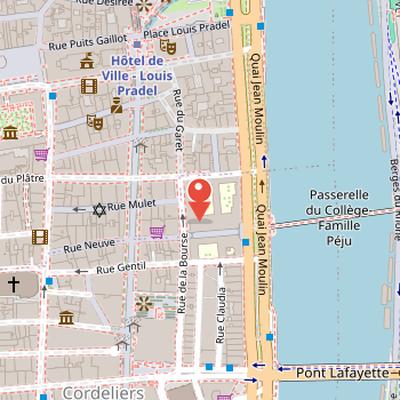
Nearby Objects
-
 Rue du Bât-d'Argent 90 m away
 -
 Place de la Bourse 140 m away
 -
 Rue de l'Arbre-Sec 150 m away
 -
 Place des Cordeliers 200 m away
 -
 Anciennes Galeries Lafayette 250 m away
Jesuit Origins and Later Uses
The Chapelle de la Trinite is a baroque deconsecrated church in Lyon that is now used as a concert hall. It was built by the Jesuits at the beginning of the 17th century and belonged to the college de la Trinite, now known as college-lycee Ampere. In the 17th century, it also housed the first astronomical observatory in Lyon. That observatory later moved to Saint-Genis-Laval, where it became the Lyons observatory.
History and Baroque Design
The Chapelle de la Trinite was part of the buildings of the Grand College between 1617 and 1622. It was built in baroque style by Etienne Martellange, a Jesuit brother and architect, and was consecrated as a church in 1622 by Francois de Sales. According to the history record, it was one of the first baroque ecclesiastical buildings in Lyon, alongside the church of Saint-Bruno des Chartreux. The chapel was used and managed by the Jesuits for college students. In 1754, it was redecorated by the urban architect Jean-Antoine Morand.
Observatory Above the Church Fronton
The history of the Chapelle de la Trinite includes an important astronomical phase linked to the church fronton above which an observatory was constructed in 1702. According to the historical account, Dominique Cassini of the Academie Royale des Sciences persuaded Pere Jean de Saint-Bonnet to create an astronomical observatory in Lyon, and this was presented as the first observatory in the city. The building is described as having a rectangular plan room with four rectangular windows placed at the cardinal points and an imperial vault. Above this room stood two small towers, each with 202 steps, set on trompes.
The observatory was most active under the direction of Laurent Beraud from 1740 to 1762, and Joseph Lalande is noted as one of his apprentices. In 1754, the chapel was redecorated using Carrara marble. The observatory suffered major destruction in October 1793 during the siege of Lyon, then was restored by Francois Clerc in 1817. Even after restoration, it did not meet the astronomy needs of the period. After the creation of the Lyon Faculty of Sciences, the observatory was moved to the Palais Saint-Pierre in 1863, although quality observations were said to be impossible there. Only the old lower room was preserved and repurposed, with remnants of the meridian line still visible on the floor.
The chapel is classified as a historical monument. It was restored again in the 1990s by the Lyon municipality and the Rhone-Alpes region, and it now hosts classical music concerts and conferences for the Quais du Polar festival.