The Bastille was a medieval fortress in Paris, known as the Bastille Saint-Antoine. It was built to defend the eastern approach to the city from English attacks during the Hundred Years' War, with construction underway by 1357 and major work beginning from 1370 onwards. The strong fortress, with eight towers protecting the strategic gateway of the Porte Saint-Antoine, had an innovative design that was influential in both France and England and was widely copied.
The Bastille played an important role in France's internal conflicts, including struggles between the Burgundians and the Armagnacs in the 15th century, the Wars of Religion in the 16th century, and the rebellion of the Fronde in 1652. Declared a state prison in 1417, it later expanded its prison role under English occupiers, Louis XI, and Louis XIV. From 1659 onwards, it functioned primarily as a state penitentiary. By 1789, 5,279 prisoners had passed through its gates. It was stormed by a crowd on 14 July 1789 during the French Revolution, then demolished and replaced by the Place de la Bastille. It later became an important symbol for the French Republican movement.
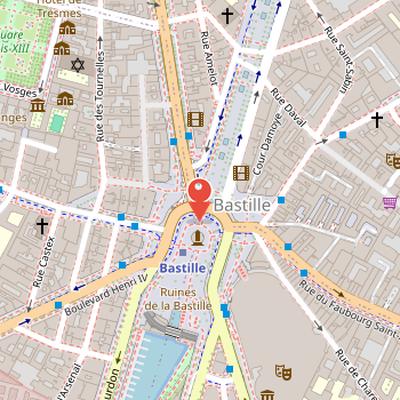
Nearby Objects
-
 Le Génie de la Bastille 20 m away
 -
 Place de la Bastille 20 m away
 -
 Elephant of the Bastille 30 m away
 -
 July Column 30 m away
 -
 Opéra Bastille 200 m away
The Bastille as Fortress and Prison
The Bastille, or Bastille Saint-Antoine, was a medieval fortress in Paris built to defend the eastern approach to the city from English attacks during the Hundred Years War. Construction was underway by 1357, and the main work continued from 1370 onward. It consisted of a strong fortress with eight towers protecting the strategic gateway of the Porte Saint-Antoine. Its innovative design was influential in both France and England and was widely copied.
For most of its history, the Bastille was used as a state prison by the kings of France. It was declared a state prison in 1417, and this role was expanded under the English occupiers in the 1420s and 1430s, as well as under Louis XI in the 1460s. The fortress also figured prominently in domestic conflicts, including fighting between the Burgundians and the Armagnacs in the 15th century, the Wars of Religion in the 16th century, and the rebellion of the Fronde and the Battle of the Faubourg St Antoine in 1652. Its defences were fortified in the 1550s in response to the Imperial threat, and a bastion was built to the east.
On 14 July 1789, a crowd stormed the Bastille during the French Revolution. It later became an important symbol for the French Republican movement. The fortress was demolished and replaced by the Place de la Bastille.
From State Prison to Revolutionary Symbol
From 1659 onwards, the Bastille functioned primarily as a state penitentiary. Under Louis XIV, it was used to imprison upper-class French society members who opposed or angered him, and it also held French Protestants after the revocation of the Edict of Nantes. During the reigns of Louis XV and Louis XVI, the prison held people from more varied backgrounds and supported Parisian police operations, especially in enforcing government censorship of the printed media.
By 1789, 5,279 prisoners had passed through its gates. Prisoners were kept in relatively good conditions, and later historians have described the Bastille as a relatively well-administered example of French policing and political control during the 18th century. Even so, criticism grew during that century, fuelled by autobiographies of former prisoners. Reforms were introduced and prisoner numbers were considerably reduced.
The Bastille was stormed on 14 July 1789 by a revolutionary crowd seeking to commandeer gunpowder. Seven remaining prisoners were found and released, and the governor, Bernard-Rene de Launay, was killed by the crowd. The prison was then demolished by order of the Committee of the Hotel de Ville. Souvenirs of the Bastille were transported around France and displayed as icons of the overthrow of despotism. Over the next century, the site and its historical legacy featured prominently in French revolutions, political protests, and popular fiction, and it remained an important symbol for the French Republican movement. Almost nothing remains today except some stone foundation remains relocated to the side of Boulevard Henri IV.
The Bastille as a Royal Fortress
The Bastille was built to defend Paris during the Hundred Years' War between France and England. Before it was constructed, the main royal castle in Paris was the Louvre. By the middle of the 14th century, the city had expanded, leaving the eastern side vulnerable to English attacks. In 1357, Marcel enlarged the city walls and protected the Porte Saint-Antoine with two high stone towers and a ditch. A fortified gateway of this kind was called a bastille, and two were created in Paris, one at Porte Saint-Antoine and another outside Porte Saint-Denis. After Marcel was removed from office and executed in 1358, Charles V later became concerned about the same eastern vulnerability, especially to English forces and mercenaries. In 1369, he ordered Hugues Aubriot, the new provost, to build a larger fortification on the site of Marcel's bastille.
The fortress was probably unfinished at Charles V's death in 1380 and was completed by Charles VI. Its design included towers and walls of the same height with crenellated walkways all around. Each of the six towers had underground cachots and curved calotte rooms in their roofs. The Bastille was garrisoned by a captain, a knight, eight squires, and ten crossbowmen. It was encircled by ditches fed by the River Seine and faced with stone. Four drawbridges allowed Rue Saint-Antoine to pass eastwards through the gates and also gave easy access to the city walls on the north and south sides. By 1380, it overlooked the Saint-Antoine gate, a strong square building with turrets and two drawbridges.
Charles V chose to live near the Bastille for safety and created the royal complex of the Hotel Saint-Pol south of it. The fortress was described by historian Sidney Toy as one of the most powerful fortifications of the period and was the most important fortification in late medieval Paris. Its design rejected 13th-century quadrangular castles and the Vincennes fashion. The Bastille's architectural influence was later copied at Pierrefonds and Tarascon in France and extended as far as Nunney Castle in south-west England. In the 15th century, when French kings were engaged in conflict with the English, Burgundians, and Armagnacs, the Bastille remained strategically vital as a royal fortress controlling a critical route in and out of Paris.
The Bastille as a Royal Fortress and Prison
The Bastille became a state prison in 1417, and it was used to hold prisoners, including its creator, Hugues Aubriot, who was the first person imprisoned there. In 1418, the future Charles VII took refuge in the Bastille during the Burgundian-led Massacre of the Armagnacs in Paris before fleeing the city through the Porte Saint-Antoine. The fortress continued to play a military role after Henry V of England captured Paris in 1420 and garrisoned the Bastille for sixteen years.
In 1436, when Charles VII of France recaptured Paris, enemies had fortified themselves in the Bastille. They surrendered after a siege and ransom payment. The Bastille was seized again in 1464 by the Burgundians, who persuaded royal troops to surrender and then used the stronghold to launch a surprise attack into Paris. During Louis XI's reign, the Bastille was used extensively as a state penitentiary. Antoine de Chabannes, Count of Dammartin and a member of the League of the Public Weal, escaped by boat in 1465.
The Bastille also retained its function as a royal castle and accommodated visiting dignitaries. Louis XI and Francis I hosted lavish entertainments there, showing that the site served both as a prison and as a setting for royal display.
The Bastille in 16th-Century Paris
The area around the Bastille developed during the 16th century, as early modern Paris continued to expand and reached around 250,000 inhabitants by the end of that century. Although Paris had become one of the most populous cities in Europe, it was still largely contained within its old city walls, and open countryside remained beyond the Bastille. In this setting, the Bastille became part of a major military centre. The Arsenal was established to the south of the Bastille by Francis I and was substantially expanded under Charles IX, while an arms depot was built above the Porte Saint-Antoine.
The fortifications were strengthened under Henry II in the 1550s. In 1553, the southern gateway became the principal entrance to the Bastille, and the other three gateways were closed. The Porte Saint-Antoine was altered again in 1573, when its drawbridges were replaced with a fixed bridge and the medieval gatehouse was replaced with a triumphal arch. The Bastille was also involved in the wars of religion between Protestant and Catholic factions in the second half of the 16th century.
The Bastille in Political Conflict
The Bastille played a prominent role in the religious and political turmoil that repeatedly shook Paris. During the Day of the Barricades on 12 May 1588, hard-line Catholics rose in revolt against Henry III, who then fled the city. In the aftermath, the Bastille surrendered to Henry I, Duke of Guise, who appointed Bussy-Leclerc as the new captain. After Henry III had Henry I, Duke of Guise, and his brother murdered later that year, Bussy-Leclerc used the fortress as a base for political action. He mounted a raid on the Parlement of Paris, arrested its president and magistrates, and detained them in the Bastille until Charles, Duke of Mayenne, intervened and ransoms were paid. Bussy-Leclerc remained in control until December 1592, when he surrendered the Bastille and fled Paris.
Several years later, the area around the Bastille had become a key stronghold for the Catholic League and its foreign allies, including Spanish and Flemish troops. In 1594, the Bastille itself was controlled by a League captain called du Bourg. Henry IV entered Paris early in the morning of 23 March through the Porte-Neuve, seized the capital including the Arsenal complex next to the Bastille, and found the Bastille isolated as a League stronghold with remaining supporters gathered around it for protection. After several days, an agreement allowed these forces to leave safely, and on 27 March du Bourg surrendered the Bastille and left the city.
Under Henry IV and Louis XIII, the Bastille continued to function as both a prison and a royal fortress. Henry IV detained Charles de Gontaut, duc de Biron, there in 1602 and had him executed in the Bastille courtyard. Later, Cardinal Richelieu began the modern transformation of the Bastille into a more formal organ of the French state. He increased its structured use as a state prison and broke with Henry IV's tradition by appointing Pere Joseph's brother to run it. The first surviving documentary records of prisoners at the Bastille date from Richelieu's period.
The Bastille again appeared in the violence of the Fronde insurrection, which broke out in Paris in 1648 amid high taxes, increased food prices, and disease. The Parlement of Paris, the Regency government of Anne of Austria, and rebellious noble factions struggled for control over several years. After Anne of Austria ordered the arrest of some leaders of the Parlement of Paris on 26 August, violence flared and 27 August became known as another Day of the Barricades. The governor of the Bastille loaded and readied guns to fire on the Hotel de Ville but did not shoot. When the royal government fled in September, it left a garrison of 22 men in the Bastille. The Fronde then decided to take the fortress, assigning Elbeuf to lead the attack on 11 January 1649. After five or six shots, the Bastille surrendered on 13 January, and Pierre Broussel appointed his son as governor. The Fronde kept control of the Bastille even after the ceasefire in March, and during the Second Fronde between 1650 and 1653, Louis, the Prince of Conde, controlled much of Paris alongside the Parlement. Broussel continued to control the Bastille through his son, and the Battle of the Faubourg St Antoine took place just outside the fortress in July 1652.
The Bastille in the Fronde
History records that during the conflict, Cond e sallied out of Paris in an effort to prevent the advance of the royalist forces under Turenne. His forces became trapped against the city walls and at Porte Saint-Antoine, which the Parlement refused to open. La Grande Mademoiselle then persuaded Gaston, Duke of Orleans, to order Parisian forces to act in the Bastille, and she personally ensured that the Bastille commander turned the fortress's cannon on Turenne's army. The resulting casualties inflicted on Turenne's forces allowed Cond e's army to withdraw safely. Cond e was later forced to surrender Paris to royalist forces in October 1652, after which the Bastille returned to royal control.
The Bastille under Louis XIV and the Regence
In 1660, Louis XIV rebuilt the area around the Bastille by erecting a new archway at the Porte Saint-Antoine. In 1670, he pulled down the city walls and fortifications and replaced them with an avenue of trees known as Louis XIV's boulevard. The Bastille's bastion survived this redevelopment and became a garden for prisoners.
During Louis XIV's reign, the Bastille was used extensively as a prison. He detained 2,320 individuals there, or about 43 people each year. Prisoners included suspected rebels, plotters, and people who irritated him by differing on religion. Typical offences also included espionage, counterfeiting, and embezzlement from the state. Financial officials such as Nicolas Fouquet and his supporters Henry de Guene gaud, Jeannin, and Lorenzo de Tonti were also detained there. After Louis XIV revoked the Edict of Nantes in 1685, the Bastille was used to investigate and break up Protestant networks by imprisoning and questioning upper-class Calvinists. Some 254 Protestants were imprisoned there during his reign.
Detention was ordered by lettre de cachet, a letter under royal seal issued by the king and countersigned by a minister. Louis personally decided who should be imprisoned, and detention was usually indefinite. There was considerable secrecy over who had been held and why, a feature later associated with the legend of the Man in the Iron Mask, who died in 1703. Legally, imprisonment in the Bastille was meant to be preventative or investigative rather than punitive, and the average length of imprisonment under Louis XIV was about three years.
Louis also reformed the administrative structure of the Bastille by creating the post of governor, often called the captain-governor. Wider controls over Paris also tightened during his reign: policing of marginal groups increased, the criminal justice system was reformed, controls over printing and publishing were extended, new criminal codes were issued, and the post of Parisian lieutenant general of police was created in 1667. By 1711, a 60-strong French military garrison was established at the Bastille, and the prison was expensive to run, especially when full. In 1691, during the campaign against French Protestants, the prison population rose and the annual cost of running the Bastille reached 232,818 livres.
After Louis's death, power transferred to the Regence between 1715 and 1723. Philippe d'Orleans maintained the prison, but absolutist rigour began to weaken. Protestants ceased to be kept in the Bastille, yet the prison remained active, with 1,459 people imprisoned there under the Regency, an average of around 182 prisoners per year.
Prisoners During the Cellamare Conspiracy
History states that alleged enemies of the Regency were imprisoned in the Bastille during the Cellamare conspiracy. Among the prisoners identified was Marguerite De Launay. While incarcerated there, she fell in love with Chevalier de Menil. History also records that she received a marriage invitation from Chevalier de Maisonrouge.
The Bastille's Plan and Interior Arrangement
By the late 18th century, the Bastille was not greatly changed from its 14th century predecessor. Its official street address was No. 232, rue Saint-Antoine. The fortress was composed of eight stone towers named La Chapelle, Tresor, Comte, Baziniere, Bertaudiere, Liberte, Puits and Coin. Each tower had a distinct role or source of naming. La Chapelle contained the Bastille's chapel, which included a painting of Saint Peter in chains. Tresor took its name from the period of Henry IV, when it held the royal treasury. The origins of Comte are unclear, but the name may refer to the County of Paris. Baziniere was named after Bertrand de La Baziniere, who was imprisoned there in 1663. Liberte may have been named after a protest in 1380 or after prisoner freedoms. Puits contained the castle well, while Coin formed the corner of Rue Saint-Antoine.
The office wing held the council room for interrogating prisoners, the library, and servants' quarters. Upper stories provided rooms for senior staff and chambers for distinguished prisoners. An elevated building in the courtyard contained the Bastille's archives. A clock installed by Antoine de Sartine between 1759 and 1774 on the office wing side showed two chained prisoners. New kitchens and baths were built just outside the main gate in 1786. Around the south-west side, adjacent to the Arsenal, an outer court developed that was open to the public and lined with small shops rented by the governor for almost 10,000 livres a year. This outer court also included a lodge for the gatekeeper and was illuminated at night to light the adjacent street. The governor lived in a 17th century house alongside the fortress and was supported by officers including the lieutenant de roi, the major, and the capitaine des portes, who were responsible for security, financial affairs and police archives, and the entrance respectively.
The Bastille as a Royal Prison
From an administrative perspective, the Bastille prison was generally well run, and by 1749 it was guarded by a small garrison of invalides, retired soldiers who were regarded locally as amiable layabouts rather than professionals. During the reigns of Louis XV and Louis XVI, the role of the Bastille changed considerably. It remained a state prison subject to special authorities answering to the monarch of the day, but it also became part of the wider policing system in Paris. The governor reported to the lieutenant general of police, who in turn reported to the secretary of the Maison du Roi responsible for order in Paris. The lieutenant general and the secretary controlled the issuing of lettres in the king's name, and the Bastille acted on behalf of the king by allowing secret imprisonment without judicial processes.
The prison was used to support police operations across Paris, especially those involving censorship. It held prisoners for extensive questioning and for cases requiring document analysis, while also storing Parisian police archives, public order equipment, and illegal goods seized by crown order. These goods included banned books and illicit printing presses, and the Bastille was used to suppress the illegal and seditious book trade in France. In the 1750s, 40 percent of Bastille prisoners were arrested for manufacturing or dealing banned material, and this figure was 35 percent in the 1760s. Seditious writers were held more often for anti-social offences than for political offences, and many writers detained under Louis XVI were imprisoned for producing illegal pornography.
The character of imprisonment also shifted across this period. Under Louis XV, 1,194 prisoners were imprisoned in the Bastille, with an annual average of around 23, while under Louis XVI there were 306 prisoners up to the Revolution, with an annual average of around 20. The Bastille moved from detaining primarily upper-class prisoners to imprisoning socially undesirable individuals of all backgrounds, including aristocrats breaking social conventions, criminals, pornographers, and thugs. Under Louis XV, around 250 Catholic convulsionnaires, often called Jansenists, were detained for their religious beliefs, and many were women from a wider range of social backgrounds than under Louis XIV. Historian Monique Cottret argued that the decline of the Bastille's social mystique originated from this phase of convulsionnaire detentions. By the later years of Louis XVI, changes in the background of detainees and the types of offences involved were also noted, with relatively few prisoners held over grander affairs of state between 1774 and 1789.
Families could apply for individuals to be detained at royal prisons like the Bastille, and detentions often preferred the avoidance of scandal or public trial over misdemeanours. Secrecy surrounding detention could protect personal and family reputations quietly, and average imprisonment lasted between six months and four years. The Bastille was considered one of the best prisons for upper-class prisoners because of the standard of facilities for the wealthy. By mid-18th century, prisoner conditions were relatively benign compared to other prisons, and the typical prisoner was held in octagonal rooms in the mid-levels of the towers. The detention of all eleven suspects in the 1786 Affair of the Diamond Necklace significantly increased the institution's notoriety.
Prison Conditions and Recreation Spaces
Historical accounts describe several distinct spaces within the Bastille that shaped prisoner life. The calottes under the roof were considered the least pleasant quarters because they were exposed to the elements. Underground cachots, or dungeons, had not been used for many years except for recaptured escapees. The main courtyard served as the exercise area, though it was often unpleasant in both summer and winter. Prisoner recreation also took place in the garden within the bastion and the castle walls.
Prison Payments and Daily Support
Historical accounts state that the governor received 19 livres a day from the Crown for each political prisoner. Conseiller-grade nobles were paid 15 livres a day per prisoner, while commoners were assigned three livres a day. The amount for commoners was described as being around twice the daily wage of a labourer and as sufficient to provide an adequate diet.
Prison Life and Daily Conditions
Accounts of life in the Bastille suggest that conditions varied considerably by rank and circumstance. History states that the upper classes ate very well there, and critics of the prison recounted excellent meals, often shared with the governor. Prisoners punished for misbehaviour could have their diet restricted, showing that food was also used as a disciplinary measure.
By 18th-century standards, the Bastille provided excellent medical treatment, and it also contained inmates suffering from mental illnesses. Its approach to mental health care was described as progressive for the period. On entry, potentially dangerous objects and money were confiscated and stored, but most wealthy prisoners still brought additional luxuries with them. These could include pet dogs or cats, which were used to control vermin. The Marquis de Sade arrived with an elaborate wardrobe, paintings, tapestries, perfume, and 133 books. Servants could also accompany their masters, and this helped preserve a degree of domestic routine. In 1746, the family of Lord Morton and their entire household were detained as British spies, yet their domestic life continued relatively normally inside the prison.
Prisoners also had access to a library that expanded during the 18th century through ad hoc purchases and Crown confiscations, reaching 389 volumes by 1787. Although detention could vary, the average length of imprisonment during Louis XVI's reign was two months.
The Bastille in French Public Debate
During the 18th century, French writers repeatedly criticised the Bastille as a symbol of ministerial despotism. These criticisms contributed to reforms and plans for its abolition. The prison also became the subject of vivid personal accounts. Constantin de Renneville, who spent 11 years there, published L'Inquisition françois in 1715 and described abuse, including being enchained next to a corpse in a cachot dungeon. Abbé Jean de Bucquoy escaped and later published his account in 1719 from Hanover, calling the Bastille the hell of the living. Voltaire referred to the Man in the Iron Mask case in 1751 and criticised his own treatment in the Bastille, which he called a palace of revenge.
In the 1780s, prison reform became a popular subject for French writers, and the Bastille was increasingly condemned as a symbol of arbitrary despotism. Simon-Nicholas Linguet, an influential author of the period, was arrested in 1780 after publishing a critique of Mar echal Duras, then published M emoires sur la Bastille in 1783 after his release. In that work he criticised the prison's physical conditions and the psychological effects of its regime on inmates. Latude's case also circulated widely: he had been imprisoned after sending a letter bomb to Madame de Pompadour, released in 1777, rearrested after publishing Memoirs of Vengeance, and publicised in pamphlets and magazines until his release in 1784. His autobiography reinforced the public perception of the Bastille as despotic. At the same time, modern historians Hans-Jurgen Lusebrink and Simon Schama stated that prisoner treatment in the Bastille was better than public impression. Reform measures were also introduced, including Malesherbes' 1775 authorisation for prisoners to read newspapers and correspond with family, and Breteuil's 1780s reforms of lettres de cachet, which required detention length and offences to be listed. In 1784, architect Alexandre Brogniard proposed demolishing the Bastille and converting it into a circular public space.
The Bastille in the Revolutionary Crisis of 1789
By July 1789, revolutionary sentiment was rising in Paris, following a series of political and social developments earlier in the year. The Estates-General had been convened in May 1789, and in June the members of the Third Estate proclaimed the Tennis Court Oath in Paris and called for the king to grant a written constitution. Tensions around the Bastille had already been building for several weeks by this time.
The situation in the city worsened on 12 July 1789, when violence broke out at Vendome between loyal royal forces, mutinous royal Gardes Francaises, and local crowds. After this fighting, royal forces withdrew from the centre of Paris. The next day, 13 July, revolutionary crowds began arming themselves by looting royal stores, gunsmiths, and armourers shops.
Within this atmosphere of unrest, the Bastille remained a significant target and symbol. By July 1789, only seven prisoners remained in the fortress, but tensions surrounding it had become part of the wider crisis unfolding in Paris.
Marquis de Sade and the Bastille
History records that the Marquis de Sade was transferred from the Bastille to the asylum of Charenton before July 1789, and that the Bastille governor removed him to an alternative site in early July 1789. During his time at the fortress, he addressed the public from the walks on top of the Bastille towers. After public walks on the towers were forbidden, he shouted from his cell window. He also claimed that the authorities planned to massacre the prisoners in the Bastille.
The Bastille on 14 July 1789
By early July 1789, the shops in the entranceway to the Bastille had been closed and the gates locked. The fortress was defended by 30 small artillery pieces, but by 14 July Governor de Launay was already deeply concerned about its situation. A crowd had gathered to take the gunpowder stored there, and at 10:00 am de Launay allowed two crowd leaders inside to negotiate. Another negotiator was admitted just after midday, while revolutionary representatives demanded guns and gunpowder. De Launay refused to hand over these supplies without authorization from Versailles, and he appears to have lacked the experience or skill to defuse the crisis. Around 1:30 pm the crowd stormed the outer courtyard, after which confused firing and chaotic fighting broke out between de Launay's forces and the crowd. At about 3:30 pm more mutinous royal forces arrived to reinforce the crowd, bringing trained infantry officers and several cannons. The attackers found that their weapons were too light to damage the Bastille walls, so they fired their cannons at the wooden gate instead. By the end of the day, around 83 crowd members had been killed and another 15 mortally wounded, while only one of the Invalides was killed in return. At one point, surrender was attempted by threatening to blow up the Bastille if the demands were not met.
Storming, Ruin, and Revolutionary Memory
After the storming, the Bastille was searched for other prisoners, but only seven were found despite a thorough search. One was identified as de Whyte de Malleville, an elderly, white-bearded man who was paraded through the streets waving happily to the crowds. Tavernier was described as accused of attempting to assassinate Louis XV, and the four forgers were later recaptured and imprisoned in the Bicetre. During the course of the afternoon, three officers and three soldiers were killed by the crowd, while history was said to have been dragged outside into the streets and killed by the crowd. The soldiers of the Swiss Salis-Samade Regiment, who were not wearing their uniform coats and were mistaken for Bastille prisoners, were left unharmed until they were escorted away by French Guards and other soldiers. Valuable powder and guns were seized from the fortress.
The capture quickly became a political and symbolic event. The storming established the revolutionary reputation of the faubourg Saint-Antoine, and a formal list of the vainqueurs began to be drawn up to honor the fallen and the survivors. Historian Simon Schama observed that the captured prison gave a shape and an image to the vices against which the Revolution defined itself. The revolutionary press described the Bastille as a place of slavery and horror containing machines of death, grim underground dungeons, and disgusting caves. In the days after 14 July, the fortress was searched for evidence of torture. Old pieces of armour and bits of a printing press were taken out and presented as proof of torture equipment, and Latude returned to the Bastille to recover the rope ladder and equipment with which he had escaped.
The storming also generated a large body of printed and theatrical material. Over 150 broadside publications used the event as a theme in the following months, and it formed the basis for a number of theatrical plays. Decisions about the prison's future included destruction, reoccupation, or preservation. Mirabeau symbolically started the demolition of the battlements, and a panel of five experts was appointed to manage the work, with Pierre-Francois Palloy assuming control. His team destroyed most of the fortress by November, and the ruins became iconic across France. Palloy also held a huge ball on the site for National Guardsmen for the 14 July celebrations. He produced 'relics of freedom' to celebrate national unity after the July 1789 events, including a working model of the fortress, royal and revolutionary portraits, inkwells, paperweights made from Bastille parts, and even Latude's biography among carefully selected items.
The Bastille as a Political and Cultural Symbol
After the fortress site was transformed, it became known as the Place de la Bastille. In 1793, a large revolutionary fountain with a statue of Isis was built there, marking the site as part of the new political landscape. The Bastille remained a powerful symbol for French republicans throughout the 19th century, and its meaning was repeatedly contested in public life and memory.
The site was especially significant for revolutionary commemoration. The storming of the Bastille on 14 July 1789 had been celebrated annually since 1790. At first, these celebrations took on quasi-religious forms, while later during the Revolution they included grand secular events such as the burning of replica Bastilles. Under Napoleon, the commemorations shifted toward military parades and national unity, reflecting his effort to marginalise the Bastille as a revolutionary symbol. He was unhappy with the connotations of the Place de la Bastille, initially considered placing his Arc de Triomphe there, and then planned a huge bronze statue of an imperial elephant instead.
The symbolic importance of the site continued into the later 19th century. The Second Republic was symbolically declared there in 1848, and in the 1870s the 14 July celebrations became a rallying point for Republicans opposed to monarchist leadership. When Jules Grevy became president in 1879, his government turned the Bastille anniversary into a national holiday, although the date remained contentious among Republicans and right-wing conservatives. Republican radicals even tried unsuccessfully to blow up the July Column in 1871. The Bastille also entered literature through writers such as Alexandre Dumas, Charles Dickens, and Victor Hugo, who drew on its history, legend, and imagery in works that helped keep its memory public. In 1889, a replica of the Bastille was built in stone and wood for the Exposition Universelle in Paris. By the 20th century, the Bastille had lost prominence as a symbol, though the Place de la Bastille continued as the traditional location for left wing rallies in the 1930s and the Bastille symbol was widely evoked by the French Resistance during the Second World War. Bastille Day remained the single most significant French national holiday until the 1950s.
Surviving Remains of the Bastille
Very little of the Bastille survives in the 21st century, since most of it was destroyed after 1789. Some of its remains were reused as stones in the Pont de la Concorde, while other objects are preserved in museums and collections. The Carnavalet Museum holds several remains, including a stone model made by Palloy and the rope ladder used by Latude to escape from the prison roof in the 18th century. The prison clock mechanism and bells are exhibited at the Musee Europeen d'Art Campanaire in L'Isle-Jourdain. Another notable object is the key given to George Washington in 1790 by Lafayette; this key is displayed at Mount Vernon. The Bastille's archives are held by the Bibliotheque nationale de France. The site itself is now mostly occupied by Place de la Bastille, and the Opéra Bastille was built on the square in 1989 to commemorate the bicentennial anniversary of the storming.
Histories and Interpretation
Histories of the Bastille were published immediately after July 1789, often under dramatic titles that emphasized prison secrets. In the 1830s and 1840s, Pierre Joigneaux and the trio of Auguste Maquet, Auguste Arnould, and Jules-Edouard Alboize de Pujol produced popular accounts that described the years between 1358 and 1789 as a period of royal tyranny and oppression. These works also included imaginative 19th-century reconstructions of the medieval torture of prisoners.
As memories of the Revolution faded and the destruction of the Bastille removed much direct evidence, later historians relied increasingly on memoires and documentary materials. The prison had sent 5,279 prisoners through its gates between 1659 and 1789, but its archives were scattered after the seizure of the prison. Around 600,000 Bastille archives were gathered by the Paris Assembly in the weeks that followed, and these now form the basis of the modern archive of the Bastille. Although safely stored and ignored for many years, the archives were rediscovered in 1840 under the kitchen floor at the Arsenal library by the French historian François Ravaisson, who catalogued and used them for research between 1866 and 1904.
At the end of the 19th century, Frantz Funck-Brentano used the same materials for detailed research into the Bastille's operation. He focused on upper-class prisoners, disproved many 18th-century myths, and portrayed the prison in a favourable light. Modern historians consider his work slightly biased because of his anti-Republican views, but it was highly influential in establishing the Bastille as a well-run, relatively benign institution. Fernand Bournon also used the archive material for Histoire de la Bastille in 1893, a work now regarded as one of the best and most balanced 19th-century histories of the Bastille. These studies inspired a sequence of popular histories in the late 19th and early 20th centuries, including an anniversary history by Auguste Coeuret that focused on glamorous prisoners from the upper classes of French society.
Historical Interpretation of the Bastille
Historiography on the Bastille has focused less on the fortress itself than on the meaning of its storming in 1789 and the social character of the crowd involved. In the late 19th century, Hippolyte Taine argued that the crowd consisted of unemployed vagrants acting without real thought. After World War II, George Rude offered a different interpretation, arguing that the crowd was dominated by relatively prosperous artisan workers. In the same post-war period, Jacques Godechot reexamined the question and showed that at least half of the crowd were recent immigrants to Paris from the provinces. He also characterized the taking of the Bastille as a national event of wider importance to French society. In the 1970s, French sociologists revisited the Bastille's historical legacy, with particular interest in critical theory. Later, Simon Schama combined cultural interpretation with a controversial critique of Bastille violence in a 1989 book. The subject continued to attract institutional attention when the Bibliotheque nationale de France organized a major exhibition on the Bastille legacy between 2010 and 2011, which led to a substantial edited volume summarizing academic perspectives on the fortress.