The Elephant of the Bastille was an unrealized Napoleonic project for a monumental fountain intended to decorate Place de la Bastille in Paris. Conceived as part of wider urban and hydrological reforms, it was to be supplied with water from the Ourcq conveyed by the Canal Saint-Martin. The fountain was designed to be surmounted by a colossal elephant statue carrying a tower-shaped howdah. After 1812, the project was entrusted to architect Alavoine.
Construction began by decree in 1806, but only the infrastructures, basin, and pedestal were completed between 1810 and 1830. The fall of Napoleon raised doubts about the project, and it was abandoned after the July Revolution of 1830 in favor of the Column of July. The realized infrastructures remain visible and form the base of that column. The elephant itself was never executed in bronze. A life-size plaster model was erected near the site in 1814 and stood as a curiosity for about thirty years before being destroyed in 1846. The image of the Elephant of the Bastille was later immortalized by Victor Hugo in Les Misérables.
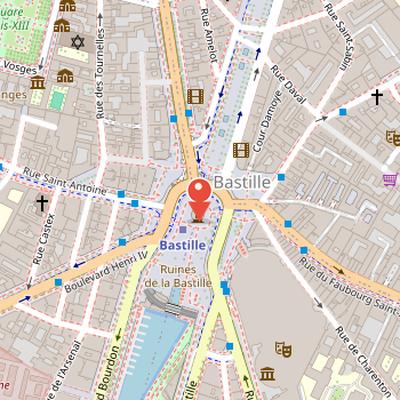
Nearby Objects
-
 July Column 0 m away
 -
 Place de la Bastille 10 m away
 -
 Le Génie de la Bastille 20 m away
 -
 Bastille 30 m away
 -
 Opéra Bastille 150 m away
Plan and Legacy of the Elephant of the Bastille
The Elephant of the Bastille was a Napoleonic project for a fountain in Paris, intended to decorate Place de la Bastille. It was designed as a monumental fountain to be surmounted by a colossal elephant statue carrying a howdah shaped like a tower, and it was to be supplied with water from the Ourcq conveyed by the Canal Saint-Martin. After 1812, the project was entrusted to the architect Alavoine. Its realization became uncertain after Napoleon's fall and was abandoned after the revolution of 1830 in favor of the Column of July. Between 1810 and 1830, only the infrastructures, basin, and pedestal were completed. These surviving infrastructures are still visible and now serve as the base for the Column of July. The elephant itself was never executed in bronze. A life-size plaster model was erected near the site in 1814 and remained there for about thirty years as a curiosity, attracting comment from several writers before being destroyed in 1846. Victor Hugo later immortalized the elephant in a scene of Les Misarables featuring young Gavroche.
Origins of the Project
After the disappearance of the Bastille fortress, which had been destroyed by entrepreneur Palloy after July 14, 1789, the site became the focus of several commemorative schemes. Under the constitutional monarchy, multiple projects were proposed for a monument on the former fortress site. Some artists suggested a column or an obelisk rising over a tholos on the ruins of the Bastille prison. The area was later transformed by law into a large public square, and in 1793 the Fontaine de la Regeneration was installed there during a celebration of the events of August 10, 1792. This fountain, decorated with an Egyptian allegory of Nature in plaster, briefly dominated the public space created on the Bastille site.
Under the First Empire, the project took a new direction. Architect Viguet proposed an elephant-themed fountain for Chaillot hill, but the design remained at the drawing stage and the site was reassigned to the unrealized Palais du Roi de Rome project. Napoleon then adopted the idea of a monument at Place de la Bastille. In 1806 he rejected a Bastille arch of triumph in favor of a monumental fountain. The project was intended to fit into wider urban and hydrological reforms of his regime. Construction began by decree, with article 6 ordered by Napoleon to Minister Emmanuel Cre tet. The first stone was laid on the anniversary of the coronation, on the same day that Paris received water from the Ourcq canal.
Origins and Symbolism of the Elephant Design
The project for the Elephant of the Bastille drew on a long and varied history of elephant imagery. Its origins were linked to European fascination with elephants carrying howdahs, first encountered in accounts of Alexander the Great's conquests, as well as to early elephant motifs in the 16th century gardens of Bomarzo. The design also recalled Charles-Francois Ribart de Chamoust's 1758 proposal for a habitable elephant monument at the Rond-Point de l'Etoile.
The elephant carried multiple political meanings in French culture. Under different regimes, it could signify both royal power and popular strength. This symbolism appeared in the elephant motif on the gallery fresco at Fontainebleau, where it represented royal power, and later in revolutionary Republic projects from Year II, including plans for obelisks and triumphal arches. The project also reflected a revived taste for the Orient after the Egyptian campaign.
Its visual sources were equally diverse. The conception was inspired by a neoclassical motif from a clock in the Prussian king's cabinet in Berlin and by the elephant in the piazza della Minerva in Rome. An unselected design preserved at the Louvre included a statue of a man on top of the elephant, and two figure options were proposed: a Greek warrior with a lance or a bearded man in oriental costume offering a sabre. The oriental version alluded to the 1807 gift of sabres from the shah of Persia's ambassador to Napoleon.
The chosen form was an elephant that blows water through its trunk, set apart from two contemporary fountains by Vaudoyer and Girard. The iconographic choice did not receive unanimous approval from specialists and was criticized as inappropriate by architect Fontaine in 1810, but it was supported by Emperor Napoleon and the art administrator Vivant Denon. A drawing by Zix later documented it as one of the masterpieces of Denon's artistic policy.
Project and Design of the Elephant
The history of the project was supervised by Vivant Denon and was initially entrusted to architect Jacques Cellerier before being entrusted to Jean-Antoine Alavoine after 1812. Alavoine designed it as a monument larger than life, with a base diameter and height that included a colossal statue. The planned bronze elements, including the statue, harness, and elephant ornaments, were to be gilded. The fountain was to stand at the center of the square, with the elephant facing rue Saint-Antoine, and the tower was meant to hide the hydraulic machine that fed the fountain.
The design also included a spiral staircase inside one leg, two meters wide, giving access to the top platform of the tower. Bronze from melted enemy cannons was planned for the construction, following the example of the Vendome column, and an imperial decree reserved artillery pieces taken at Friedland for this use. Among several estimates submitted in May, the project favored the foundry estimate of Honoré Gonon.
The project changed over time: Alavoine's final proposal in 1809 differed from an earlier project, and between 1812 and 1813 he signed a watercolor, also signed by Denon, showing water flowing from the trunk. Construction was slow in 1813, especially on the basin, and about forty workers were on site, with a complaint about the lack of young workers because of conscription. The project was presented by Alavoine in the Salon of 1814. In 1813, sculptor Pierre-Charles Bridan and assistant Antoine Mouton built a full-scale plaster model, which was later displayed southeast of the place for more than thirty years and was protected by a wooden hut and a guard. The final design of the fountain was made by Louis Bruyere in 1828.
Project Revisions and Delayed Completion
The fall of the Empire halted the monumental works begun by Napoleonic initiative, and the fountain works were suspended after having already cost money while producing only the infrastructure and basin. Activity resumed somewhat the following year, when the place known as place Saint-Antoine or place de l Elephant was also intended to be renamed place Louis XVIII. At this stage, the work centered mainly on the monument base, planned as a square pedestal with twenty-four metopes for marble bas-reliefs. The creation of twenty-four marble bas-reliefs, each representing sciences and arts, was begun, and plaster models of most of them were shown at the Salon of 1817. During the slow progress, Alavoine and Bridan proposed new projects that often differed greatly from Napoleons original design.
The project then moved through successive official decisions. The Interior Minister Corbiere stated that the initial project including the elephant was abandoned, while also insisting that the basin and bas-reliefs had to be finished so that funds already spent would not be lost. Responsibility for choosing a new project was transferred to the city of Paris, under the Seine prefect. Prefect Gaspard de Chabrol agreed to replace the elephant with a Paris statue by Cortot surrounded by river allegories representing the Loire, the Seine, the Rhone, and the Garonne. Works continued under Alavoine and were supervised by Quatremere de Quincy, but they were awarded before being prematurely stopped the following month by the Trois Glorieuses revolution.
On January 22, 1831, a commission of artists led by Odilon Barrot was asked to determine the fate of several construction sites in Seine. Some members proposed reviving the elephant as an allegory of the peoples strength and intelligence, but artists and architects including Fontaine rejected the idea and opposed the Napoleonic project from the beginning. A royal ordinance condemned the project after Count dArgout proposed a new monument on Place de la Bastille. The plaster model, painted in bronze color, was placed behind a fence and became more visible and vulnerable after its shelter was removed. Alavoine gradually abandoned the elephant and accepted Fontaines proposal for a commemorative column on the existing structures. Even so, the elephant was not completely abandoned: in 1833 Alavoine asked for the model to be restored but was refused, and later exhibitions continued to propose new uses for the colossal statue.
Project Delays and the Fate of the Plaster Model
In 1841, the project was reassessed with a new estimate from the founders Soyer and Inge, and the intended site was the barriere du Trone on the present Place de la Nation. The cost of the project was evaluated that same year. In 1842, the plan was reiterated, with execution proposed in bronze, iron, or repoussee copper. However, the project was postponed indefinitely because it depended on a state subsidy.
The plaster model had its own brief and troubled history. In 1843, it was moved a few dozen meters to make room for a new guardhouse. Over time, it deteriorated through exposure to weather, stones thrown by children, and rats. It also served as a refuge for homeless people and alleged criminals. The model was destroyed in 1846, following a prefectural decision made in 1845, and the rubble and recoverable materials were sold for 4,753 francs.
The Elephant in Literature and Public Memory
L'elephant vu par les ecrivains was a plaster model that remained a curiosity during the Restoration and became a recurring subject in literary and journalistic commentary. It inspired the fancy of figures such as Lémontey and the serious reverend Dibdin, while also provoking criticism from the Ultras, who were upset by its Empire memory. Vaudevillists later highlighted it humorously for the delay in making the white elephant, showing how the project entered popular satire.
The monument also appeared in literary works and poetry. It is described with wit in Lémontey's 1816 novel L'Enfant de Paris, where it is discussed in relation to the appropriateness of zoological iconography and contrasted with a colossal mammoth statue imagined by the same author. It was also featured in the 1819 Almanach des Muses, directed by Etienne Vigee, where M. F. O. Denesle wrote a poem that opposed the elephant to the equestrian statue of Henri IV at Pont Neuf. In this context, the elephant symbolized the ideological significance of Paris's urban embellishments.
After 1830, romantic chroniclers became interested in the monument as they witnessed its deterioration and destruction. It was mentioned in a one-act vaudeville at the Theatre des Varietes in 1835, and then referenced by Delphine de Girardin in 1836 in relation to the July Column and the Genius of Liberty statue. In 1837, Heinrich Heine described it in a letter comparing the elephant monument and King Louis-Philippe, noting that it was infested with rats and not demolished because of neighborhood fears. He also linked it metaphorically to the political and social situation of the July Monarchy. The interpretations and testimonies of Heine and Hugo helped secure posthumous recognition for the aborted project, which Victor Hugo later partially salvaged at the time of demolition in 1846.