Place de la Bastille is a square in Paris identified with the site of the former Bastille, a fortified structure built to defend the city against Burguignons and English attacks. According to the recorded history of the square, Étienne Marcel built a fortified gate on Rue Saint-Antoine, later flanked by a small bastion called a Bastilha. Hugues Aubriot laid the first stone of the fortifications in 1370, and subsequent rebuilding under Charles V and Charles VI expanded the original stronghold into a more elaborate defensive complex with towers, walls, and a moat. Further fortifications were built under Henry II in the 16th century. The Bastille later served as a prison, including during the reign of Louis XI and under Richelieu, before it was invaded on 14 July 1789 by the population of Faubourg Saint-Antoine. This event is considered the first act of the French Revolution and gave the square its lasting symbolic importance. The outlines of the eastern fortress walls are marked by special pavement on the western part of the square.
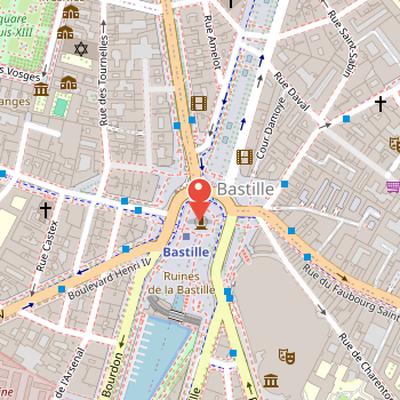
Nearby Objects
-
 Le Génie de la Bastille 10 m away
 -
 Elephant of the Bastille 10 m away
 -
 July Column 10 m away
 -
 Bastille 20 m away
 -
 Opéra Bastille 150 m away
Origins of Place de la Bastille
The history of the square begins with a fortified gate built by Etienne Marcel to defend Rue Saint-Antoine. This gate was flanked by a small bastion called a Bastilha. Later, Charles V ordered the reconstruction of the fortifications to preserve the Hotel de Saint-Paul, and Hugues Aubriot laid the first stone in 1370. The original fortress had two towers, and two more were added soon after. Around 1383, Charles VI ordered four new towers to be built, joined them with large walls, and surrounded them with a moat. In 1553, Henry II ordered new fortifications, completed in 1559, including a curtain wall flanked by bastions and wide moats with tank bottoms. The outlines of the eastern fortress walls are marked today by a special pavement on the western part of the square.
Historical Role of the Bastille
The history of Place de la Bastille is closely linked to the Bastille Saint-Antoine, which was built to protect Paris from Burguignon and English attacks. In May 1418, Carlos VII fled Paris through the Bastille during the Burguignon massacres. In August 1418, the Burguignons besieged the Bastille Saint-Antoine to capture Armagnacs, and the gates were broken during the siege. The Armagnacs were later massacred when a guard escort was attacked during prisoner transfer attempts.
The Bastille later served as a prison during the reign of Louis XI. Louis de Luxembourg was imprisoned there on November 27, 1475, and decapitated at Place de Greve on December 19, 1475. Richelieu transformed the Bastille into a state prison. On July 14, 1789, it was invaded by the population of Faubourg Saint-Antoine, an event considered the first act of the French Revolution.
Symbolic Uses of the Bastille Site
The Bastille site gained symbolic importance through a series of public and political acts after the fortress began to be demolished. On August 14, workers found five stone balls embedded in the County Tower; these are presumed to have been fired during the Battle of Faubourg Saint-Antoine in 1652. Some of the demolition materials were later used to build the Louis XVI Bridge. A law of June 27, 1792 prescribed the formation of a place on the terrain of the Bastille, and a government decree of December 3, 1803 adopted a plan with provisions for the site, although this project was not executed.
The place was also marked by ceremonial and commemorative actions. On July 14, 1790, the private businessman Palloy organized a parallel party at the Bastille ruins with a tent labeled Here we danced; a gouache by Henri-Joseph Van Blarenberghe in the Carnavalet Museum represents this tent. On June 16, 1792, it was decided that the Bastille site would become a place called of liberty, with a column to be erected. Palloy provided the first stone for the column, but construction remained incomplete. A fountain was installed on the site in 1793.
The area also had a darker public role during the revolutionary period. From June 9 to 14, 1794, a guillotine was installed on Place Antoine, the former Bastille fortress remains. Citizens demanded its removal to Place du Trone-Renverse, and seventy-five people were guillotined on Place de la Bastille.
The Unbuilt Elephant Monument
In 1808, Napoleon planned a 24 meter high elephant monument for the Bastille site in Paris. The design called for a howdah on the elephant and a stairway leading to the top inside one of its legs. The monument was intended to be cast in bronze from captured Spanish cannons, and an imperial decree of February 24, 1811 ordered the elephant for the Bastille Fountain to be cast in bronze. The bronze was to come from arsenals and was not to be included in the expenses, with war trophies from the Friedland campaign supplying the material.
Work on the project began in 1833 under architect Jean-Antoine Alavoine, but only a full size plaster model by sculptor Pierre-Charles Bridan was erected. Victor Hugo later recalled the elephant monument in Les Miserables as sheltering Gavroche. The monument was demolished in 1846, leaving only the circular foundation of the fountain.
The Bastille Site in the Nineteenth Century
Place de la Bastille acquired major symbolic and practical roles throughout the nineteenth century. In 1830, the decision was made to construct the Coluna de Julho to commemorate the Revolucao dos Tres Gloriosos. This was followed by a royal ordinance issued on 6 July 1831, which called for a funerary monument honoring the victims of the three days. The first stone was laid by King Luis Filipe I on 27 July 1831, and the column was inaugurated in 1840. The Coluna de Julho is of Corinthian order and its pedestal bears inscriptions, palms, crowns of immortelles, oak branches, city arms, a Gaulish rooster, and a lion symbol.
The square also served as a site for public activity and changing urban uses. It was identified as the entrance to the Arenas Nacionais, inaugurated on 1 July 1851 for outdoor presentations, and it hosted the debut of the Boeuf Gras carnival procession on 23 February 1852. The grounds of the Arenas Nacionais were sold in 1854 for new building construction.
Transport history later became closely linked to the site with the opening of the Bastille station, or Gare de Paris-Bastille, in 1859. It operated until 1969 as the head of the Vincennes Line connecting Paris to Verneuil-l'Etang. After railway activity ceased, the passenger building was used for art exhibitions until its destruction in 1984, when the Opera de la Bastille was built on the site.
The Coluna de Julho also became a target during the Paris Commune. On 24 May 1871, Communards attacked it in an attempt to destroy it like the Coluna de Vendome. They sent a barge filled with petroleum under the vault supporting the column near Canal Saint-Martin, causing flames up to 50 meters long, and nearly thirty shells were launched from Pont d'Austerlitz and Buttes-Chaumont, but the column remained intact.
Public Gatherings and Civic Celebrations
Place de la Bastille serves as a regular location for fairs, concerts, and markets, and it also has a strong role in public and political life. The Third Republic formalized the French national holiday there in 1880, and the square is recognized as a site for republican demonstrations. It is frequently used as the starting point, passage, or arrival point for social, political, and union demonstrations. Among the recorded events were a major demonstration in support of the Free School on March 24, 1984, and a rally organized by Front de Gauche candidate Jean-Luc Melenchon on March 18, 2012. The square also became a place of repeated symbolism during celebrations of socialist electoral victories, including gatherings on May 10, 1981, after the election of Francois Mitterrand, and on May 6, 2012, after the election of Francois Hollande. Since the 1980s, it has been the traditional meeting point for the annual Gay Pride Parade, whose attendance increased significantly from the mid-1990s, reaching audiences of 200,000 to 700,000.
Beyond political and commemorative uses, the area is noted for its lively nightlife and public activity. It is especially popular on Friday and Saturday nights with youth from Parisian suburbs, and it contains many cafes, restaurants, cinemas, and nightclubs. Since 1998, and weather permitting, a long skating walk has started from near Place de la Bastille every Sunday afternoon. Organized by the association Rollers et Coquillages, this route covers about twenty kilometers on Paris streets and has become a must for skating enthusiasts worldwide.
Urban Reorganization of Place de la Bastille
Place de la Bastille in Paris was part of an urban reorganization project by Atualidade within the reconstruction of seven Parisian squares. The work began in 2019 and the renovated square was inaugurated in January 2021 after two years of construction. The project was intended to make pedestrian crossing easier, improve cycling access, provide access to the July Column and the Arsenal Basin, and strengthen the presence of plants in the square.
The renovation added 6,620 square meters of additional space for pedestrians. It also included 350 meters of bidirectional cycle paths and a new staircase giving access to the Arsenal Basin. These changes reshaped the square as a more accessible public space with improved movement for pedestrians and cyclists.