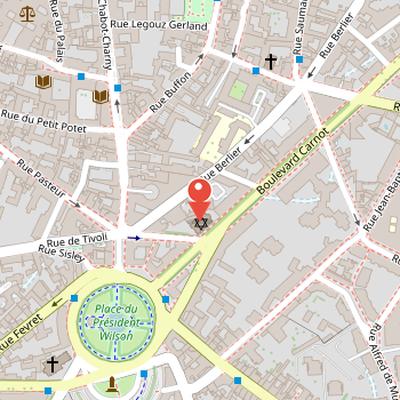
The Synagogue of Dijon is a synagogue located in Dijon, in the French department of Côte-d'Or. It is fully registered in the Supplementary Inventory of Historical Monuments by prefectural decree. The site is associated with the long history of Jewish life in Dijon, where Israelites lived in two special quarters: rue Buffon, which included a synagogue, a school, and a cemetery, and rue de la Petite-Juiverie. The city later ceded three ground-floor rooms in the town hall free of charge for Israelite worship, and these rooms served as the city’s worship place until 1879. When the municipal council sought a larger solution, Mayor Joliet granted free land for a neo-Byzantine synagogue. The project predates the Franco-Prussian War of 1870, but construction was delayed by the fall of the Second Empire. The synagogue was inaugurated on May 4, 1875. It was designed by engineer-architect Alfred Sirodot, modeled after the Paris Synagogue on rue de la Victoire, with stained glass by Eugène Oudinot workshops, ornamentation, dome, turrets, and sculptures by Jules Schanoski, and paintings by Leniept.
Nearby Objects
-
 Musée Rude 400 m away
 -
 Église Saint-Étienne 400 m away
 -
 Castrum de Dijon 400 m away
 -
 Saint-Michel Church 400 m away
 -
 Musée Magnin 450 m away
Location and Heritage Status
The Synagogue of Dijon is located in Dijon, in the French department of Cote-d'Or. It is fully registered in the Supplementary Inventory of Historical Monuments by prefectural decree. This designation places the building within the recognized heritage record for the area and reflects its protected status as a historic religious structure.
Jewish Quarters and Worship in Dijon
Historical records indicate that Israelites in Dijon lived in two special quarters. One was located on rue Buffon, where there was a synagogue, a school, and a cemetery. The other was on rue de la Petite-Juiverie, which housed Israelites who owned considerable property and were able to make loans to important persons. The same sources note that this wealth attracted reprisals. For worship, the city ceded three ground-floor rooms in the town hall free of charge for Israelite use. These rooms served as the city worship place until 1879, when the municipal council sought a solution because they had become too small.
Construction and Design of the Synagogue of Dijon
The project for the Synagogue of Dijon predates the Franco-Prussian War of 1870, but the fall of the Second Empire delayed its construction. Mayor Joliet granted free land for the neo-Byzantine synagogue, which was inaugurated on May 4, 1875. The building was designed by the engineer architect Alfred Sirodot and modeled after the Paris Synagogue on rue de la Victoire. Its first rabbi was Michel Aron, also known as Gerson, who served from 1869 to 1900.
Several artists contributed to the synagogue's decoration. The stained glass windows were created by the workshops of Eugene Oudinot. Jules Schanoski was responsible for the ornamentation, dome, turrets, and sculptures, while Leniept provided the paintings. These elements formed part of the building's distinctive architectural and decorative character.
War, Liberation, and Community Life
The history of the Synagogue of Dijon is closely linked to the wartime experience of Jews in the city. Dijon was occupied by Germans from June 1940 to September 1944, and the period saw the deportation of many Jews and resistants. Rabbi Elie Cyper, appointed in 1937, was mobilized at the declaration of war in 1939. He was captured, escaped immediately, joined the resistance, became an FFI captain, and died in deportation in Lithuania in 1944.
The occupation also brought repeated arrests and deportations. An imposed census recorded 376 Jews in Dijon and 842 in the Cote-d'Or. A large raid targeted foreign Jewish refugees in Dijon, after which 21 people were detained at the town hall for two days and deported from Dijon station to the Pithiviers camp. Those detainees later joined Convoy no. 6 on 17 July 1942 to Auschwitz. In 1944, a similar event took place at Jean-Jaures school on rue Jules-Ferry, where 87 people were arrested and later deported to Drancy camp. They joined Convoy no. 69 on 7 March 1944 to Auschwitz, and Paulette Levy was the only survivor.
The historical record also preserves acts of protection. On an unspecified date, the director Marcelle Parde and secretary Simone Plessis of Dijon girls' high school were arrested for hiding Jewish refugee girls from Germany. Among those hidden was Rita Thalmann, who was saved by English teacher Madame Connes and escaped to the free zone. Thérèse Katz was deported during the Dijon raid and died during the death march.
After Liberation, the former Menagere department store at Coin du Miroir was requisitioned and converted into a refuge for returning deportees. Its ground floor was arranged as a restaurant and the first floor as a dormitory. The municipality also requested volunteers to assist survivors and guide them to the reception center for families seeking deported relatives. Later, a Sephardic community established in Dijon between 1956 and 1967 joined the existing Ashkenazi community. The synagogue was classified as a historical monument in its entirety by an order dated on an unspecified date.