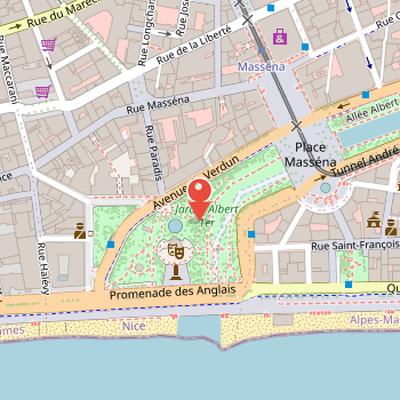
Albert I Garden is one of the oldest public gardens in Nice. It is enclosed by avenue des Phocéens, place Masséna, avenue de Verdun, and promenade des Anglais. The garden has been successively called jardin Paradis, jardin des Plantes, jardin Masséna, and jardin des Palmiers before being named jardin Albert-Premier in 1914 after Albert, King of the Belgians.
Its history begins with a public garden created by royal letters patent from King Charles-Félix on Château hill in May 1828, with pathways and green spaces. A second public garden was later planned as winter visitors grew in number along the Riviera. The city acquired marshland between the right bank of the Paillon and the seaside axis for this use, and the 1832 Plan régulateur described a tree-planted square on the site. In 1852, about one hectare was levelled and planted in an Italian garden style with 26 stone benches. Later additions included water supply works, an armillary sphere, a music kiosk, a refreshment booth, and a landscaped extension over the covered Paillon.
Nearby Objects
-
 Théâtre de verdure de Nice 30 m away
 -
 Monument du Centenaire 80 m away
 -
 Place Masséna 200 m away
 -
 Jetée-Promenade de Nice 200 m away
 -
 Casino Municipal de Nice 250 m away
History and Setting
Albert I Garden is one of the oldest public gardens in Nice. It is enclosed by avenue des Phocens, place Massena, avenue de Verdun, and promenade des Anglais. Over time, it was successively named jardin Paradis, jardin des Plantes, jardin Massena, and jardin des Palmiers. In 1914, it took the name jardin Albert-Premier, in reference to Albert, King of the Belgians.
Development of the Garden
Albert I Garden was created by royal letters patent from King Charles-Felix on Chateau hill in May 1828. It included pathways and green spaces, and it formed part of a wider municipal response to the growing number of winter visitors on the Riviera, many of whom favored walking as physical activity. The city later decided to create a second public garden because of this growing clientele. At the same time, attendance began to decline during the Belle Epoque, when casinos and beaches attracted more visitors.
The garden's later planning can be traced to the 1832 Plan regulateur, which proposed a 65-meter-radius round, tree-planted square on marshland known as Prato della foce. The city acquired this land between the right bank of the Paillon and the seaside axis for public garden use, and the Consiglio d'Ornato fixed the future facade spelling in advance. In 1852, the terrain was leveled and about one hectare was planted in Italian garden style, with 26 stone benches. Water for the central circular basin was supplied by a terracotta pipeline extended from the Eau-Fraiche source in the Saint Jean-Baptiste suburb.
The planting inventory of 1851 shows a highly varied composition, including horse chestnuts, elms, lindens, acacias, Judas trees, mimosas, Constantinople mulberries, carob trees, ashes, umbrella pines, plane trees, cherry trees, holm oaks, and maples. The garden soon became socially competitive with the Cours, and a military orchestra alternated between the two sites. Old tourist guides described it as the most sociable place for foreigners. It also hosted Alphonse Karr's successful shop in 1854 near Hotel d'Angleterre, where flower bouquets and seasonal fruits and vegetables were sold.
Further changes followed in 1863, when the right bank quay from Place Massena to the promenade was completed, extending the garden onto Paillon riverbed land. An armillary sphere was installed in 1865 on a tall stone pedestal in the new southern seaside space, and a music kiosk and refreshment booth were added in 1868. In 1890, the garden was extended again by covering the Paillon downstream from Place Massena, incorporating part of Square des Phoceens and reaching the current area. This extension was landscaped with a French-style lawn along the Paillon axis and winding English-style paths on the seaside side, with standardized benches and lampposts. The garden's planting then reflected exotic acclimatization fashion and the shallow soil on the slab, with predominant palm trees and subtropical trees and shrubs. It also included a now-disappeared swan basin, the Fontaine des Tritons, and an artificial grotto with stalactites later replaced by the Theatre de Verdure.
From Centenary Monument to Albert I Garden
The site now known as Albert I Garden was originally associated with the Centenary Monument, erected in 1892 to mark the centenary of the 1792 attachment of Nice. The monument was inaugurated by President Felix Faure in 1896. In 1914, Historique was renamed King Albert 1er Garden in honor of King Albert of Belgium. The new name reflected recognition of his courageous positions against Germany's ultimatum at the beginning of the First World War.
Historic Features and Sculptures
Albert I Garden includes several distinctive historical and artistic features. At the center of the garden is a Greek-inspired Theatre de Verdure, constructed in 1946. Its stage is marked by a stone wall with two antique-style statues and amphitheater seating. The statues, named La Tragdie and La Danse, were created by sculptor Victor Nicolas. Until the mid-20th century, children were allowed to ride wooden donkey-drawn carts around the garden, but this activity ended in the 1960s because of increasing automobile traffic. The garden also contains Arc Monumental 115,5°, a 19-meter-long metal sculpture erected in 1988 by Bernar Venet. This work is described as a second version of the Arc de 124,5° located in Berlin.
Current Use and Cultural Activity
In the 21st century, Albert I Garden functions as a green space where retirees rest and tourists stroll. It also serves as a venue for frequent events, including the annual book festival held at the end of June. The garden additionally supports live performances, with many artists appearing in concerts on the open-air theater stage. These uses give the site a public role that combines leisure, cultural programming, and outdoor entertainment.