Jetée-Promenade de Nice was an old building constructed on stilts over the sea in Nice, opposite the Hôtel Palais de la Méditerranée. It was initially intended for recreation and tourism and was meant to satisfy visitors, especially English tourists. The structure was inspired largely by the Brighton Pier.
The project was conceived during a trip to London by the marquis d’Espouy de Saint-Paul, who discovered the Crystal Palace in Hyde Park. It was planned as a floating glass palace modeled after the piers for construction in Nice. Its plans were submitted to the prefecture for a concession on the maritime domain, and on July 3, 1881, the prefect authorized the concession for a pier promenade allowing tourists to walk above the sea after paying an entrance fee. The theatre hall was not completely finished when the concession was authorized.
Three days after opening, the structure was interrupted by a fire. The causes were never determined, and no casualties were reported. Only the access footbridge and terraces remained. Despite plans for reconstruction, the company lacked funds, declared bankruptcy, and its remains were auctioned in 1884. The structure was later destroyed in 1944.
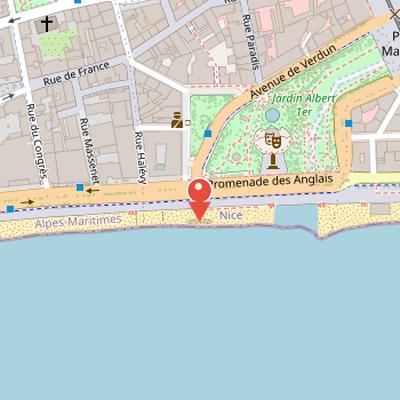
Nearby Objects
-
 Monument du Centenaire 150 m away
 -
 Théâtre de verdure de Nice 200 m away
 -
 Albert I Garden 200 m away
 -
 Hyatt Regency Nice Palais de la Méditerranée 250 m away
 -
 Place Masséna 450 m away
Origins and Purpose of La Jetee-Promenade
La Jetee-Promenade de Nice was an old building constructed on stilts in 1882 over the sea, located opposite the Hotel Palais de la Mediterranee. It was initially designed for recreational and tourist use, with the aim of attracting visitors, especially English tourists. Its concept was largely inspired by the Brighton Pier. The structure was destroyed in 1944.
Planning, Fire, and Reconstruction
The Histoire project was conceived during a trip to London by the marquis d'Espouy de Saint-Paul, after he discovered the Crystal Palace in Hyde Park. It was planned as a floating glass palace, modeled after the piers, for construction in Nice. The project and its plans were submitted to the prefecture to obtain a concession on the maritime domain. On July 3, 1881, the prefect authorized the concession for a pier promenade that would allow tourists to walk above the sea after paying an entrance fee. At that time, the theater hall was not yet completely finished.
The structure was damaged only three days after opening, when a fire interrupted it. Its official inauguration had been scheduled for July 16, 1881. No casualties were reported, and the causes of the fire were never determined. An investigation found that the building materials included wooden walls and marquetry soaked with petroleum oil. In Nice, some people suspected that the fire had been intentional in order to benefit the Municipal Casino. Firefighters tried to save the building, but only the access footbridge and terraces remained.
Despite the fire, the company announced plans for rapid reconstruction and reopening, but it lacked the funds to carry out the works. The enterprise declared bankruptcy, and its remains were auctioned at the start of 1884. With no buyers found, the company was dissolved in 1885. A judicial liquidator was appointed to find a buyer and obtained ministerial authorization for retrocession. After three unsuccessful auctions, a new company, the Societe Anonyme de la Nouvelle Jetee-Promenade de Nice, was formed on March 15, 1888. Reconstruction of the ruined building resumed in 1889 and was completed two years later.
Between 1891 and 1914, the Palais de la Jetee entertained winter visitors during the Belle Epoque. Its operating company offered a promenade, conviviality, a gaming circle, reading, and quality musical shows. The Jetee-Promenade later had to close its doors during the occupation of Nice.
Occupation Changes in Nice
After the publication of Italy fascist capitulation, Italian troops withdrew from the southern zone. Histoire's Wehrmacht entered Nice immediately after the Italian troops withdrew.
Wartime Destruction and Final Loss
During 1943 and 1944, the Jetee casino was stripped of all metals, including copper, bronze, statues, silverware, and wiring, after the city was required to comply with the new occupant's demand to mobilize non-ferrous metals. The German army barricaded the seafront and used the Jetee building as a fortified camp. Later, the Wehrmacht abandoned the site and ordered the dismantling of the building's superstructure to recover steel. By the time of Liberation, only submerged debris and many metal structures remained on the site. In the postwar period, the casino operating company lost its authorization to occupy the maritime domain by prefectural decree, appealed to the Council of State, and the decree was confirmed. The Jetee-Promenade never emerged again from the waters where it sank.
Structure and Interior Design of the Jetee-Promenade de Nice
The first structure was built too close to the water surface in 1883. The superstructure rested on 250 hollow cast iron piles screwed into the ground. These piles had an embedded diameter and depth in the ground, and the water depth varied from 2 to an unspecified measurement depending on the position of each pillar in relation to the beach slope. At their upper part, the piles were connected by lattice beams and Saint Andrew's crosses.
The floor slab was made of Grenoble cement concrete and cast on a reinforcement lattice over a specified surface area. The metal framework was made by a company from Moisant, and the framework was decorated and veneered with hollow visible bricks. The building contained several rooms, with decoration varying in Orientalist styles including Japanese, Indian, Turkish, and Moorish. The main painter was Mathon, and the interior architect was Theodore Charpentier.