The Monument du Centenaire was commissioned for the centenary celebrations of the Republic in 1892 and inaugurated by Félix Faure, Léon Bourgeois, Maurice Rouvier, Alfred Borriglione, Flaminius Raiberti, and François Alziary de Malausséna. It has been registered as a historical monument. The memorial is composed of a very slender pyramid topped with a bronze statue of Victory wrapped in a French flag. The statue represents Niké, an allusion to the mythical origin of the name Nice, and is shown swearing an oath of loyalty, recalling the city’s motto, Nissa fidelissima. At the base, a white marble group shows Nice giving itself to France, with a young girl kissing a woman holding a bundle. The city of Nice is shown crowned with its walls, while France appears calm, helmeted, and with her breast covered. The monument also includes the city’s coat of arms, a representation of the Mediterranean, and inscriptions dating 1793-1893 with 1860 below. It commemorates the unions of 1793 and 1860.
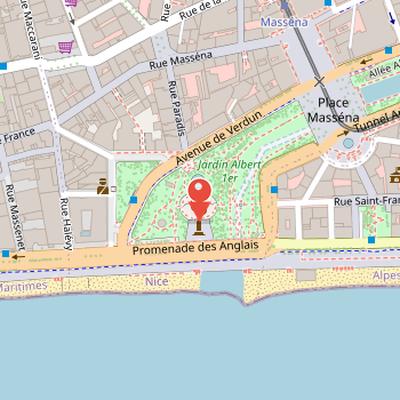
Nearby Objects
-
 Théâtre de verdure de Nice 50 m away
 -
 Albert I Garden 80 m away
 -
 Jetée-Promenade de Nice 150 m away
 -
 Place Masséna 300 m away
 -
 Casino Municipal de Nice 300 m away
Commissioning and Inauguration
The Monument du Centenaire was commissioned for the centenary celebrations of the Republic in 1892. Its inauguration brought together several public figures, including Felix Faure, president of the French Republic; Leon Bourgeois, president of the Council; Maurice Rouvier, president of the general council of Alpes-Maritimes; Alfred Borriglione, senator of Alpes-Maritimes; Flaminius Raiberti, deputy of Alpes-Maritimes; and Francois Alziary de Malassena, mayor of Nice. The monument was later registered as a historical monument.
Design and Symbolism of the Monument du Centenaire
The Monument du Centenaire is composed of a very slender pyramid surmounted by a bronze statue of Victory wrapped in a French flag. The statue represents NikE, an allusion to the mythical origin of the name Nice, and is shown swearing an oath of loyalty, referring to the city's motto, Nissa fidelissima. At the base of the pyramid, a main group in white marble depicts Nice giving itself to France, with a young girl kissing a woman holding a bundle.
France is shown without a Phrygian cap, but wearing a helmet and with her breast covered. Her calm expression presents her as an orderly, moderate, prudent, legalistic Republic that is maternal, reassuring, and pacifying. Nice appears crowned with its walls, recalling an older medieval representation and alluding to the surrender of the city to the Counts of Savoy in 1388. In this monument, the 1793 union is presented as a new form of surrender, this time to France.
The city's coat of arms is carved in the center of the base, and a representation of the Mediterranean is placed at the back. Four figures planned for the angles of the base were intended to represent the benefits of annexation, but they were not realized. The inscriptions are more numerous than on previous monuments and were meant to explain the meaning of the statue while also preserving the memory of local elected officials. On the front face of the pyramid, the dates 1793-1893 appear with 1860 below. The monument commemorates the union of 1793 and the union of 1860.