Casino Municipal de Nice was a famous entertainment complex in Nice, at Place Masséna. Built between 1882 and 1884 on the Paillon river, it formed part of a project initiated by promoter Omer Lazard to cover the river with a thick slab from Place Masséna to the sea and to create a casino complex on the new surface. The work was authorized by the municipality under the 1879 treaty, on public domain land, and the municipality granted an exploitation right lasting 80 years.
The building faced Place Masséna directly and included arcades on that side, a portico alley on Avenue Félix-Faure, and a large glass roof or hall with a winter garden at the back. Its interior contained a circle, game rooms, an ice cream parlor, a restaurant, a grand hall, and performance rooms. The theatre was built by Édouard-Jean Niermans, with decorations by Paul Gervais and Vincent Lorant-Heilbronn. The hall was designed by A. and G. Messiah, and the new salons of the Grand Cercle were decorated by Niermans. The casino was transformed between 1939 and 1940 and demolished in 1979.
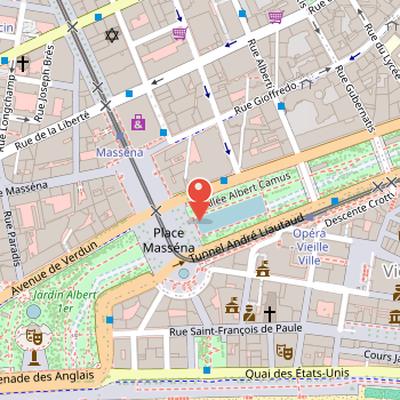
Nearby Objects
-
 Place Masséna 60 m away
 -
 Opéra de Nice 250 m away
 -
 Albert I Garden 250 m away
 -
 Théâtre de verdure de Nice 300 m away
 -
 Monument du Centenaire 300 m away
Casino Municipal de Nice
The Casino Municipal de Nice was a famous entertainment complex in Nice, located at Place Massena. It was built between 1882 and 1884 on the Paillon river and included a circle, game rooms, an ice cream parlor, a restaurant, a grand hall, and performance rooms. The building was transformed between 1939 and 1940, reflecting a later phase in its history. It was ultimately demolished in 1979.
Construction and Architectural Layout
The Casino Municipal de Nice was initiated by the promoter Omer Lazard as part of a larger project to cover the Paillon river with a thick slab extending from Place Massena to the sea. The plan included an entertainment complex with a casino built on this covering slab. The undertaking was authorized by the municipality under the 1879 treaty, on public domain land, and the municipality granted an exploitation right for 80 years while also preventing similar concessions from being given elsewhere.
Construction works took place between 1879 and 1882 for the covering of the river, and the building was completed in early 1884. The casino faced Place Massena directly. Its arrangement included arcades on the Place Massena side and a portico alley on the Avenue Felix-Faure side. At the back, it had a large glass roof or hall containing a winter garden. The hall was designed by the architectural firm A. and G. Messiah.
Several interiors were attributed to different designers. The theater of the casino was built by Edouard-Jean Niermans, with decorations by Paul Gervais and Vincent Lorant-Heilbronn. The salle de baccara was decorated by the architect Henri Labrouste, and the new salons of the Grand Cercle were also decorated by Edouard-Jean Niermans.
Gaming at the Municipal Casino
Games at the municipal casino included boule, baccarat, trente et quarante, and roulette. At first, these games were held upstairs in the salons of the Grand Cercle and were available only to holders of subscription cards. After the 1907 law authorized les jeux to be accessible to all visitors, gaming developed further. Boule rooms were installed on the ground floor, and the Ministry of the Interior granted annual authorization following a public inquiry and municipal opinion.
Cultural Programming and Public Prestige
At Casino Municipal de Nice, Les spectacles made artistic programming central to the life of the establishment. The casino hosted theater, recitals, concerts, music-hall performances, and cinema, and it also premiered La Vida breve by Manuel de Falla. It welcomed major artists and maintained a permanent orchestra, while on some occasions it operated four stages at the same time. In 1948, Les spectacles launched the casino's jazz festival with Louis Armstrong and Django Reinhardt, adding to its cultural profile. The casino also received memorable parties and banquets for several presidents of the French Republic, including Armand Fallieres and Emile Loubet. Its gaming authorization was conditioned on the artistic effort of the establishment, showing that entertainment was closely tied to its official status. Les spectacles also complained to the municipality of Nice about the lack of shows in other gaming establishments and even suggested unfavorable opinions for the renewal of their licenses.
Management After Construction
For several decades, the Casino Municipal de Nice was operated by the Societe fermiere des casinos de Nice. Its direction was under Pierre Ducis, and after World War II it was directed by Pierre-Jean Ducis, the son of Pierre Ducis. These successive leadership arrangements shaped the building's longer period of use and administration.
Redesign and Interior Changes at the Casino Municipal de Nice
In 1906, the casino's salons and theater room were redecorated by architect Edouard-Jean Niermans, marking an important interior transformation. The same period also saw the installation of an organ by the house Mutin-Cavaill-Coll, adding to the building's cultural and musical facilities. This organ was later dismantled in 1947 and is now located in the chapel of the Saint-Joseph College of Rodez.
The exterior appearance of the original building was then profoundly modified in 1939-1940. The work was carried out to better integrate the casino architecturally with neighboring buildings in a Turinese style environment. As part of this redesign, the gray roof was removed, balustrades were added, and the facade was painted pink in order to harmonize with the older buildings in Place Massena, which had been constructed under the initiative of the Consiglio d'Ornato and architect Joseph Vernier.
Closure and Transformation of the Site
The Casino Municipal de Nice operated under an 80-year concession that expired in 1964. In that year, the managing company returned the operation of the hall and theater to the municipality, and gaming activities ceased. The building was later demolished in 1974 under Mayor Jacques Medecin. Medecin had planned to build a convention center on the former site, but the convention center, named Acropolis, was eventually built beyond the Barla bridge. The former casino site was then transformed into gardens and fountains known as Forum Jacques Medecin.