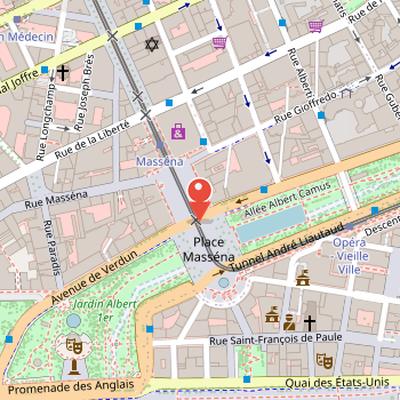
Place Masséna is a central square in Nice, situated between Vieux-Nice and Avenue Jean-Médecin and near the Promenade des Anglais. It was progressively constructed from the 1820s to the 1830s, following the model of Piazza Vittorio Veneto in Turin. Originally planned as part of a general project to beautify the city, it is considered one of the greatest successes of the Consiglio d'Ornato and one of its largest projects.
The square has existed for nearly two centuries and has undergone several urban planning projects. It is noted for its architectural and geometric singularities, as well as for its deep integration into the heritage of Nice. Place Masséna is also a major transportation hub and a place of civic and cultural activity, hosting social, political, and artistic events, including the carnival. Named after Marshal André Masséna, a French patriot with Niçois origins, it carries both local and national significance and remains an important site of Niçois culture.
Nearby Objects
-
 Casino Municipal de Nice 60 m away
 -
 Albert I Garden 200 m away
 -
 Théâtre de verdure de Nice 250 m away
 -
 Monument du Centenaire 300 m away
 -
 Opéra de Nice 300 m away
Place Massena
Place Massena was progressively constructed from the 1820s and 1830s, following the model of Piazza Vittorio Veneto in Turin. It was originally planned as part of a general effort to beautify Nice and is considered one of the greatest successes of the Consiglio d Ornato. Over nearly two centuries, the square has undergone several urban planning projects while remaining deeply integrated into the heritage of Nice.
Located between Vieux Nice and Avenue Jean Medecin, and near the Promenade des Anglais, Place Massena is regarded as a central space in the city. It is also a major transportation hub, which strengthens its role in everyday urban life. The square is noted for its architectural and geometric singularities, which distinguish it within the cityscape.
Place Massena hosts a wide range of cultural, social, political, and artistic events. It contributes to the vitality and effervescence of Niçois culture and provides a place where locals and tourists can meet. It also helps visitors discover Niçois culture through events such as the carnival. Named after Marshal Andre Massena, a French patriot of Niçois origin, it also symbolizes a national dimension through its name. Recognized as an important site of Niçois heritage, it is defended and preserved by residents of Nice.
Origins and Urban Planning
Place Massena was one of the largest projects of the Consiglio d'Ornato and was included in the regulatory plans used to establish the foundations of modern Nice during its expansion. Its origins are tied to a broader effort to beautify and modernize the city after a royal circular encouraged municipal authorities to prepare regulatory plans, at a time when Nice had returned to Sardinian rule about ten years earlier. In 1825, architect Jean-Antoine Scoffier and surveyor Louis Trabaud began planning the project. One of the main aims was to cross the Paillon River in order to develop the right bank of Nice.
The regulatory plan was completed in 1828 and then required approval by the doubled municipal council in 1831. Final validation came through royal letters patent issued in 1832, after King Charles-Albert, who had ascended the Sardinian throne in 1831, approved the urban and architectural overhaul that allowed Nice to expand beyond the old Paillon river walls. The letters patent contained 11 articles and a 23-article regulation that provided financial aid and easier access to land for construction, including expropriation.
Within this framework, Article 8 of the 1832 regulation required the Consiglio d'Ornato to preserve and improve streets, squares, promenades, and public monuments. The council had a functional and well-defined organization, met every two weeks, balanced public and private interests by seeking consensus, and exercised considerable control over all proposed projects under powers granted by the king. Place Massena therefore formed part of a planned urban transformation rather than an isolated project.
Early Plans and Royal Monuments at Place Massena
Place Massena was shaped by a nine-member Historique that deliberated on projects involving the first or second consul of the city. Its membership included the judge of the canton of the city intra-muros, the engineer of the province, the first riguardatore responsible for weights and measures, two councilors designated by the municipal council, two external members noted for expertise in Beaux-Arts, and the architect of the city of Nice. In 1820, under Victor-Emmanuel, work began on a new bridge over the Paillon. The bridge used plans by the Nice engineer Gardon and contributions from neighbors, and it was completed in 1824 as Pont royal Saint-Charles. Locals commonly called it Pont-Neuf. The same planning process also included projects for a semicircular square, with a central point at the intersection of the bridge axis and the facades of Rue du Pont-Neuf. After the annexation in 1861, French authorities moved the square. In 1827, a monument was dedicated to Charles-Felix to commemorate his 1826 visit to Nice. Made of iron and white stone, it featured an eagle and a royal monogram and symbolized the Piedmont monarchy with the medieval Savoy coat of arms.
Name and Historical Meaning
The name of place Massena honors Marshal of the Empire Andre Massena, who was born in Nice. His early military career began with enlistment in the Royal-Italian regiment in Toulon in 1775, followed by discharge, before he returned to the army during the French Revolution. In 1792, he took part in the actions led by General d'Anselme during the capture of the County of Nice and fought against the troops of Victor-Amadee III. He later had a distinguished career in the Napoleonic army and received the titles Marshal of the First Empire, Duke of Rivoli, and Prince of Essling, titles linked to the battles of Rivoli in 1797 and Essling in 1809. Throughout his life, he remained attached to his Niçoise origins. The historical record also notes his participation in financial efforts requested by the local municipality, including support for the construction of Lycee Massena in 1810. In this context, Massena is presented as a figure who embodies the identification of Nice with France, in contrast with Garibaldi's Italian patriotism.
Transformation of Place Massena
Place Massena underwent major transformations during the Belle Epoque, as French authorities sought to reorganize new territories in a symbolic way and emphasized urbanism, cleanliness, and hygiene in Nice. The area was closely linked to the Paillon river, which had once been a visible and active part of daily life, with laundresses and children bathing, but later became more imaginary than real in the minds of the population. Because the river posed problems for the development and beautification of Nice, it had to be covered. The first attempt was made at Square Massena, now Square General-Leclerc, which became the oldest covered section of the Paillon and was built between 1866 and 1868 by engineer Durandy. A statue of Marshal Massena, created in 1868 by the sculptor Albert-Ernest Carrier de Belleuse and erected in 1869, gave the square its original name.
The recouvrement of the Paillon also made possible further urban projects around the place. In 1879, Omer Lazare negotiated the construction of the municipal casino with the mairie, and the municipal council accepted the project in exchange for an 80-year exploitation right for the buildings. Vast gardens were planned alongside the casino, but financial problems and changes of concessionaire delayed their completion. A large eucalyptus tree was even cut down by Mayor Honor Sauvan at quai Massena, and Espace Massena was later created as a large area attached to the place. The adjacent public garden, known as King Albert I garden, had already appeared in the plans of the Consiglio d Ornato in 1832, was established with the help of botanists in the 1850s, completed between 1863 and 1865, and extended in the 1890s so that it adjoined Place Massena after the Paillon was covered.
Place Massena also became a major point of urban connection. It was the heart of the new town built on the right bank of the Paillon and served as the link with the old town, creating a coherent ensemble. As the population increased exponentially in 1848, 1886, and 1906, new suburbs became indispensable, and Place Massena remained the heart of the new zone. All new constructions on the Faubourg were connected to the old town through the place. Its southern openness created a luxurious panorama that attracted many winter visitors to the Cote d Azur, reinforcing the area's role as a passage and meeting point.
Commercial and social activity quickly concentrated there. Shops, cafes, and bistros opened on Place Massena for both tourists and locals. The Cafe de la Victoire opened in 1861 at the corner of rue Massena and belonged to Niçois owners Cauvin, Donaudy, and Pin families. Winter tourists regularly rented apartments in these buildings and in those of the Tiranty family. Vogade pastry shop was established in 1862 in one of the ground floors and gained a strong reputation. The place also hosted two grocery stores selling colonial goods, wines, teas, English articles, and a music shop. During summer, concerts were held every evening at 8 PM, and the flower market was located nearby before moving to rue Saint Francois de Paule, cours Saleya. By the Belle Epoque, Place Massena had become one of the most important economic centers of Nice.
Place Massena and Nice's Tramway Network
Place Massena held a central position in Nice's transport history at the end of the 19th century. During the industrial revolution, the city's move toward modernity depended on the development of a transport network. Private entrepreneurs introduced horse-drawn omnibus services in Nice from 1860, and after Nice joined France, the municipality assumed responsibility for public transport. The completion of the Marseille railway line further integrated the city into the French network.
In 1871, a commission drafted a preliminary plan for an American railway in Nice. The animal-drawn tramway service was declared a public utility by decree and began operating in 1873. By 1880, the tramway network had been completed and consisted of four lines, three of which originated at Place Massena. This made the square a key node in the urban transport system.
Modernization continued with the introduction of electric traction in 1895 on the line to Cimiez. In 1897, Nice signed a contract with Tramways de Nice et du Littoral to modernize transport, and the network was fully electrified by 1899. The electrified tramway network was inaugurated in 1899 with overhead wires in Nice, marking a new stage in the city's public transport history.
Place Massena as a Transport and Urban Center
Place Massena played a central role in the urban history of Nice as both a transport node and a civic center. Historique identifies it as the central station and departure point for multiple tram destinations, and notes that it was the center of tramway networks that introduced modern transport to the city. During the Belle Epoque, Place Massena became one of the main urban centers in Nice and served as the commercial, tourist, and transport heart of the city. At the dawn of the 20th century, it also became a focal point at political, social, and cultural levels.
The importance of the square was reinforced in the 1920s, when Nice had 11 passenger transport lines and the central station at Place Massena organized the tramway network until the last line closed. Later, road circulation routes were prioritized for buses and cars, which contributed to congestion problems because of the limited space and the large number of motorists. These difficulties were part of broader traffic problems in Nice, where most economic activities were concentrated in the city center.
In 1998, the mayor Jacques Peyrat and the city hall began consultation for a new tramway. Construction started in the 2000s and made Place Massena nearly unusable. The new Place Massena was inaugurated by Jacques Peyrat, and tramway Line 1 began service there by the end of the inauguration year. After this work, Place Massena was served by two stations, Massena and Opera - Vieille ville, and included two automobile traffic lanes, a parking garage with 325 spaces, and Velo Bleu stations. It remains a significant traffic hub in the Nice urban area.
Urban Transformation and Public Space
Place Massena is located on the south side of the square in the heart of the former Charles-Albert square. Its recent history is marked by a sequence of urban changes that altered both its form and use. About twenty years before the new tramway, the municipal casino at Place Massena was demolished and replaced by a forum. The former casino had been deeply transformed in 1939, when its architecture was adapted to the Turinese style defined by Joseph Vernier in 1843. At that time, its facade was considered disharmonious with the square, and the gray roof was replaced by a pink painted facade to improve color harmony with the surrounding buildings. The casino concession of eighty years expired in 1964, games ceased, and the building was decided to be demolished a few years later under Mayor Jacques Medecin, who also took the decision to replace it with a forum initially called forum Massena. After demolition and debris removal, the open space beside Place Massena was equipped with water jets, paths, and gardens, while a convention center was planned at Acropolis.
Further changes came with the tramway, which freed Place Massena from cars and made it nearly pedestrianized. Earlier works had already opened the square to a more open and airy dimension. The wider urban renewal led by architect Bruno Fortier involved an investment of nearly fourteen million euros and earned a special mention in the 2008 Trophees de l'amenagement urbain, which recognized daring urban policy and exemplary municipal achievements. In 2007, the forum was renamed forum Jacques-Medecin in honor of the former mayor, who had held office in Nice for 24 years and also served as deputy of Alpes-Maritimes and president of its general council. Nearby, the administration of Christian Estrosi launched the Coulee verte project, an urban park extending from the National Theatre of Nice to the sea, with construction beginning in 2010.
The Fountain of the Sun and Contemporary Installations
Place Massena includes the fountain known as the Fontaine du Soleil, inaugurated in 1956. The fountain originally featured five bronze statues by Alfred Janniot, representing figures from Greco-Roman mythology: Earth, Mars, Venus, Mercury, and Saturn. At its center stood a marble statue of Apollo, seven meters high. In the 1970s, the Apollo statue was moved to the Charles Ehrmann sports park. In 1990, the other statues were dismantled for restoration, and the fountain was stopped because of waterproofing problems. After renovations linked to the installation of the tramway, the Apollo statue was restored to the fountain. From 2007, contemporary art works were installed along the tramway route, adding a new layer to the site. Among these works are seven white resin statues by the Catalan sculptor Jaume Plensa, placed about ten meters above ground and representing scribes in crouching or seated positions. At night, these figures are illuminated with changing colored lights and are known as Sitting Tattoos. The space has also been described as a territory appropriated by residents through architectural modifications and representations.
Place Massena and the Carnival of Nice
Place Massena is described as a large public space capable of hosting gatherings, and it can be occupied by organizers for any type of event. This flexibility has made it a place that can become political, social, or cultural depending on the occasion. Among its most significant uses is the Carnival of Nice, a culturally important event held there and recognized nationally and internationally.
The Carnival of Nice has a long history, with its first representations dating back to the 13th century. Its modern form and parade route were established at the end of the 19th century, when local authorities sought to end the anarchic atmosphere of the festival. The first modern Carnival took place in 1873, and that same year the festival committee fixed the parade route using Pont-Neuf, connecting Place Massena and Place Charles-Albert. After this successful modern edition, Carnival events grew continuously.
Place Massena became the heart of the Carnival festivities, with grandstands for spectators. The parade route was not changed by covering works, and the Carnival passed through Place Massena throughout the 20th century except during cancellations in 1914, 1940, and from 2005 to 2008. Today, the Carnival procession still passes through Place Massena before heading toward Promenade des Anglais. The festival maintained a strong local cultural identity while also gaining national and international dimensions during the 20th century.
Cultural Life and Public Use of Place Massena
Place Massena occupies a central role in the life of Nice, and its reputation is shaped by a range of cultural events and public activities. The square has hosted film shootings, including major productions, and its appeal as a filming location has remained strong despite urban works and modifications. In 1955, Alfred Hitchcock filmed Grace Kelly and Cary Grant there for La Main au collet, and in 2011 Luc Besson filmed many scenes of the television adaptation of Le Transporteur at the square.
The site is also closely linked to local sociability and international cultural events. Historique notes that such events enhance the reputation of Place Massena and of Nice, while the square itself serves as a central space in Niçoise life. This social dimension is expressed through spontaneous and organized artistic performances, including dance, music, acrobatics, roller, and skate. Street performers also contribute to interactions among pedestrians, and organized events help animate the square and entertain city residents.
Seasonal and recurring installations further reinforce this role. Each December, a Christmas market is set up at Place Massena, with food, drink, and various goods stands. During the same period, a skating rink is installed between Place Massena and the former Jacques-Medezin forum, while a Ferris wheel with rides and shops is located between the square and the Albert I garden. The Ferris wheel's position at the heart of the city is described as contributing to Place Massena's social space. Occasional salons on real estate, gastronomy, and sports also form part of city life.
Place Massena is likewise used as a public forum for political expression. Historique describes it as an agora for political protests and records demonstrations organized by ruling powers or politicians. The Vichy regime organized a Jeanne d'Arc celebration there in 1941 as a moment of propaganda and support, while General de Gaulle's speech from the Casino Municipal balcony on April 9, 1945, offered a historical counterpoint after the liberation of Nice on May 28, 1944. The disappearance of the Casino Municipal made the square more open and more suitable for political demonstrations. Over time, the buildings around the square also lost their red Sardinian color, leading to renovation works, with the last renovation in 2003 and another major project beginning and expected to end in spring 2021.
Visual Records of Place Massena
The collection Batiments remarquables et lieux de memoire includes several visual records of Place Massena at different moments in its history. One drawing and perspective show the building facades planned for the square in the Place Massena project by Consiglio d'Ornato. Other images present the square around 1900, including a view with the municipal casino on the left and scenes of Carnival in the 1900s. The collection also depicts Place Massena in 2004 before tramway construction and shows the renovated ground on a summer morning. Together, these images illustrate the changing appearance and public use of the square over time.