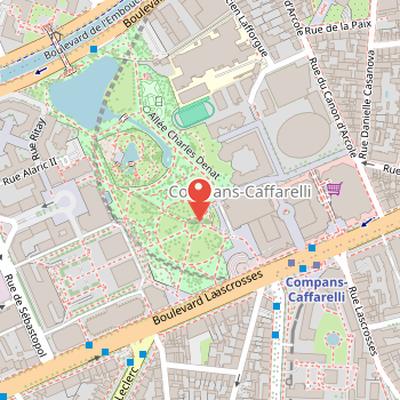
The Japanese Garden of Toulouse is a closed park located in the green space of the Compans-Caffarelli district. Designed by the bureau d'étude du service des jardins et des espaces verts as a place of meditation, it offers botanical varieties from the Far East in Toulouse. The garden is isolated from the rest of the park by greenery curtains and a hill, creating a distinct enclosed setting.
Its composition includes a mineral garden, a dry garden with a Crane island, a Turtle island, and nine rocks, as well as a lake, a tea pavilion, and a planted garden. Among its features are a dry waterfall, stepping stones, a lantern, a red bridge, a Paradise island, Mount Fuji, and the stones of the three saints. A red wooden bridge links an island symbolizing paradise. The garden is inspired by gardens created in Kyoto between the Muromachi and Edo periods. It also contains a bust of master Taisen Deshimaru, who founded many Zen dojos in France in the 1970s.
Nearby Objects
-
 Palais des sports André-Brouat 250 m away
 -
 Musée Saint-Raymond 700 m away
 -
 Saint-Pierre des Chartreux Church 750 m away
 -
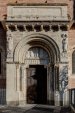 Porte Miègeville 750 m away
 -
 Basilica of St. Sernin 750 m away
Design and Features of the Japanese Garden
The Japanese Garden of Toulouse is a closed park located in the green space of the Compans-Caffarelli district. It was designed by the bureau d'etude du service des jardins et des espaces verts as a place for meditation, and it offers botanical varieties from the Far East in Toulouse. The garden is isolated from the rest of the park by greenery curtains and a hill, reinforcing its enclosed character.
Its layout is inspired by gardens created in Kyoto between the Muromachi and Edo periods. The site includes both mineral and planted compositions. Among its features are a mineral garden, a dry garden with a Crane island, a Turtle island, and nine rocks, as well as a lake, a tea pavilion, stepping stones, a lantern, a dry waterfall, a red bridge, a Paradise island, Mount Fuji, and the stones of the three saints. A red wooden bridge links an island symbolizing paradise.
The garden also contains a bust of master Taisen Deshimaru, who founded many Zen dojos in France in the 1970s.