Église Saint-Pierre des Chartreux de Toulouse was built for the Carthusian order, which generally did not settle in cities or open its doors to laypeople. After being expelled from the Notre-Dame de Bellevue Charterhouse near Castres, the Carthusians took refuge in Toulouse at the end of the 16th century. They obtained asylum from the Capitouls and financial support from the inhabitants for the construction of their church, with patrons receiving the right to attend services. Construction began in 1602 outside the walls of Toulouse. After the first dome fell in 1609, the building was raised, and the church was later consecrated by Cardinal François de Sourdis. The portal, sculpted in 1613 by Antoine Bachelier, leads to an atrium that once served as a buffer space between the street and the convent. The central nave is divided into a nave for the faithful and a choir formerly reserved for monks. After the Revolution, the convent was turned into an arsenal, and only the church and a few associated remains survive today. The building was damaged by the 2001 AZF factory explosion, and superficial cracks remain visible.
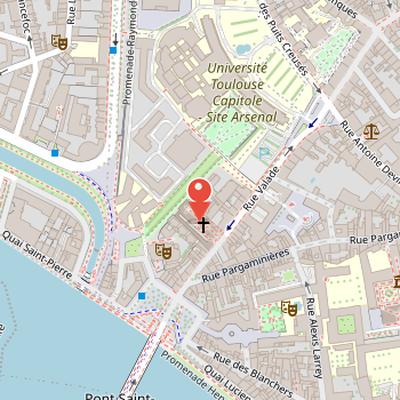
Nearby Objects
-
 Saint-Pierre des Cuisines 80 m away
 -
 Place Saint-Pierre 90 m away
 -
 Palace of the Visigoth Kings 200 m away
 -
 Toulouse Regional Conservatory 250 m away
 -
 Monastery of the Jacobins 350 m away
History and Later Uses
The Carthusian order generally avoided settling in cities and did not open its doors to laypeople, yet after being expelled from the Notre-Dame de Bellevue Charterhouse in Saix near Castres by Protestants, the Carthusians took refuge in Toulouse at the very end of the 16th century. Toulouse was a Catholic stronghold in a region largely supporting Protestantism. The Carthusians asked the Capitouls for asylum and sought financial support from the inhabitants of Toulouse for construction work. In return, patrons received the right to access the church to celebrate services.
Construction of the church began in 1602 and was planned outside the walls of Toulouse. After the first dome fell in 1609, the building was raised. Cardinal Francois de Sourdis consecrated the church. In 1780, the Carthusians renewed the transept decor, replacing a frescoed ceiling, and commissioned a new high altar.
After the Revolution, the monks were expelled and the convent was converted into an arsenal. Today, only the church, the old pharmacy, parts of the hospice including an exterior brick corridor, and part of the cloister remain. The church was damaged in 2001 by the AZF factory explosion, which required reinforcement work, and superficial cracks are still visible. In September 2007, the Saint-Pierre parish was merged into the Saint-Sernin parish grouping, and the Saint-Pierre church became the seat of the Toulouse student parish, a personal non-territorial parish.
Interior Layout and Notable Features
The portal of Saint-Pierre des Chartreux was sculpted in 1613 by Antoine Bachelier, son of Nicolas Bachelier, and it opens onto a large atrium that once served as a buffer space between the street and the convent. This atrium now contains the parish war memorial and is used for parish activities such as concerts, conferences, and exhibitions. The church interior is arranged to accommodate the public: the central nave is divided into two parts by a double-sided main altar. One part, the nave des fideles, is accessible to all, while the choir, called the nef des moines, was formerly reserved for monks. On the left side of the nave des fideles are three chapels dedicated to the souls in Purgatory, the Sacred Heart, and Our Lady of the Rosary. On the right side are three more chapels dedicated to baptism, Our Lady of Sorrows with a one-piece stone Pieta, and Saint Peter. The chapel walls and ceilings are painted with neo-Renaissance motifs, probably added after the Revolution, and a high row of windows above the chapels provides light without stained glass.
Among the furnishings, the nave contains an eighteenth-century pulpit brought from the church of Saint-Pierre des Cuisines during the Revolution. Its decoration includes the contours of an image showing a boat hull sailing on a globe, symbolizing Saint Peter, although the figure itself is now missing. The nave also holds several paintings, including The Adoration of the Shepherds by Jean-Baptiste Despax and a portrait of a cardinal-archbishop of Toulouse. The double-faced grand altar, which separates the public and monastic spaces, was formerly adorned with a large altarpiece now visible in the church of Saint-Bruno de Roquettes. The church also includes two monumental white Carrara marble angels sculpted by François Lucas, one masculine and one feminine, inspired by drawings and molds from his trip to Rome. In the Sainte-Croix chapel under the organ loft, there are wood sculptures by Artus Legoust and his workshop dating from the early seventeenth century.
The Church Carillon
The church has a carillon that was restored in 2023 and inaugurated by Mael Proudom, carillonneur of the Saint-Sernin basilica. It is manually operated and is described as the only carillon in the city. The bells are rung daily at Angelus and at 7 pm by volunteer students. Since 2024, Corentin Pigout has served as both carillonneur and choir conductor.