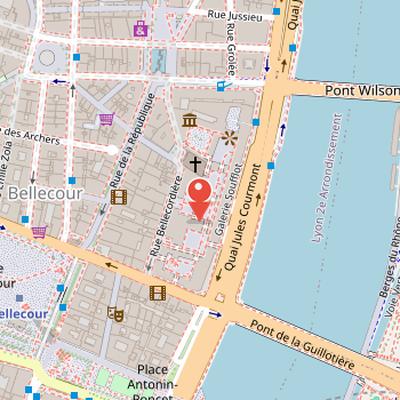
The Cité internationale de la gastronomie de Lyon is a cultural place entirely devoted to gastronomy, located in the Grand Hôtel-Dieu in Lyon. It belongs to the French network of four cities of gastronomy, alongside Dijon, Paris-Rungis, and Tours. This network was established after UNESCO inscribed the French gastronomic meal as intangible cultural heritage in 2010. The site’s thematic focus is the relationship between health and food.
The venue occupies part of the old Hôtel-Dieu de Lyon, dating from the seventeenth century, and has offered historical tours and temporary exhibitions. Its initial concept was proposed within a project initiated and led by the Métropole de Lyon in partnership with the Ville de Lyon and the State, with operation managed by the MagmaCultura group. The site closed with the first Covid-19 lockdown, later reopened in a redesigned version prepared by the Comité Rabelais. Its programming has included exhibitions such as Banquet ! and, in 2024, Microbiote, d'après le charme discret de l'intestin. It also hosted a space for the Biennale d'art Contemporain de Lyon until early 2025.
Nearby Objects
-
 Hôtel-Dieu de Lyon 0 m away
 -
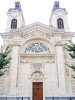 Chapelle de l’Hôtel-Dieu de Lyon 100 m away
 -
 Rue des Marronniers 200 m away
 -
 Veilleur de pierre 250 m away
 -
 Antonin-Poncet Square 250 m away
Cite Internationale de la Gastronomie de Lyon
The Cite Internationale de la Gastronomie de Lyon is a cultural site entirely devoted to gastronomy, located in the Grand Hotel-Dieu. It belongs to the network of four cities of gastronomy, alongside Dijon, Paris-Rungis, and Tours. It was created as one of the French cultural facilities with a tourism vocation established after UNESCO inscribed the French gastronomic meal as intangible cultural heritage in 2010.
The site focuses specifically on the link between health and food. It was inaugurated on an unspecified date, but later closed with the implementation of the first lockdown related to the Covid-19 pandemic. MagmaCultura, the operating company, then announced that it would not reopen because of the significant impacts caused by the coronavirus health crisis.
On a later unspecified date, the site reopened in a completely redesigned version. This relaunch was prepared by a committee of local specialists called the Comite Rabelais and supported by an annual endowment of an unspecified amount.
Operation, Exhibitions, and Public Reception
The operation of Histoire was initiated and led by the Metropole de Lyon in partnership with the Ville de Lyon and the State. Its concept was proposed, and its day-to-day management was entrusted to the MagmaCultura group after it won the Metropole de Lyon's tender. The project was financially supported by eleven patrons, including Groupe Seb, Apicil, Credit Agricole Centre-est, Dentressangle, Eiffage Construction, Elior, Institut Paul Bocuse, Meryieux Nutrisciences and bioMeryux, Metro France, Plastic Omnium, and Valrhona.
At the time of opening, Histoire expected visitors per year. Its initial reception was mixed, with some assessments calling for written or multimedia supports. The tasting experience was only accessible after paying the entrance fee to the spaces. Chef Regis Marcon also pointed to operational issues linked to scenography and exhibition clarity, and criticized the exhibition for lacking a popular direction and a clear guiding line, while noting that the children's area was successful.
The Metropole de Lyon later decided to reopen Histoire by modifying permanent exhibition rooms and installing a long-term temporary exhibit. The site hosted the exhibition Banquet !, dedicated to the inscription of the French gastronomic meal to UNESCO, before replacing it in 2024 with Microbiote, d'apres le charme discret de l'intestin. Until early 2025, Histoire also housed a space for the Biennale d'art Contemporain de Lyon. In parallel with these exhibition changes, it offered free monthly programming of conferences, workshops, festivals, and culinary activities. Since then, Histoire has been reserved for private events and is no longer accessible to the general public.
Heritage Spaces and Exhibitions
The Cité internationale de la gastronomie de Lyon occupied a space in the old part of the Hotel-Dieu de Lyon, a seventeenth century building. It offered a historical tour and temporary exhibitions, as well as cooking workshops, conferences, and an interactive area for children under 12 years old. Within the site, the altar and the chancel were exhibited under the dome of the Quatre-Rangs. The apothecaries of Charite and the old Hotel-Dieu hospital were preserved and restored, and three hundred pots were presented to visitors under the large dome. One of the displayed creations by Vincent Breed was a chandelier representing a plate and thirteen spoons, symbolizing the survival rate of patients at the Hotel-Dieu.