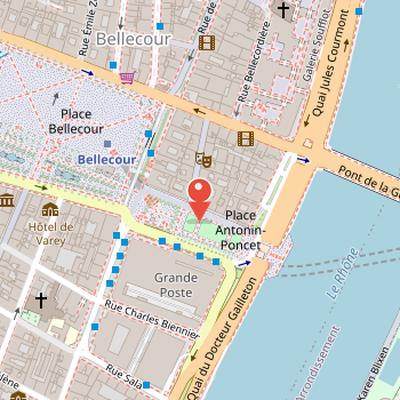
Antonin-Poncet Square is a square in the Bellecour quarter of the 2nd arrondissement of Lyon, France, near Place Bellecour. It lies on the Presqu'île between Place Bellecour and the Rhône and is part of a zone classified as a UNESCO World Heritage Site. Designed by landscaper Michel Bourne in 1990, the square has a rectangular form running east to west. It includes lawns, fountains, benches, and vegetation mainly composed of horse chestnuts, maples, and magnolias.
The square is bordered to the south by the post hotel, which replaced the Hôpital de la Charité in 1938. To the north are buildings by JF Desarnod with Lyon-style facades and ground-floor shops. The western part of the square was raised in 1980 and is edged by rows of lime trees, while this area also serves as a setting for many events. The square provides access to Rue des Marronniers and has stairs leading down to the Rhône river. At the river end stands The Flower Tree, a large floral artwork by Korean artist Jeong-Hwa Choi.
Nearby Objects
-
 Hôpital de la Charité de Lyon 80 m away
 -
 Rue des Marronniers 100 m away
 -
 Bellecour School 200 m away
 -
 Place Bellecour 250 m away
 -
 Veilleur de pierre 250 m away
Location and access
Place Antonin-Poncet is a square in the Bellecour quarter of the 2nd arrondissement of Lyon, France. It is located near Place Bellecour and is served by Bellecour metro station on lines A and D, as well as by many bus routes. The square lies within an area classified by UNESCO as a World Heritage Site, which places it in a protected urban heritage setting.
Location and Layout
Place Antonin-Poncet is located in the Presqu ile, between Place Bellecour and the Rhone. It has access to Rue des Marronniers, a pedestrian street known for many bouchons, and stairs leading down to the Rhone river. The square was designed by landscaper Michel Bourne in 1990 and has a rectangular form extending from east to west.
The southern edge of the square is bordered by the post hotel, which replaced the Hôpital de la Charite in 1938. The hotel was designed under the supervision of architect Michel Roux Spitz between 1935 and 1938. Its architecture is marked by long horizontal lines and it resembles the classical 18th century facades north of the square. The building also includes a 250-m2 wall painting by Louis Bouquet evoking the worldwide influence of Lyon through exchange and waves, as well as bas-reliefs at the entrances sculpted by Georges Salendre, JH Bardey, and Renard.
On the northern side, the buildings were made by JF Desarnod. They have Lyon-styled facades and a ground floor composed of trades.
Western Layout and Floral Artwork
The western part of Antonin-Poncet was elevated by 50 cm in 1980. It is bordered to the north and south by rows of lime trees, and it serves as the location for many events. The area includes lawns, fountains, and benches, with vegetation made up mainly of horse chestnuts, maples, and magnolias. At the end of the space next to the river stands a giant bunch of flowers artwork. This work, entitled The Flower Tree, was created by the Korean artist Jeong-Hwa Choi.
Historical Layers of Place Antonin-Poncet
Place Antonin-Poncet preserves several layers of urban history. Its best-known surviving feature is the bell tower of the old Hôpital de la Charite, a remnant of the hospital designed by the Jesuit architect Etienne Martellange in 1622. The bell tower was built by J. Abraham in 1665-66. The hospital itself was destroyed in 1934.
The square also witnessed ceremonial and civic events. In 1816, the History and Monuments commission erected a triumphal arch there, and Princess Caroline of Naples and Sicily passed beneath it before hearing a welcome speech by the Lyon mayor. The square later hosted other institutions and residents, including the offices of Le Salut Public at No. 18 in 1858, the king's commissioner Pierre-Thomas Rambaud in 1792, and the king's court adviser Devienne in 1834. Its name was changed from Place de la Charite by municipal council deliberation on 29 December 1913.
Resistance History and Memorial
Number 7 was a hotbed of resistance activities during the Vichy regime. Gynecologist Dr. Jean Rousset helped British agent Virginia Hall in these activities and used an insane asylum on the top floor to hide Allied pilots. He was arrested by the Germans on 7 November 1942, tortured, and survived the war. The square also contains a monument made of two steel plates, each two meters high. Inaugurated on 24 April 2006, it is a tribute to the victims of the Armenian genocide.
Civic Protection of the Plaza
On January 8, 2016, a civic initiative created the non profit organization Les Amis de la place Antonin Poncet. Its mission was defined as promoting the heritage and beauty of the Antonin Poncet plaza and preserving it as an exceptional public space. The initiative described the plaza as a unique doorway to the city of Lyon and as a symbol of the Art of Living in Lyon. It also worked to protect, maintain, and keep the plaza attractive in a helpful and friendly manner.
The organization collaborated with all public authorities and brought together citizens, including residents, firms, businesses, and professionals who live on or near the plaza. It also included all people who value the Antonin Poncet plaza as part of Lyon's identity.