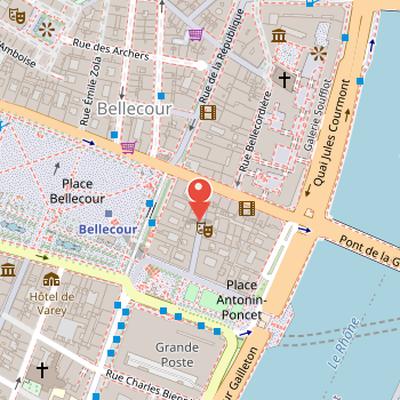
Rue des Marronniers is a small paved pedestrian street in the Bellecour quarter of Lyon’s 2nd arrondissement. It is associated with many bouchons and is served by the Bellecour metro station and several bus lines. The street belongs to a zone classified as a UNESCO World Heritage Site, which places it within a protected historic urban context.
Historically, the street was located near Place Bellecour and Place Antonin-Poncet. It was named after the trees that lined the square on its eastern side until the eighteenth century. Before taking its current name by consular decree of 30 September 1723, it was called Rue de Jérusalem and then Rue Neuve des Basses-brayes. The street was drawn in the early eighteenth century during the construction of buildings east of Place Bellecour. Its even-numbered buildings from 2 to 10 were built in 1714, demolished in 1793, and rebuilt in 1810. Since the late twentieth century, the street has been pedestrianized. Among its notable monuments, the Théâtre des Marronniers is described as the most famous.
Nearby Objects
-
 Antonin-Poncet Square 100 m away
 -
 Hôpital de la Charité de Lyon 140 m away
 -
 Veilleur de pierre 150 m away
 -
 Hôtel-Dieu de Lyon 200 m away
 -

Location and Heritage Context
Rue des Marronniers is located in the Bellecour quarter of the 2nd arrondissement of Lyon. It is a small paved pedestrian street known for its many bouchons. The street is served by the Bellecour metro station and by many bus lines, making it easily accessible within the city. It also belongs to a zone classified as a UNESCO World Heritage Site, which adds to its heritage significance.
History and urban development
Rue des Marronniers is located near Place Bellecour and Place Antonin-Poncet. Its name refers to the trees that lined the square on its eastern side until the eighteenth century. Before receiving its current name, it was called Rue de Jerusalem and then Rue Neuve des Basses-brayes. The present name was chosen by a consular decree of 30 September 1723. The street was drawn in the early eighteenth century during the construction of buildings to the east of Place Bellecour.
Several buildings on the street are associated with named builders. Pierre Gauthier participated in the construction of the building at No. 1, Marc-Antoine Trollier in the building at No. 5, Melchior Munet at No. 7, and Gabriel Rigod at No. 11. The even-numbered buildings from 2 to 10 were built in 1714, demolished in 1793, and rebuilt in 1810. In 1849, Dophile Laforest, who was mayor of Lyon and a member of the National Assembly, lived on the street. Rue des Marronniers became pedestrian in the late twentieth century.
Th catre and Traboule at No. 3 bis
Rue des Marronniers is especially associated with the Theatre des Marronniers, which is described as the street's most famous monument. A major theatrical presence developed there in the mid-20th century. In 1952, Roger Planchon created the Theatre de la Comedie at number 3 bis in a former locksmith's workshop. He was later succeeded by Marcel Marechal, who installed the Theatre du Cothurne. Several actors trained at the Theatre du Cothurne, including Pierre Arditi, Catherine Arditi, Marcel Bozonnet, Maurice Benichou, and Bernard Ballet. In 1986, the small theatre was converted into a cinema called CNP Bellecour, which is now open on Rue de la Barre. As of 2008, a Theatre des Marronniers still existed at number 7. The street also includes a traboule at No. 3 bis, which crosses four buildings. It begins with a porte-cochere and leads to the former Theatre des Marronniers. The traboule has two exits: one ends with a semicircular gate, a paved floor, and a Louis XVI-styled building, while the other is blocked and located higher up in the same three-story building.