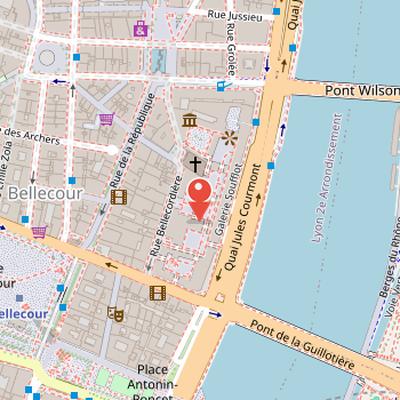
Hôtel-Dieu de Lyon is a historic building complex located on the peninsula of Lyon, on the west bank of the Rhône in the Bellecour district. It was formerly a hospital and is now a mixed-use site containing offices, shops, restaurants, museums, and a hotel. The entire building is classified as a historical monument by order.
The site has a long hospital history. Its first buildings are documented in 1184, and the institution took over a hospital role assigned by an earlier establishment created in 542. Historical accounts describe an earlier pilgrims’ house and hospital connected to the Rhône bridge, established in the late 12th century. In 1478, the municipality bought the hospital building and rebuilt it on a larger scale. The new hospital had a main building sixty-five meters long and could accommodate up to two hundred sick men or women. A chapel was added, connected to the wards and the street.
In 2007, services were transferred to other establishments so the exceptional building and site could be rented. The complex remained unused from 2010 to 2015 before major renovations, and it later reopened with new uses.
Nearby Objects
-

-
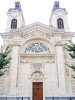 Chapelle de l’Hôtel-Dieu de Lyon 100 m away
 -
 Rue des Marronniers 200 m away
 -
 Veilleur de pierre 250 m away
 -
 Antonin-Poncet Square 250 m away
From Hospital to Mixed-Use Landmark
Htel-Dieu de Lyon is a historic building on the peninsula of Lyon, located on the west bank of the Rhne river in the Bellecour district. Although it is often identified with the citys medical history, it was not the first hospital in Lyon. Its first buildings are documented in 1184, and its hospital role was assigned by another establishment created in 542. That earlier institution, the hospital Notre-Dame de Lyon, was located at Saint Paul and was also known as Notre-Dame du Pont and Hpital Saint- Eoi before disappearing in the late century.
In 2007, it was decided to transfer the hospitals services to other establishments so that the exceptional building and site could be rented. The building then remained unused from 2010 to 2015 before major renovations were undertaken. It later reopened as a mixed-use complex with offices, shops, restaurants, museums, and a hotel. The reopened spaces include those occupied by InterContinental Hotels Group, shops, and the Cite de la Gastronomie. The entire building is classified as a historical monument by order.
From Pilgrims' House to Grand Hospital
The origins of the Hôtel-Dieu de Lyon lie in a brotherhood of Lyonnais bourgeois formed around the year 1000 to support pilgrimages and exchanges by providing shelter. This Order of the Pontifical Brothers built bridges and hospices for pilgrims, travelers, and wandering poor, and later these lodging places became hospitals. In Lyon, the Order began building the Guillotiere bridge over the Rhone in 1184-1185 and established a pilgrims' house that became the Hospital of the Rhone Bridge, the ancestor of the later Hotel-Dieu. The first hospital stood on land owned by the Archbishop of Lyon, opposite the first Rhone bridge and north of rue Merciere, under the invocation of Beatae Mariae. It was modest in scale, with a priory and a small church open to the needy. Maetre Martin Conras was appointed as the first doctor in 1454.
By 1478, population growth led the municipality to buy the building and rebuild it on a larger scale. The new hospital opened in 1493. Its main building was 65 meters long and could hold up to two hundred sick men or women. A chapel was added, linked both to the wards and to the street, while other parts of the complex served as annexes. Full completion, including a cemetery, passages for transient visitors, and a nursery for children, was reached by the mid 16th century. Later descriptions note that no part of this medieval Hotel-Dieu remained after the modifications of the 18th century.
In the 16th century, Lyon magistrates including Gadagne and Symphorien Champier decided to build a larger hospital at the present chapel site. This institution was named the Notre-Dame de la Pitie Hospital of the Rhone Bridge, or Grand Hotel-Dieu. Francois Rabelais was appointed doctor in 1532 and had about twenty nuns available, but he left suddenly in 1535, probably because of the Affair of the Placards. By 1622 the buildings were again too small, and they were demolished and replaced by new cross-shaped constructions arranged around a central dome, known as the Four-Ranks rooms. A new church was built on the site of the old building according to the designs of Guillaume Ducellet, and its foundation stone was laid on September 8, 1622, in the presence of Cardinal Alphonse-Louis du Plessis de Richelieu and the Marquis de Villeroy.
The institution continued to expand and remained under financial pressure. A building reserved for convalescents was constructed on the Rhone quays from 1658 to 1663. At the end of the century, long wars increased the number of beggars to one tenth of the population, while Louis XIV authorized three successive lotteries and granted new privileges to the Hotel-Dieu. Among its noted physicians were Claude Pons, who treated contagious patients and left all his property to the poor, Jean de Lamoniere, author of a Treatise on the plague, and Pierre Garnier, a respected medical writer who died in 1709.
Major rebuilding took place from 1741 to 1761 on the Rhone curtain walls according to plans by Soufflot. The resulting building was described by Joseph of Austria as a real hospital. It had an opulent white stone facade with rich exterior decoration. The large dome, begun in 1755 to renew the air in the huge common rooms, was completed in 1764. The main entrance was adorned with statues of King Childebert and Queen Ultrogothe, sculpted by Pierre-Marie Prost. These figures referred to the founders of the first hospital of Lyon in 549, located by the Saone in the Saint-Paul district. At that time, the Hotel-Dieu enjoyed an excellent reputation, and its mortality rate between 1737 and 1748 was one in fourteen, compared with one in four at the Hotel-Dieu of Paris.
Early Radiology at the Hotel-Dieu
The history of the Hotel-Dieu de Lyon is closely linked to the beginnings of radiology. Wilhelm Rontgen discovered X-rays in 1895, and the history presented here describes this technology as a donation to humanity. In Lyon, Etienne Destot carried out the first radiographies in 1897. He also established the first French radiology service at the Hotel-Dieu. Later in his career, Ollier frequently used radiology, showing the growing importance of the technique in medical practice at the hospital.
From Hospital Reforms to Wartime Damage
Between 1903 and 1909, Jules Courmont and Mayor Edouard Herriot planned the closure of the hospital and the partial demolition of the site. In 1936, the museum des Hospices civils de Lyon was created inside the Hotel-Dieu, and artworks from the hospital de la Charite were transferred there. During World War II, the building suffered several forms of damage. The destruction of the pont de la Guillotiere on September 23, 1944 caused the loss of some stained glass windows, and on September 26, 1944 the large dome caught fire and was destroyed after receiving gunfire. Funds were released in the 1960s to rebuild the dome. Despite these events, the Hotel-Dieu continued its medical activity in the second half of the twentieth century, including many births in the hospices civils de Lyon and the creation of digestive surgery and diabetology services.
Privatisation and Reuse of Hotel-Dieu
L'Hotel-Dieu was a hospital-university center dependent on Hospices Civils de Lyon before it was definitively closed, with its services transferred to other Hospices Civils de Lyon establishments. Renovation works began in 2015, and the site was then developed under the name Grand Hotel-Dieu, combining office space, commercial units, a hotel, and a gastronomy city. According to the stated plan, the ground floors were assigned commercial activities in line with Soufflot's plans, while the rest of the site was occupied by tertiary activities and a convention center. The internal courtyards were also opened to the public.
The steering committee announced a retained team composed of Eiffage Construction, Generim, Albert Constantin, Didier Repellin, and InterContinental. The site included a partial conversion into a 5-star luxury hotel with entrance via the central dome, and the opening of the 5-star InterContinental Lyon - Hotel Dieu along the main facade with the bar Le Dome under Soufflot's dome. The international city of gastronomy of Lyon opened around the dome des Quatre-Rangs in the old 18th century buildings, but it closed on 15 November 2021 because of the Covid-19 crisis. A new version, managed by the metropolis, opened in 2022.
The hospital also housed the museum of Hospices Civils de Lyon, which closed definitively at the end of 2014. A project exists to reinstall a large medical and anatomical museum, bringing together collections including those of Musee Testut-Latarjet, and it could become one of the largest medical museums in France. Public access has become a major part of the site, with an estimated seven million visitors possible each year. The official public opening took place with a two-month festival program, and 4.8 million visitors attended during the first year.
Chapels, Courtyards, and Courtyard Facades
The available images present several distinct parts of the Hotel-Dieu de Lyon, showing both exterior and interior spaces. They include an overview of Lyon identified as Vue d'ensemble, as well as the exterior and interior of the chapelle de l'Hotel-Dieu de Lyon, referred to as Chapelle. One image highlights a pulpit by Marc Chabry inside the chapel, indicating the presence of notable interior furnishing or ornamentation.
The complex is also represented through a number of named courtyard and facade views. These include the facade on Cour Saint-Henri, including a view of its north-east side, and the facade on Cour Saint-Martin. The entrance to the cour d'honneur is shown together with the dome of the entrance viewed from inside. The cour d'honneur itself appears as a tree-lined space with flowerbeds, and Cour Sainte-Elisabeth is also depicted. In addition, the ornamentation of a fountain in an interior courtyard is shown.
Other images document later or associated features at the site, such as Le Dome bar at the Hotel-Dieu de Lyon and the statue of Amédee Bonnet. Together, these views present the Hotel-Dieu de Lyon as a site with multiple architectural layers, interior spaces, and courtyard settings.