Église Saint-Martin d'Angers is an ancient collegiate church located in the historic center of Angers. It is considered one of the best preserved Carolingian monuments in France and stands as a testimony to fifteen centuries of architectural evolution. Its choir is a notable example of Angevin Gothic style.
The building reflects several major phases of reconstruction and enlargement. In the 10th and 11th centuries, work associated with Count Foulques Nerra of Anjou and his wife Hildegarde led to the establishment of 13 canons at Saint-Martin and the installation of a dome at the transept crossing. Around the middle of the 12th century, the Carolingian choir was transformed in Gothic style. A second campaign of works later enlarged the collegiate church with a second bay and an apse in Angevin or Plantagenet Gothic style. At the beginning of the 13th century, the former High Middle Ages chapel was expanded and became known as the Chapelle des Anges. The church also preserves remnants of its original painted decor and a rich collection of capitals.
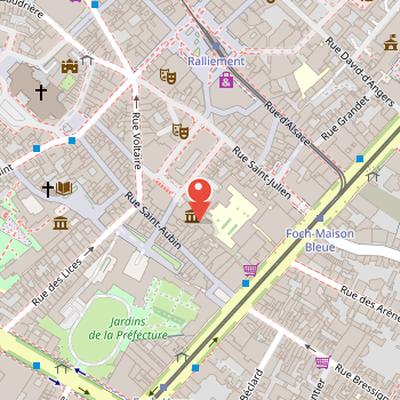
Nearby Objects
-
 Abbaye Saint-Aubin 130 m away
 -
 Musée des Beaux-Arts d'Angers 200 m away
 -
 Grand Théâtre d'Angers 250 m away
 -
 Place du Ralliement 250 m away
 -
 Angers Cathedral 300 m away
A Carolingian Monument in Angers
The Church of Saint Martin of Angers is an ancient collegiate church located in the historic center of Angers. It is regarded as one of the best preserved Carolingian monuments in France, and it stands as a testimony to fifteen centuries of architectural evolution. Its choir is also a notable example of Angevin Gothic style, adding to the church's importance as a site of architectural and historical interest.
Reconstruction and Romanesque Features
In the 10th and 11th centuries, the church was reconstructed with four large arches at the transept crossing, alternating tuff stones and bricks. This work was associated with the period shaped by Count Foulques Nerra of Anjou and his wife Hildegarde, who established 13 canons at Saint-Martin. At the count's command, a dome was also installed at the transept crossing, adding a distinct architectural feature to the building.
Gothic Transformations of the Collegiate Church
During the Gothic period, the collegiate church underwent a major transformation. Around the middle of the 12th century, the Carolingian choir was rebuilt in Gothic style, and a second campaign of works enlarged the church further. This later phase added a second bay and an apse in Angevin, or Plantagenet, Gothic style, a form marked by the bulging appearance of its vaults. At the beginning of the 13th century, the former High Middle Ages chapel was also enlarged and later came to be known as the Chapelle des Anges because of its remarkable decor. The Gothic reconstruction ended with the transformation of this chapel. Although much of the original painted decor was lost, remnants were preserved. At the beginning of the last century, the paintings were still recorded as including the Massacre of the Innocents and the Adoration of the Magi, while only the Virgin and the Child Jesus remained clearly distinguishable. The chapel also contains a rich collection of capitals, now highlighted by current lighting.
Royal Patronage in the 15th Century
In the second half of the 15th century, King Rene, described as the founder and patron of the church, supported a campaign of improvements to the collegiate church. He financed the raising of the transept walls and paid for the installation of a paneled frame on each arm of the transept. His arms and emblems were also placed on the paneling. In addition, he commissioned a decorative campaign in which the walls were covered with stonework imitation and emblematic warming pans.
From Abandonment to Cultural Venue
After the French Revolution, the chapter of canons was suppressed, and the church entered a period of abandonment. It was then used as a warehouse for confiscated books for the town hall, before being sold to private individuals. Over time, the building was repurposed for practical storage, serving as a firewood store and as a warehouse for tobacco industries. During this period, the church deteriorated rapidly: the nave roof disappeared, as did the upper floor of the bell tower, the remains of the cloister, and part of the facade. Buildings were also constructed in front of the church and in the former nave.
The eastern part of the building belonged to Externat Saint-Maurille from 1902 to 1903 and again until 1986. During this time, canon Pinier, superior of the Externat, carried out some excavations. The building was used for meetings, award ceremonies, theater performances, and festive meals before its reconsecration. In 1986, the school association sold the church to the Maine-et-Loire department for one franc, and the department acquired the collegiate church of Saint-Martin. The church was desacralized in 2006 and converted into a venue for performances and visits after twenty years of rehabilitation work and archaeological studies. It now offers the public a cultural space including several dozen Angevin statues, and it is classified as a historic monument.