Abbaye Saint-Aubin d'Angers is an ancient abbey in Angers, in Maine-et-Loire, Pays de la Loire. It originated as a funerary basilica built between 529 and 550 to house the tomb of Bishop Aubin. Aubin was first buried in a small cell while a larger basilica was completed between 550 and 576, and the new building was soon called Saint-Aubin, as mentioned by Grégoire de Tours in Dix Livres d'histoire. By the 7th century, the funerary basilica had become a monastery, and monastic activity is suggested by references from 616. The site later housed a canonical community before monks returned in 966 during a reform of the establishment. The abbey monks were dispersed by the French Revolution. The abbey church was destroyed in 1811 to create the present Place Michel-Debré, while the cloister was integrated into the new prefecture hotel of Maine-et-Loire. The fortified bell tower, known as the Saint-Aubin tower, remains visible on rue des Lices and continues to mark the historic site.
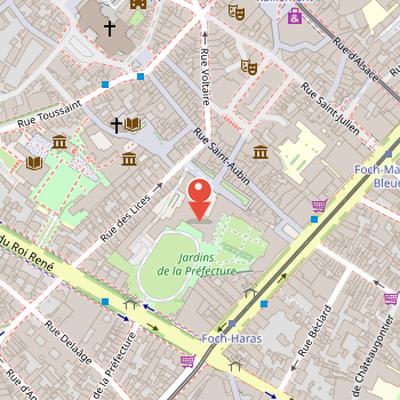
Nearby Objects
-
 Église Saint-Martin d'Angers 130 m away
 -
 Musée des Beaux-Arts d'Angers 140 m away
 -
 Galerie David d'Angers 250 m away
 -
 Angers Cathedral 300 m away
 -
 Grand Théâtre d'Angers 350 m away
Abbey History in Angers
Abbaye Saint Aubin d'Angers, also referred to as L'abbaye Saint-Aubin, is an ancient abbey located in Angers, in the department of Maine-et-Loire, within the Pays de la Loire region. The abbey was founded at an unspecified time, but its early history is not further detailed in the available facts. It was dispersed during the French Revolution, marking a major change in its institutional history.
From Funerary Basilica to Abbey
The origins of the Abbaye Saint Aubin d'Angers lie in a funerary basilica built between 529 and 550 to house the tomb of Bishop Aubin. Aubin was first buried in a small cell while a larger basilica was completed between 550 and 576, and this new church was soon called Saint-Aubin, as noted by Gregoire de Tours in Dix Livres d'histoire. By the 7th century, the funerary basilica had become a monastery. The monastic presence is also suggested by references from Bishop Bertrand du Mans and the author of Vita S. Magnobodi in 616.
Archaeological excavations in 1997 at Logis Barrault found that the courtyard area was free of housing and contained some graves from this period. This space has been interpreted as the enclosure of the Saint-Aubin abbey. Around the 9th century or early 10th century, monks were replaced by a canonical community. The site also played a political role: between 818 and 820, it held Bishop Theodulf of Orleans until his death.
The abbey regained its status in 966, when monks returned during a reform of the establishment. The monks were later dispersed by the French Revolution. The abbey church was destroyed in 1811 to create what is now Place Michel-Debre, while the cloister was incorporated into the new prefecture hotel of Maine-et-Loire. Today, the fortified bell tower, known as the Saint-Aubin tower, remains visible on rue des Lices.
The Saint-Aubin Tower and its Changing Uses
Erected in the 12th century, the Saint-Aubin Tower stands outside the abbey itself and rises to a height of 41 meters, dominating the city of Angers. In the Middle Ages, it served as a watchtower and formed a small fortress with loopholes and a well. Over time, the tower fell into ruin through weathering and multiple uses. Its belfry, campanile, and roof were destroyed in the 19th century, and it was later turned into a lead tower for making hunting pellets.
Despite this decline, the tower received official recognition as a Monument historique in 1862. Further protections followed through classification and inscription in 1901, 1904, 1968, and 2007. During the first half of the 20th century, the building housed the museum of industry and a meteorological observatory. It currently hosts temporary art exhibitions, continuing a long history of adapted use within the urban landscape of Angers.
The Cloister of Saint-Aubin Abbey
The cloister of Saint-Aubin Abbey stood on the site of the present prefecture of Maine-et-Loire. It was built at the initiative of Robert de La Tour-Landry, abbot of Saint-Aubin from 1127 to 1154, and its twelve arcades date from the 12th century. Today, only the eastern gallery remains, together with the door of the chapter house and two series of arcades on each side.
The surviving cloister elements show a carefully organized Romanesque design. On the northern side, the arcades are arranged in two triplets of three arcades each. On the southern side, they consist of paired windows placed under three framing arcades. The chapter house door has three rolls of archivolts. The capitals on the cloister side represent episodes from the story of Samson, while the corner scenes under the southern archivolts show the Virgin in majesty and the story of David and Goliath. A painted composition associated with the Virgin in majesty, surrounded by two angels, includes the Magi showing the star and heading toward Jerusalem on the right, Herod ordering the Massacre of the Innocents on the left, and Jerusalem symbolized in the center under the representation of the Virgin.
In the 15th century, monks who wanted to cover the cloister with a Gothic vault caused damage to the Romanesque sculptures. The buildings were then rebuilt from 1668 to 1692. The arcades that remain in the courtyard of the prefecture of Angers and in a ground floor room of the central building were classified as Historic Monuments on July 28, 1911.