Le Grand Théâtre d'Angers is a performance hall in the city centre of Angers, Maine-et-Loire, located on Place du Ralliement. It serves as a municipal theatre and a major venue for performances in the city. The auditorium has 723 seats and follows an Italian-style theatre design. The building is used for music, theatre, and opera, and it also hosts exhibitions and other events.
A theatre has existed in Angers since the Gallo-Roman era. A municipal theatre was built in 1794 in the old Grandes Écoles at Place du Ralliement. After a fire destroyed that building, the municipality decided to reconstruct it starting in 1867, under Alphonse Botrel and then Auguste Magne. The new building was inaugurated in 1871 and included a vestibule, performance hall, stage, and backstage lodges. Two cafés were completed the following year, forming a complex. The building was renovated in 1957, 1981, and 1993. It has been used for opera and other cultural events, including exhibitions and meetings.
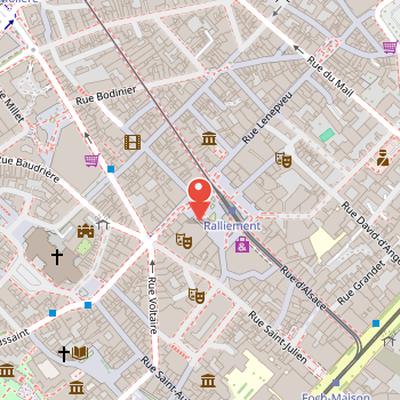
Nearby Objects
-
 Place du Ralliement 40 m away
 -
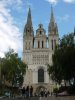 Angers Cathedral 200 m away
 -
 Église Saint-Martin d'Angers 250 m away
 -
 Musée des Beaux-Arts d'Angers 300 m away
 -
 Abbaye Saint-Aubin 350 m away
Le Grand Theatre in Angers
Le Grand Theatre d Angers is located in Maine-et-Loire, in the city center on Place du Ralliement. It is a municipal theater and serves as one of the main venues for performances in the city. The building has 723 seats and follows an Italian-style theater design. It hosts a range of performances, including music, theater, and opera.
History of the Grand Theatre in Angers
A theater has been recorded in Angers since the Gallo-Roman era, and a municipal theater was built in 1794 in the old Grandes Ecoles at place du Ralliement. In the 19th century, Angers also had significant musical activity, with several ensembles developing. A fire destroyed the building on the night of 4th to an unspecified day, after which the municipality decided in 1867 to reconstruct it. The rebuilding was led first by Alphonse Botrel and then by Auguste Magne. The new building was inaugurated in 1871.
The rebuilt theater consisted of a vestibule, a performance hall, a stage, and backstage lodges. The following year, two cafes were completed, forming a complex. In the late 19th century, the orchestra of the Association artistique d'Anger conducted the theater's lyrical season. The troupe compositions recorded for 1879 to 1880 and 1880 to 1881 show a structured organization including administration, choristers, actors, and musicians. The building was later renovated several times, in 1957, 1981, and 1993.
Programming and Cultural Use
Since its creation in 2003, the theater has hosted Angers-Nantes Opera in residence. Its programming has included operas by Angers-Nantes Opera and chamber music by the Amarillis ensemble, including in the 2014-2015 season. The theater also serves as a venue for exhibitions and other events. Recorded activities include a 1999 exhibition of paintings by the Spanish painter Laurent Jimenez-Balaguer, a photography exhibition at an unspecified date, and events in 2014 such as writer meetings, Fete de la Science, Nuit des Chercheurs, and film screenings for the Premiers Plans and Cinemas d'Afrique festivals.
Architectural Design of the Grand Theatre
The Grand Theatre was constructed using tuffeau and dressed stone in medium and large sizes. Its design is organized into three bodies, with the two lateral bodies set slightly back from the main body. The ground floor is marked by a hall vestibule and two fluted columns with Ionic capitals. Between the ground floor and the first floor, masks representing tragedy and comedy create a clear decorative transition.
The first floor is defined by fluted columns with Corinthian capitals and large windows. Between these windows are niches containing statues of muses representing lyric poetry, comedy, tragedy, and music from left to right. The upper part of the building is finished with a semicircular pediment decorated with the arms of the city of Angers. A thermal window is framed by allegories on both sides: on the right, cherubs represent fame, eloquence, and history, while on the left, cherubs represent satire, music, and drama.
Architectural Layout
The Grand Theatre, inaugurated in 1871, is described through its internal arrangement of performance spaces and support areas. It includes a vestibule and a large foyer, which form part of the public circulation areas. The building also contains a performance hall and a stage equipped with machinery. Behind the scenes, the theater has backstage areas made up of dressing rooms and administrative sections. The stage is defined by its width between the walls and its height under the grid, indicating the technical dimensions of the performance space.
Theater Administration and Leadership
From 1972 to 1978, the administration was headed by the municipal theater and the National Choreographic and Lyric Center. In 2014, Anne Mouly directed the theater. After her departure for the citys cultural direction, Brigitte Livenais served as interim director. Jean-Jacques Garnier later became director of the theater, as well as of two other Angevin theaters, the Claude-Chabrol hall and the Chanzy theater.
Cultural Partners and Shared Use
In the early 2020s, the Grand Theatre was part of a network of cultural partners in Angers that included Angers Nantes Opera, the regional conservatory, Le Quai, Nouveau theatre d Angers, and the Centre national de danse contemporaine. These organizations used the Grand Theatre alongside other city venues in shared programming and performances. Angers Nantes Opera performed in Nantes and Angers at both the Grand Theatre and Le Quai. The regional conservatory also presented activities at multiple locations, including the Grand Theatre, Le Quai, and theatre Chanzy. Le Quai, inaugurated in 2007, shared programming with the Grand Theatre, while the Centre national de danse contemporaine organized events at both venues. Nouveau theatre d Angers, housed at Le Quai since 2007, also used the Grand Theatre, THV Saint Barthelemy, and the castle of Angers.