The Musée des Beaux-Arts d'Angers is an art museum located in Angers, in the historic private mansion known as Logis Barrault. It stands at place Saint-Éloi, near the city’s historic center, and is part of the Toussaint complex, alongside the jardin des beaux-arts, the Galerie David d’Angers, and the municipal library. The museum presents a collection of artworks acquired over centuries.
Its history is closely linked to the city’s cultural institutions. The collections were transferred to the Logis Barrault in 1797, and the museum became municipal in 1805, with the collection belonging to the city of Angers. The building and institution were affected by war damage in 1944, followed by reorganization and reopening in 1950. More recent restoration work has aimed to combine historical character, modern museography, and visitor comfort. The museum is administered by the city hall of Angers and is classified and controlled by the Ministry of Culture.
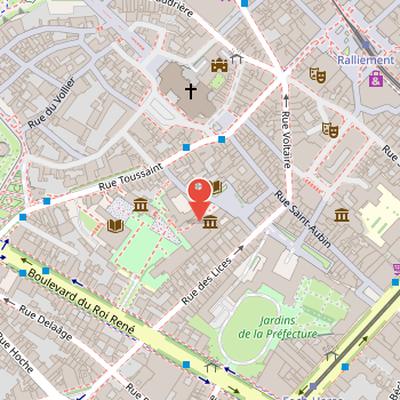
Nearby Objects
-
 Galerie David d'Angers 90 m away
 -
 Abbaye Saint-Aubin 140 m away
 -
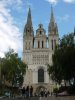 Angers Cathedral 200 m away
 -
 Église Saint-Martin d'Angers 200 m away
 -
 Grand Théâtre d'Angers 300 m away
Setting and Museum Status
The Musee des Beaux-Arts d'Angers is an art museum in Angers housed in the old private mansion known as logis Barrault. It is located at Place Saint-Eloi, near the historic city center, and forms part of the Toussaint complex together with the jardin des beaux-arts, the galerie David d'Angers, and the municipal library. The museum displays a collection of artworks acquired over centuries across a total surface area not specified in the provided facts. It has undergone recent restorations intended to combine historical character, modern museography, and visitor comfort. The museum is administered by the city hall of Angers and is classified and controlled by the Ministry of Culture. In 2010, Journal des arts ranked it the best museum in the Grand Ouest and the tenth museum in France outside Paris.
History and Development
In 1797, the institution was transferred to the hotel particulier of Logis Barrault in Maine-et-Loire. It opened as the museum of the Ecole centrale de Maine-et-Loire, following the model of the Louvre museum. In 1805, it preserved the painting museum and added a natural history cabinet and the municipal library in Angers. That same year, it became a municipal museum, with its collection belonging to the city of Angers.
The museum later initiated enlargement projects and the creation of a new public entrance, but these plans failed. It was damaged by war in 1944 and classified among provincial museums in 1946. From 1949, it was reorganized and reopened in 1950, although it then had limited ability to display its collections.
A redevelopment project was planned by the city in 1977. This plan included moving the municipal library and transferring the David d'Angers gallery in 1980. The new David d'Angers gallery was inaugurated by Francois Mitterrand in 1984. In 1998, the city approved a scientific and cultural project presented by Patrick Le Nouene. Between 1999 and 2004, the museum was associated with the opening of the musee-chateau de Villeveque. In later years, the institution continued to attract visitors, including a rise in total attendance across its five museums in Angers in 2011. It also welcomed nearly visitors during anniversary and Nuit des musees events in May, and in 2014 it was ranked first by the Journal des arts among 139 French city museums in the 100000 to 200000 population range.
Notable Works and Provenance
The Musee des Beaux-Arts d'Angers, through its Vie des collections, is associated with several works of notable provenance and recovery. In 2007, Vie des collections recovered a stolen painting, a fragment of Triomphe du peuple francais (1799) by Philippe-Auguste Hennequin. In 2013, it launched a subscription to acquire a painting by Jean-Baptiste Le Prince. The collection also includes seven looted paintings identified as MNR (Musees nationaux Recuperation) from World War II. Among its displayed works is a painting attributed to Sandro Botticelli, La Vierge, saint Jean-Baptiste et un ange adorant l'Enfant Jesus, as well as a similar subject by Domenico di Zanobi. Another painting, Le Siege de Carthage par Scipion Emilien by a 15th-century Florentine artist, was returned by Culture Minister Rima Abdul Malak to the heirs of Agathe and Ernst Saulmann.
The Museum Collections
The collections of the Musee des Beaux-Arts d'Angers originate from numerous donations, bequests, acquisitions, and deposits, and are presented in the museum's historic rooms. Around 900 works are displayed in these spaces, including approximately 150 pieces that underwent fundamental restoration during the renovations. The collections are organized into two distinct permanent routes. They offer a rich range of paintings, punctuated by art objects and sculptures, and trace artistic movements from the 14th to the 18th century. On the first floor, two restored rooms are dedicated to 14th century Primitives, including French, Italian, and Flemish works, as well as to art objects from the late Middle Ages and the Renaissance. The collections also include works from the Northern schools of the 16th century, as well as French and Italian schools of the 17th century.
Collection Highlights
The Musee des Beaux-Arts d'Angers holds a collection with works spanning several centuries, including pieces by Segna di Bonaventura, Benvenuto Tisi, Jehan Bellegambe, and Jan Brueghel the Elder. The collection also contains works by Hendrick van Balen, Frans Francken II, Jacob Jordaens, Nicolaes Berchem, Jan Asselyn, Jan van Kessel, Willem van Mieris, Jacob van Ruisdael, and Theodoor van Thulden. Other represented artists include Jacob van Es, David Teniers the Younger, Philippe de Champaigne, Charles Le Brun, Charles de La Fosse, Jacques Stella, Pierre Mignard, Antoine Coypel, Sisto Badalocchio, and Pier Francesco Mola, as well as Giovan Battista Vanni, Lorenzo Lippi, Luca Giordano, Francesco Solimena, Francesco Guardi, and Giambattista Tiepolo.
Among the named works are Segna di Bonaventura's Christ du Jugement dernier, circa 1305; an anonymous Crucifixion from 1380; an anonymous La Vierge a l'Enfant Jesus, circa 1450; and an anonymous La Vierge et saint Jean-Baptiste adorant l'Enfant Jesus, circa 1480. The museum also includes Jehan Bellegambe's Triptyque de la vierge et l'Enfant, circa 1505, an unknown Portrait d'Agnes Sorel, Lorenzo Lippi's Allegorie de la Simulation, circa 1640, and Giambattista Tiepolo's Apotheose de la maison Pisani, 1760. These holdings indicate a collection that ranges from early religious works to later allegorical and portrait subjects.
Painting Collections from the 18th to the 20th Century
The museum's collections include a substantial range of French painting from the 18th century onward. They exhibit artworks from the reigns of Louis XV and Louis XVI, and hold major paintings from the first half of the 18th century. Among the artists represented are Antoine Watteau, Alexandre-Francois Desportes, Charles Andre van Loo, Francois Boucher, Jean-Francois de Troy, Noel Halle, Nicolas Lancret, and Jean-Baptiste Pater. The collection also includes several works by Jean-Honore Fragonard, including the sketches La Poursuite, La Surprise, and La Nymphe Io, as well as the paintings Cephale et Procris, Jupiter, sous les traits de Diane, seduit Callisto, and Corésus et Callirrhoé. Other 18th-century and early 19th-century artists represented include Jean Siméon Chardin, Jean-Baptiste Greuze, Hubert Robert, Francois-André Vincent, Jacques-Louis David, Louis Lafitte, Joseph-Marie Vien, and the famous bust of Voltaire by Jean-Antoine Houdon. The collections also present artworks from the first half of the 19th century by Ingres, Pierre-Narcisse Guerin, Jean-Baptiste Camille Corot, Ary Scheffer, and Eugene Devéria, along with works by Pierre Puvis de Chavannes. In addition, a large room on the first floor is dedicated to modern art and contemporary art, while the Gumery room on the ground floor displays large format paintings and sculptures. The museum includes large academic formats of the 19th century by Pierre-Narcisse Guerin and Henri Gervex, works by Eugene Boudin, Jules-Eugene Lenepveu, Johan Barthold Jongkind, Alfred Sisley, Henri Lebasque, and Albert Lebourg from the second half of the 19th century, and 20th-century works by Maurice Denis, Maxime Maufra, Louis Valtat, Alexis Merodack-Jeaneau, Francois Morellet, Jean-Pierre Pincemin, and Daniel Tremblay.
Archaeology and Urban History in the Collections
The collections incorporate material from the former Museum of Antiquities, together with excavations and acquisitions from Angers, forming a gallery of archaeological objects and decorative arts. They present the development of the city from its origins to contemporary urban planning projects, and show, through archaeological discoveries, early traces of occupation in the Neolithic period and the creation of the Gallo-Roman city of Juliomagus.
Among the objects on display are the Protom de griffon, a bronze from around 600 BC, and a limestone lion-guardian that once stood at the entrance to a funerary monument from the 1st century AD. The collections also include the polychrome mosaic called du ralliement, decorated with geometric and floral motifs from the end of the 3rd century AD, a model of a Gallo-Roman potter's kiln, and a map of Juliomagus in the High Empire period based on archaeological discoveries.
Later periods are represented by a 19th-century painting of the Grohan amphitheater by Marie-Louis-Claude Coulet de Beauregard, as well as lapidary fragments and wooden elements that illustrate the sculpted decoration of churches and timber-framed houses. The collections also document social, economic, and cultural life through portraits, city views, and photographs.
Drawings and Graphic Arts Collections
The museum's cabinet d arts graphiques conserves more than 13,500 drawings, making the graphic arts holdings one of the most notable parts of the collections. The old drawing fund is regarded as prestigious because of the artists represented and the provenances of the sheets. It includes works that once belonged to collectors such as Everhard Jabach, Pierre-Louis Eveillard de Lievois, Louis Antoine Crozat, Pierre-Jean Mariette, and Joshua Reynolds.
The collections bring together three distinct funds from the Museum de l Ecole Centrale de Maine-et-Loire, the musee des Antiquites, and the musee Turpin de Crisse. They also preserve a significant legacy of drawings from Lancelot Theodore Turpin de Crisse and about 300 drawings from the legacy of Etienne de Saint Genys. Other donations and bequests include drawings and works from Flore Bodinier, works from David d Angers's collection bequeathed by his spouse and children, and drawings bequeathed by Auguste Michel, Adrien Recouvreur, and Henry Jouin. The collection was also studied by Adrien Recouvreur and Henry de Morant, and later promoted by Viviane Huchard, Patrick Le Nouene, and Ariane James Sarazin.
The museum's graphic arts holdings are especially rich in drawings by David d Angers, with more than 3,900 works. They also include works by Guillaume Bodinier, and the collections are represented by artists such as David d Anger, Lancelot Theodore Turpin de Crisse, Guillaume Bodinier, and Jules Eugene Lenepveu. Among the notable works are two paintings of the Treilles bridge in 1859 by G. Clarkson Stanfield, a masterpiece titled Isaac promising his blessing to Jacob by Rembrandt, Deux prisonniers enchains by Pierre Paul Rubens after Francesco Salviati, and a portrait of Rubens by Cornelis Schut.
The cabinet des arts graphiques preserves nearly one hundred sheets from the Renaissance to the Baroque, mainly from the Turpin de Crisse and Saint Genys collections. These include works by Timoteo Viti, Giulio Romano, Giulio Campi, Nicola dell Abate, Battista Franco, Pelegrino Tibaldi, Taddeo Zuccaro, Ricci di Novara, Cavalier d Arpin, Ottavio Mario Leoni, Giovanni Francesco Grimaldi, Pietro Testa, Domenico Piola, Luca Giordano, Francesco Solimena, Giovanni Paolo Pannini, as well as several works of Parmesan and Guerchin and copies of works by Michel Ange, Salviati, and Tadeo Zuccaro. The cabinet d arts graphiques also includes works by Van Dyck, Pieter Bout, Abraham Bloemaert, Jan van Goyen, Isaac van Ostade, Barend Fabritius, Willem van de Velde, and Adriaen van de Velde. In 19th-century holdings, the Turpin de Crisse collection added works by Gegard, Girodet, Ingres, Percier, Delacroix, and Gericault. The collections have been re-catalogued and digitized and are accessible on Micromusee via the museum's website.
Temporary Exhibitions
The Musee des Beaux-Arts d'Angers presents two or three temporary exhibitions each year in its temporary exhibition room. These exhibitions have included shows devoted to Niki de Saint Phalle in 2004 and Francois Morellet in 2006. The museum also stages some exhibitions within the permanent collections route, including one by Agnes Thurnauer in 2008. In addition to these displays, the museum organizes temporary archaeology exhibitions and has developed a number of themed exhibitions over time. Among the documented projects are Cent dessins des musees d'Angers, presented in Angers in 1978, and La Fabrique de l'oeuvre : dessins des musees d'Angers, organized in Angers in 2015. Other exhibitions organized by the museum include Splendeurs medievales, la collection Duclaux revelee, Alexis Merodack-Jeaneau, en quete de modernite, Au temps des faluns, 1870 une guerre oubliee ? Memoire des arts en Anjou, Jules-Eugene Lenepveu, peintre du monumental, I've got a feeling, les 5 sens dans l'art contemporain, L'etoffe des Flamands - Mode et peinture au 17e siecle, and Miguel Chevalier, Digital Floralia. The museum also organized the first exhibition dedicated to women artists in 2009.