Angers Cathedral is a Catholic church in Angers, France, dedicated to Saint Maurice and serving as the seat of the Bishops of Angers. Built between the 11th and 16th centuries, it is known for its mixture of Romanesque and Gothic architecture. The cathedral also includes an ornate Baroque altar and sculpture, along with an extensive collection of stained-glass windows. Among these, the transept window of Saint Julian is designated as a national monument of France and is considered a masterpiece of French 13th-century glasswork.
The site has a long religious history. The earliest cathedral there was dedicated to the Virgin Mary, and Saint Martin, Archbishop of Tours, added Saint Maurice to the dedication in 396. The cathedral later acquired a relic associated with the Theban Legion, and devotion to Saint Maurilius, Bishop of Angers in the 4th century, began in the 7th century. In 873, his body was transferred to the cathedral. A new Romanesque cathedral was ordered at the beginning of the 11th century, consecrated in 1025, and later rebuilt after a fire. Mid-12th-century work introduced Angevin Gothic walls and vaults supported by clustered columns in the nave.
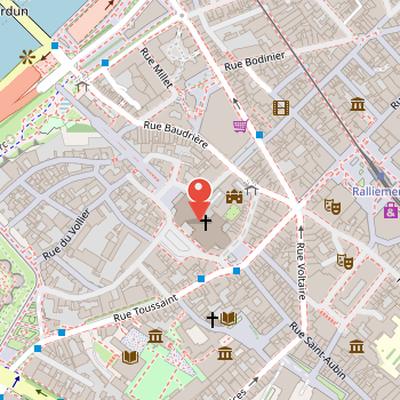
Nearby Objects
-
 Galerie David d'Angers 150 m away
 -
 Musée des Beaux-Arts d'Angers 200 m away
 -
 Grand Théâtre d'Angers 200 m away
 -
 Place du Ralliement 250 m away
 -
 Église Saint-Martin d'Angers 300 m away
Architecture and Artistic Features
Angers Cathedral is a Catholic church dedicated to Saint Maurice in Angers, France, and it serves as the seat of the Bishops of Angers. Built between the 11th and 16th centuries, it is known for combining Romanesque and Gothic architecture. The interior also includes an ornate Baroque altar and sculpture, reflecting later artistic additions to the building. Another notable feature is its extensive collection of stained-glass windows. Among these, the transept window of Saint Julian is recognized as a national monument of France and is considered a masterpiece of French 13th-century glasswork.
Patronage and Reconstruction
The earliest cathedral on the site was dedicated to the Virgin Mary. In 396, Saint Martin, Archbishop of Tours, added Saint Maurice to the cathedral dedication, and the church later received a relic of blood associated with the Theban Legion, said to have been brought to Tours and then given to Angers according to legend. Devotion to Saint Maurilius, Bishop of Angers in the 4th century, began in the 7th century, and a biography of Saint Maurilius was written before his body was transferred to the cathedral in 873. For about 200 years, Saints Maurilius and Maurice were the cathedral's patron saints, before Saint Maurice became the primary patron.
At the beginning of the 11th century, Hubert de Vendome, Bishop of Angers, decided to replace the existing church with a new Romanesque cathedral. The new church was consecrated on 16 August 1025, but it was ravaged by fire in 1032. Reconstruction was then ordered by Geoffroy de Tours, Bishop of Angers from 1081 to 1093, and it continued under Bishops Renaud de Martigne, Ulger, and Normand de Doue. The altar crucifix was blessed in 1051, and the new altar was consecrated in 1096.
Medieval Rebuilding and Later Interior Changes
Angers Cathedral was transformed in the mid-12th century with new walls and vaults built in the Angevin Gothic style. The vaults featured high crossing ribs supported by rows of clustered columns in the nave, and large windows were opened in the upper walls between the ribs. After this work on the nave, the choir and a new transept were rebuilt between 1235 and 1274 under Guillaume de Beaumont, Bishop of Angers from 1203 to 1240. The choir is marked by large blind arches topped with a narrow passageway with a wrought-iron railing below large upper-level windows. Its arches are taller and more slender than those of the nave, and its decoration is more stylised.
The interior was rebuilt again in the 17th century, following the directives of the Council of Trent. This redesign removed the jube, or rood screen, that separated clergy and congregation, and moved the altar closer to the congregation in the nave. In 1757, a baldaquin was installed over the altar, with columns of red marble supporting a crown filled with sculpture, and the altar was positioned to face both the clergy in the choir and worshippers in the nave.
The cathedral also saw major changes to its western and tower elements. In the 16th century, a new base was built for the two towers, and sculptures depicting Saint Maurice and his seven knight-companions and their martyrdom were added. The central tower received a Renaissance-style hexagonal crown finished in 1515, and the south tower was given a Renaissance spire completed in 1523. The mediaeval porch on the west front, built in the Angevin Gothic style and arranged on two levels, was demolished in 1806 because of dilapidation, leaving four pointed arches as the only surviving parts. Deteriorating original sculptures were replaced by copies in 1909. In the mid-19th century, a Neo-Gothic pulpit was created with the support of Eugene Viollet-le-Duc. Several 20th-century reconstruction projects were planned, but none progressed beyond the planning stage, including a 5.5 million euro project that received mixed reviews.
Gothic Reconstruction of the Church
In the mid-12th century, Angers Cathedral was rebuilt from the original Romanesque church with Gothic details. The design vaulted the single aisle with pointed arches resting on a re-clad interior elevation. Its nave was planned as three simple bays, with single bays on either side of a crossing. The layout also included a transept, followed by a single-bay choir backed by an apse. These features show a clear and orderly composition, combining structural refinement with a compact church plan.
The West Front of Angers Cathedral
The exterior west front of Angers Cathedral illustrates Romanesque, Gothic, and Renaissance architectural levels. Its lower portions are Romanesque, with thick walls, rounded arches, a Romanesque portal, and a central window. On either side, the towers are Flamboyant Gothic, marked by rich decoration and a delicate dissymmetry. The central tower is Renaissance architecture, built between 1533 and 1537.
The portal was originally protected by a porch. Above the doorway, the tympanum represents Christ in majesty and is decorated with column-statues from the 12th century. The decorative ironwork on the doors also dates to the Romanesque period. A gallery above the portal, added in the 16th century, depicts eight knights who represent the companions of Saint Maurice. The original sculptures of the knights were replaced with copies in 1909.
Interior Structure and Choir
Angers Cathedral has an interior nave built as a single vessel without chapels. The current chapel on the south lower nave was originally a separate church for the parish. The lower interior walls are Romanesque and were rebuilt in the early 11th century. Around 1150, major rebuilding added enormous arches between the supports of the Romanesque walls, and massive pillars of clustered columns were installed to carry arches supporting three large vaults. The spaces between the ribs of the upper vaults were filled with very large stained glass windows.
The choir and transept were constructed between 1235 and 1274. Their walls and vaults were similar in character, but the arcade of large pillars was replaced by blind arches and a narrow passageway. The choir decoration was later adapted to the Baroque style imposed by the Vatican Council of Trent. The old rood screen separating the choir from the nave was demolished, and the altar was placed between the two spaces facing both. In 1757, an enormous Baroque ciborium, or altar canopy, supported by columns of red marble and crowned with a pyramid of sculpture by Gervais, was installed.
Stained Glass and Interior Decoration
Angers Cathedral contains a notably rich program of art and decoration, especially in its windows and sculptural interior. The oldest original window dates from around 1165 and depicts the infant Christ. At the end of the 12th century, new nave windows were made under Bishop Raoul de Beaumont, including scenes of the Martyrdom of Saint Catherine of Alexandria and the Martyrdom of Saint Vincent, while windows in Bay 123 showed the life of the Virgin Mary. These 12th-century windows used painting onto glass or silver stain. Other early and later windows include the Glorification of the Virgin at Bay 123 from the late 12th to early 13th century, which was signed with the emblem of its maker, the Virgin in Majesty window at Bay 129, and the Crowning of the Virgin and Dormition of the Virgin windows at Bay 123, all created between 1190 and 1226. The cathedral also preserves a 13th-century Thomas Becket window in the choir, a Calvary window at Bay 111, and several works by Andre Robin in the 1450s, including the south rose window with Christ with elders and Zodiac, the center of the south rose window depicting Christ in Majesty, and the Saint-Rene et Saint-Cenere window at Bay 109. In the interior, murals dating from 1240 to 1260 were discovered around 1980 behind 18th-century woodwork in the back of the apse by Sebastien Leyssner. These murals depict miracles of Saint Maurilius of Angers, including the resurrection of Saint Rene, who later became a member of the cathedral chapter. The cathedral also has a particularly rich collection of sculpture, from Romanesque and Gothic column capitals decorated with faces to dramatic Baroque scenes above the main altar, as well as tomb sculpture from different periods.
The Grand Organ
The grand organ of Angers Cathedral is located in the balcony of the organ loft at the west end of the cathedral. Its history reflects a long sequence of rebuilding, restoration, and technical change. The present instrument was built in 1617 by organ maker Jacques Girardet, and it was probably made using pipes and parts from the previous organ in the cathedral. Earlier phases included an organ case replaced in 1416 by Jean Chabencel, followed by the destruction of that case by fire in 1451. A replacement was then built in 1507 in the organ loft in the choir. After another fire, the organ was restored in 1533 by Peter Bert. In 1701, Marin Ingoult restored the grand organ and added the pedalboard. After this work, it had 47 stops with four manuals and a pedalboard. The case was replaced again in the 18th century. Between 1869 and 1872, Aristide Cavaillé-Coll reorganized the instrument. In 1957, the organ was electrified, and 19 stops were added, bringing the total to 66 stops with three manuals and a pedalboard.
The Cathedral Bells
Angers Cathedral has nine bells housed in a central tower. The largest bell is named Maurice, and it is also called The Bourdon. Maurice is the oldest bell and produces the deepest notes among the set. It was founded by the firm of Besson and weighs 6700 kilograms. These details make Maurice the most prominent bell in the cathedral's collection, both for its size and for its role in the sound of the tower.