Église Saint-Vincent de Rouen is a former Catholic church of Gothic style in Rouen, France, associated with L'église Saint-Vincent in the Seine-Maritime department. Named Saint-Vincent-sur-Rive Church because of its proximity to the quays of the Seine, it was under the patronage of Saint Vincent of Saragosse. Its parish existence is attested in Rouen since 1169, and its history was tied to the economic and commercial activity of the nearby port and the Vicomté, opposite the hotel that regulated port activities, river traffic, and trade measurements. By dimensions, architecture, and heritage, it was the fourth most important Gothic church in Rouen. The building developed in several phases, including a mid-15th-century nave, an enlarged transept crossing and new portals in the 1470s, and a rebuilt choir from 1512 to 1528 with large stained-glass windows. A square lantern tower was added around 1669, while later campaigns modified the choir and other parts. The church was almost entirely destroyed by a bombing in May 1944.
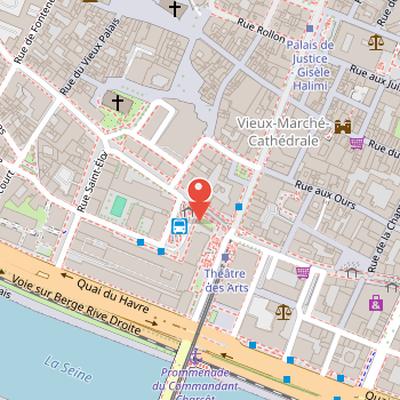
Nearby Objects
-
 Rouen Opera House 100 m away
 -
 Église Saint-Pierre-du-Châtel 130 m away
 -
 Place de la Pucelle-d'Orléans 200 m away
 -
 Saint-Éloi de Rouen 200 m away
 -
 Church of St Joan of Arc 300 m away
Gothic Church in Rouen
The former Catholic church was located in Rouen, France, and was built in the Gothic style. It remained a notable religious building in the city until it was almost entirely destroyed by a bombing in May 1944. The surviving facts identify it as a historic church whose architectural character was defined by its Gothic design, while its later history was marked by wartime destruction.
Location in Rouen
Eglise Saint-Vincent is associated with Rouen, in the Seine-Maritime department of France. Its localisation places it within the urban and historical context of the city, making its setting an important part of its identity. The available information identifies the church by this specific location, linking it directly to Rouen and to the broader administrative area of Seine-Maritime.
History and Setting of Saint-Vincent Church
The church is named Saint-Vincent-sur-Rive because of its proximity to the quays of the Seine. Its parish existence in Rouen is attested since 1169. Dedicated to Saint Vincent of Saragossa, an Iberian-origin saint, the church includes a stained glass window depicting his martyrdom. In Rouen, it is considered the fourth most important Gothic church by its dimensions, architecture, and heritage. Its location reflects the economic and commercial life of the area, as it benefits from the nearby port and the Vicomte. It also stands opposite the Vicomte hotel, which regulated port activities, river traffic, and trade measurements.
Architectural Development and Wartime Loss
The nave of the church was built in the mid-15th century, together with an initial transept tower. In the 1470s, the transept crossing was enlarged and new portals were built on the north, south, and west sides. The choir was then rebuilt between 1512 and 1528, oriented eastward, and given a high elevation with an ambulatory. Its height rose almost to the ridge of the lantern tower roof, and the reconstruction included large stained glass windows in the crossings.
Around 1669, a square lantern tower was added while preserving the Gothic style. During the 18th century, the north collateral was added and the nave was repaved. From 1735, the choir was remodeled and redecorated by Jean-Pierre Defrance, who added Baroque ornaments to the Gothic masonry. The high altar, inaugurated in 1750, included a single-piece breccia marble slab. In the 1870s, Louis Sauvageot carried out work on the buttresses of the apse and on the south portal.
The building was only partly visible from the public space, with its north and east sides bordered by private buildings. This changed as Rue de l Imperatrice and Rue Fleurus-Duvivier were opened to improve visibility, and the church was recorded near the bottom of Rue Jeanne-d Arc in 1861. Its 29 ancient stained-glass windows, dating from around 1520 to 1530, were removed and taken to Niort in 1939 for safety. The church was then destroyed by multiple bombs during the Allied bombings on Rouen during the week known as red week in World War II. In 1945, the remains were judged too damaged for reconstruction, and Rue du General-Giraud was created on the site in the 1950s. Today, only the south portal of the transept and a small part of the adjoining wall survive. The remains were classified as a historical monument in 1862.
Architecture and Site
Eglise Saint-Vincent de Rouen was a flamboyant Gothic style church built between 1450 and 1556. It was raised in 1515 in the extension of the old Haranguerie street. Following usual Norman Gothic church plans, its unfinished bell tower was placed above the crossing of the transept. The west facade included a polygonal porch erected in 1490. Today, only the heavily damaged south portal remains. Although the Second World War caused major destruction elsewhere, the churchs entire building walls were spared.
The Choir Stained Glass Windows
The church's choir stained glass windows formed one of its most significant decorative features. Three main stained glass windows of the choir were made around 1525 by the workshop of Jean and Engrand Le Prince in Beauvais, a workshop known for its work on Beauvais Cathedral of Saint-Pierre. Ten other choir windows were produced in the 1520s by the Atelier rouennais. The windows were restored in the late 1860s by the Duhamel-Marette workshop from Evreux. After the war, the windows dismantled in 1939 were brought back to Rouen in 1954. Their future then became a matter of public decision, as the entire set of choir stained glass windows was considered indivisible and awaited a ruling. In the early 1970s, the municipality decided to redevelop the Old Market Square by building a new church to replace the building as the parish church. The north wall of the new Sainte-Jeanne-d'Arc church was designed to receive thirteen choir stained glass windows from the old church, and these were embedded there in 1978. One stained glass window was installed in the Le Secq des Tournelles museum, while eight were placed in Rouen's Notre-Dame Cathedral, in the Virgin chapel and the Saint-Romain tower. Some other windows, including the Last Judgment and a Tree of Jesse, are held in the reserves of the Fine Arts Museum. Some Duhamel-Marette windows that were not dismantled were destroyed in a bombing.