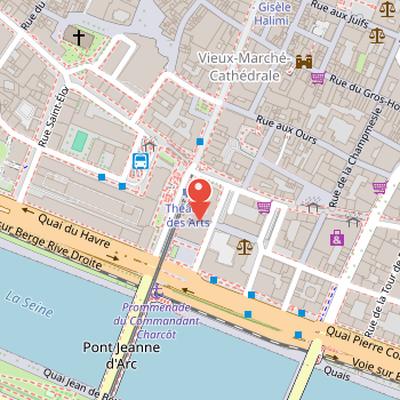
Rouen Opera House, formally known as Rouen Normandy Opera House - Theatre of Arts, is a French opera house located in Rouen, Normandy. It is home to the Rouen Philharmonic Orchestra and operates a portfolio of concert venues, including its headquarters known as the Théâtre des arts and the Chapelle Corneille concert venue. The building is situated next to the Métro and TEOR station Théâtre des arts. The site has a long history: former halls called the Théâtre des Arts were built between 1774 and 1776 by François Guéroult, inaugurated on 29 June 1776 with a performance of Corneille’s Le Cid, and later damaged by fire in 1876 and during the Second World War before being completely destroyed in 1944. The current hall was begun in 1952 to a plan by Jean Maillard and Robert Levasseur, with construction interrupted in 1954 and resumed in 1958. After ten years of work, it was inaugurated in the presence of Bernard Tissot and doctor Rambert.
Nearby Objects
-
 Église Saint-Vincent 100 m away
 -
 Église Saint-Pierre-du-Châtel 140 m away
 -
 Place de la Pucelle-d'Orléans 300 m away
 -
 Saint-Éloi de Rouen 300 m away
 -
 Church of St Joan of Arc 400 m away
Location and Role in Rouen
The Rouen Opera House, formally known as the Rouen Normandy Opera House - Theatre of Arts, is a French opera house in Rouen, Normandy. It is home to the Rouen Philharmonic Orchestra and operates a portfolio of concert venues that includes its headquarters, the Theatre of Arts, as well as the Chapelle Corneille concert venue. The opera house is situated next to the Metro and TEOR station Theatre des arts, placing it within an accessible urban transport setting.
The former Theatre des Arts
The former halls, known as the Theatre des Arts, were built between 1774 and 1776 by Francois Gueroult near today's Grand-Pont and Charrettes Streets. They were inaugurated on 29 June 1776 with a performance of Corneille's Le Cid. The building later suffered repeated wartime damage: it was gutted by fire on 25 April 1876, partially destroyed by fire when hit by shells on 9 June 1940, and continued to host performances throughout the war until its complete destruction by allied bombing on 10 June 1944.
Construction and Later Recognition
The current hall in Rouen began construction in 1952, following a plan designed by Jean Maillard and Robert Levasseur. Work was interrupted in 1954 because of reduced funding, then resumed in 1958. During the process, the original plan was reworked and the idea of a large hall with a capacity of 500 people was abandoned. After ten years of work, the hall was inaugurated in the presence of Bernard Tissot and Doctor Rambert.
In 2012, the Rouen Philharmonic Orchestra celebrated the fiftieth anniversary of the inauguration. As part of these commemorations, the Rouen Opera House also asked people to provide documents related to the building.
The opera house is associated with a statue that was situated at the crossing between both spans of the pont Corneille and the exit towards the Ile Lacroix. It is one of the few statues in Rouen not melted by the Nazis to reuse the metal. The statue fell into the shallow water of the Seine near the edge of the bridge when the block and tackle broke, and it was later sawn by the Nazis to remove it from the river before reassembling it. It was also saved after the truck hired to carry it stopped working.