Saint-Éloi de Rouen is a Protestant temple located at place du Pasteur-Martin-Luther-King in Rouen. The building was a Catholic church from 1228 until the French Revolution, and it was assigned to the Reformed Church in 1803. Its parish is a member of the Église protestante unie de France.
The site began as a chapel on an island that was later joined to the mainland during the period of the Dukes of Normandy. It became parochial when the surrounding neighborhood was built, and construction as a church began on an unspecified date. The building depended on the chapter of the Notre-Dame de Rouen cathedral. It was rebuilt at the beginning of the 16th century, pillaged by the Huguenots, and completed in 1580 with a tower and a rose window on the main portal. Works were carried out at the beginning of the 18th century by architect Jean-Jacques Martinet. Expropriated and decommissioned in 1791, it was later used as a forage store and then a hunting lead factory. The building has been classified as a historic monument, suffered damage during the Allied bombings of 1944, and was later reopened for worship. Excavations in 2018 and 2019 revealed a nearby medieval Catholic cemetery with densely arranged skeletons.
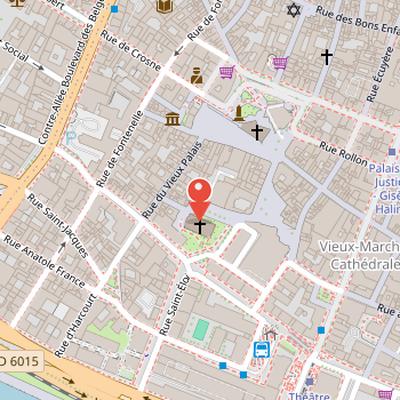
Nearby Objects
-
 Place de la Pucelle-d'Orléans 100 m away
 -
 Church of St Joan of Arc 150 m away
 -
 Jeanne au bûcher 150 m away
 -
 Place du Vieux-Marché 200 m away
 -
 Église Saint-Vincent 200 m away
From Catholic Church to Protestant Temple
Saint-Eloi de Rouen is a Protestant temple located at Place du Pasteur-Martin-Luther-King in Rouen. The building served as a Catholic church from 1228 until the French Revolution, after which it was assigned to the Reformed Church in 1803. Today, its parish is a member of the Eglise protestante unie de France. This history reflects a long continuity of worship at the site, together with a change in religious affiliation over time.
History of the Church
Eglise Saint-Eloi began as a chapel on an island that was later joined to the mainland during the period of the Dukes of Normandy. It became parochial when the neighborhood was built, and construction as a church started on an unspecified date. The building depended on the chapter of the Notre-Dame de Rouen cathedral. It was rebuilt at the beginning of the 16th century after having been pillaged by the Huguenots, and in 1580 it was completed with a tower and a rose window on the main portal. Further works were carried out at the beginning of the 18th century by the architect Jean-Jacques Martinet.
The church was expropriated and decommissioned in 1791 during the French Revolution. After that, it was transformed first into a forage store and then into a hunting lead factory because of its bell tower. The 1789 Declaration of the Rights of Man and Citizen granted freedom of worship for Protestants, and in 1802 Napoleon organized Reformed and Lutheran consistories by department under the Organic Articles of the French Concordat Regime. In 1803, Eglise Saint-Eloi was assigned to the Reformed Consistory of Seine-Inférieure. Shops adjacent to the temple were destroyed in 1857. The building has been classified as a historic monument since an unspecified date, suffered damage during the Allied bombings of the Red Week in 1944, and was reopened for worship on an unspecified date.
Medieval Cemetery Evidence
Excavations carried out by Historique in 2018 and 2019 revealed a medieval Catholic cemetery near the temple. The remains were densely arranged, with skeletons placed closely together, indicating intense use of the cemetery space. These findings provide evidence of the site’s earlier funerary use and its role within the surrounding medieval landscape.