The Catacombs of Paris are a municipal ossuary and a museum of the City of Paris, created in former underground quarries connected by inspection galleries. Transformed into a municipal ossuary in the late 18th century, they received about six million human remains transferred from various Parisian cemeteries until 1861, for public health reasons. The name was borrowed by analogy with Roman underground necropolises, although the site was never officially used as a burial place.
The visitable section measures about 1.7 kilometres and lies around twenty metres below the surface. Public access begins at place Denfert-Rochereau. This public section represents only about 0.5% of the vast underground quarries beneath Paris, which extend under several arrondissements. Other underground ossuaries in Paris are not open to the public. Based on 2015 data, the Catacombs receive about 500,000 official visitors per year.
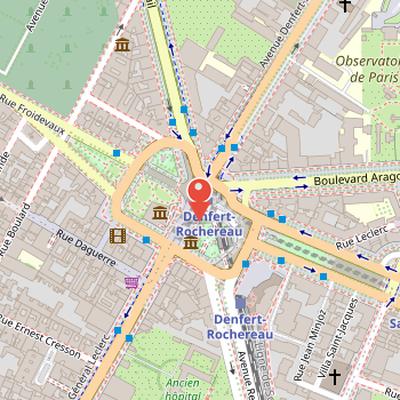
Nearby Objects
-
 Denfert-Rochereau Square 40 m away
 -
 Lion of Belfort 50 m away
 -
 Fondation Cartier 350 m away
 -
 Montparnasse Cemetery 500 m away
 -
 The Kiss 650 m away
The Municipal Ossuary in the Underground Quarries
The Catacombs of Paris are the municipal ossuary of the city and are formed from old underground quarries in Paris. These quarries are connected by inspection galleries and extend under several arrondissements of the city. In the late 18th century, the site was transformed into an ossuary for public health reasons, and about six million human remains were transferred there from various Parisian cemeteries until 1861. Although the Catacombs were named by analogy to Roman underground necropolises, they never served officially as a burial place.
The public section is only a small part of the vast underground quarry system, representing about 0.5 percent of it. Approximately 1.7 kilometers are visitable, at a depth of about 20 meters below the surface. Public access begins from place Denfert-Rochereau. The site is identified as a museum of the city of Paris and receives about 500,000 official visitors per year, based on 2015 data. Other underground ossuaries in Paris also exist, but they are not accessible to the public.
Underground Quarries and the Catacombs
Histoire describes nearly three hundred kilometers of galleries under Paris intra-muros, arranged on up to three levels of quarries and lying at an average depth of about twenty meters below natural ground level. For several centuries, building stone was extracted from these quarries to construct Paris buildings without importing materials. The text also identifies underground voids formed by old gypsum quarries near Sacre-Coeur; nearly all of these voids have been filled or deliberately collapsed by pillar explosions, and only the Buttes-Chaumont cave remains as part of an old underground quarry. In this context, the catacombs are often incorrectly considered to represent the entire quarries of Paris, although they form only a tiny fraction of them. A decision was made to move bones into quarries beyond the barriere d'Enfer of the Fermiers generaux wall, under the Montsouris plain in Montrouge territory.
Origins and Growth of the Saints-Innocents Cemetery
The history of the Saints-Innocents cemetery begins around the Notre-Dame-des-Bois church, a Merovingian worship site that was probably destroyed during the Norman invasions of 885 to 886. It was later replaced by the church of Sainte-Opportune, which received the dead from several parishes on the right bank within its enclosure. The cemetery was named Saints-Innocents in 1130, in reference to the children killed by order of King Herod. Histoire also notes later confusion over the name, linked to the burial of a child allegedly crucified by Jews in Pontoise around 1179, and to miracles reported under King Philippe-Auguste.
Located between rue Saint-Denis, rue de la Ferronnerie, rue de la Lingerie, and rue Berger, the cemetery received generations of Parisians from twenty-two city parishes, as well as bodies evacuated from the Hotel-Dieu and the morgue, for thirteen centuries. It grew from a small countryside cemetery into the largest cemetery in Paris. Over time, it was progressively surrounded by constructions and became part of a lively city district.
Sanitation Crisis and the Move Underground
Before the creation of the Catacombs of Paris, burial conditions in Histoire had become a major public health concern. Wars, epidemics, and famines caused thousands of bodies to be buried in a very limited space, where mass graves reached more than ten meters in depth and could hold up to fifteen hundred bodies. These graves were periodically emptied to make room for new burials, and the bones were transferred to large charnel houses around the cemetery. By the end of the 18th century, Histoire's ground level stood more than two meters above the street, adding to long-complained sanitation problems.
The continuous decomposition of so many bodies was said to promote disease spread. Doctors from the Paris faculty opposed the epidemic risks as early as 1554, and the Royal Academy of Sciences confirmed this concern in 1737. Complaints from neighbors increased over time, and the cemetery was described as affecting daily life: wine in the neighborhood was said to turn to vinegar in less than a week, food to spoil in a few days, and well water to become contaminated by putrid materials. François Pourrain, the last gravedigger of Histoire, estimated that he buried about ninety thousand bodies in less than thirty years. Individual burials did not exceed two hundred per year.
The pressure to end burial within the city grew stronger. In 1765, the Parlement of Paris banned all burial within city limits, leading to the creation of eight cemeteries outside the walls. Even so, religious traditions and popular piety slowed the change, while economic reasons also pushed cemetery closures because of a lack of markets and space in Les Halles. In this context, an anonymous proposal was presented to Paris authorities and ecclesiastics for an underground ossuary in an old quarry. The proposal suggested treating bodies with resin, installing an embalming workshop or corpse drying room underground, using the constant temperature to aid preservation, and covering cadavers with thick clay or bitumen to protect workers and reduce harmful effects.
From Quarries to Ossuary
The term catacombs was misapplied in 1782 to these underground galleries, which originally had no underground graves or monuments. The name was given by analogy with Roman necropolises, even though the site lacked the sacred character usually associated with catacombs. The true name of the galleries is different, and the quarry inspection service later used the term catacombs incorrectly for them.
After several debates, the project was approved as a solution for transferring bones outside Paris from the Innocents cemetery. The underground quarries of Tombe-Issoire, under the Montrouge plain beyond the Enfer barrier south of Paris, were considered suitable. A Conseil du Roi decree ordered the removal of the Innocents cemetery, the evacuation of the bones, and the conversion of the site into a public market. Paris also bought an old Commanderie de Saint-Jean-de-Latran house on the current rue Dareau in the commune of Montrouge. The underground enclosure measured about 3000 square meters and contained nearly 3000 meters of winding tunnels beneath an area framed by rue Dareau, d'Alembert, Hallé, and Montsouris park.
More than two million Parisians were buried at the Innocents cemetery during its existence, and the transfer of bones began in the remaining months of 1785. The bones were progressively removed from charnels and soil, cleaned, and stacked with forks into closed carriages. A religious rite accompanied the transport: funeral carts with black catafalques traveled at dusk to the service well of the Tombe-Issoire quarries, preceded by religious choirs, death lanterns, and torch bearers, and followed by priests singing mass for the dead. The bones were then thrown into a stone extraction shaft at the current 21 avenue Rene-Coty. The work was directed by Louis Thiroux de Crosne, successor to Lenoir, while Guillaumot managed the arrangement of the site and the bone transfers. Men collected the bones at the bottom of the overflow shaft and loaded them onto wheelbarrows or small wooden carts, then carried them to designated areas in underground rooms or galleries marked with plaques indicating their origin and the date of transfer.
Over a century, more than six million remains were moved into the ossuaries beneath Paris, which form the largest accessible necropolis in the world. In 1809, Louis-Etienne Hericart de Thury organized the first regular visits. A black line was traced on the ceiling to guide visitors, and in 1810 and 1811 he arranged the ossuary with aligned decorated bones and plaques engraved with quotations from sacred, literary, philosophical, or poetic sources. These consolidation works were transformed into funeral monuments, and the ossuary was isolated from other underground quarries, resembling its appearance in 1811. Hericart de Thury later published Description des catacombes de Paris in 1815. Visits were banned in 1830 because of damage and disturbances, then reauthorized at a rate of four per year. Under his direction, two cabinets were also created, one for mineralogy and one for bone pathology. The mineralogy cabinet displayed numerous mineral and fossil curiosities, while the pathology cabinet presented selected bones, deformed or abnormally proportioned skulls, and rudimentary prostheses. Both cabinets were filled in after the events of the Paris Commune in 1871, and their collections were dispersed.
Visits, Management, and Recent Preservation
Access to the Catacombs is through a staircase located at the current 2, place Denfert-Rochereau. The site has long been associated with organized visits. In 1850, four annual visits were again arranged after many requests, and in 1867 and 1874 the frequency increased to twice per month, with one additional visit on All Souls Day. An underground service is also celebrated there on the day following All Saints Day for the rest of souls.
The Catacombs drew notable visitors in the nineteenth century. Histoire states that Francois, emperor of Austria, visited the site while residing in Paris as a victor. In 1860, a person descended into the Catacombs with his son, Prince Imperial Louis-Napoleon. That same year, the photographer Nadar produced the first series dedicated to underground Paris, especially the Catacombs and sewers. In 1867, Oscar II of Sweden and Chancellor Bismarck also visited. The site was later marked by political violence in 1871, when fleeing communards took refuge and were massacred by Versailles troops in several Paris quarries, including the Catacombs.
The Catacombs continued to attract attention in modern times. On July 18, 2004, a clandestine concert was held there and caused significant attention; after this event, bones were stacked between pillars to prevent similar gatherings. Site management transferred in 1983 from the General Inspection of Quarries to the Paris Cultural Affairs Directorate. In 2015, the Catacombs officially became a site dedicated to the history and memory of Paris, managed by the Carnavalet Museum. Histoire states that the municipal ossuary hosted more than an unspecified number of visitors in 2015.
Preservation and security work have led to repeated closures and reopenings. The Catacombs reopened on October 15, 2016, after eight months of closure for consolidation, wall restoration, and lighting revision. On February 10, 2023, the site closed again for major security standard upgrades financed entirely by the Paris Cultural Affairs Directorate at a projected cost of 2.5 million euros. The works included fire detectors on air treatment centers, smoke propagation prevention devices, a new emergency staircase, automatic visitor counting between the gallery entrance and exit, and fire doors at the bottom of the access staircases. Histoire also notes later reopening after several months of work, including the Port-Mahon gallery, the foot bath of the quarrymen, and the Descenderie. A further closure followed vandalism on an unspecified March date, leading to a three-month closure and repair work by a permanent team of four workers.
Quarry Galleries and Historic Features
Not all sections of the Catacombs are accessible to the public, and the site includes several areas with distinct architectural and historical character. Among them are narrow consolidation galleries connected to the Arcueil aqueduct, which was built for Marie de Medicis and supplied water to the Luxembourg Palace. These consolidations were made by Guillaumot after several collapses caused by water infiltration in unspecified years. The aqueduct was supported by a masonry mass with two lateral galleries linked by transversal galleries, and its route was cut by avenue Reille in 1860. After that date, the aqueduct portion became permanently dry.
Another part of the site, called the Workshop, consists of old Lutetian limestone quarries with closed galleries. It retains an end-of-exploitation appearance. Its ceiling is supported by turned pillars and arm pillars, while the quarry walls are formed by hagues that stabilize the fillings. A gently sloping corridor gives access to lower levels in the Workshop. The passage called doubles carrieres also includes a gallery height increase.
The Port-Mahon gallery contains stone sculptures made between 1777 and 1782 by a quarryman named Decure, nicknamed Beausejour. He is described as a veteran of Louis XVs armies, and the 1829 Conducteur portatif states that he enlisted in 1756 in Richelieus army during the reconquest of Minorca. After being discharged, he joined the Inspection of quarries to supplement his pay. He worked under Guillaumot on consolidation by day and sculpted after work, creating a model and various views of the Port-Mahon fort, located as the main city of Minorca in the Balearic Islands. The same account says he had been a temporary prisoner of the English in Port-Mahon. Decure began building an access staircase from the upper quarry level, but the staircase caused a collapse that killed him instantly. The sculptures were damaged during the Revolution and restored in 1854 and several times afterward.
The site also contains a small well known as the bain de pieds des carriers, which has particularly clear water and a guardrail. It was used by workers consolidating the ossuary, and its name comes from the fact that the water transparency made it barely visible. Guides reportedly took advantage of this transparency before electric lighting was installed in 1983. The well is also described as the first geological drilling under Paris, with a geological section lifted in 1814 by Héricart de Thury in order to recognize the geological constitution of the subsoil.
The Ossuary Vestibule and Bone Galleries
The ossuary vestibule is described as a place for temporary exhibitions, while the entrance to the ossuary is marked by a metal door framed by two pillars decorated with white geometric motifs on black. Above the entrance, an inscription on the lintel gives an alexandrine from Jacques Delille's translation of the Aeneid, repeating the phrase that welcomes Aeneas by Charon, the boatman of the Styx. A commemorative plaque on the left wall of the first room marks the creation of the ossuary.
Inside, the Catacombs contain the bones of about six million French people, laid through some 300 kilometers of winding galleries that are mostly inaccessible to the public. The bone display covers a total surface area of 2500 square meters and reaches an average height of 1.5 meters. The walls are arranged with rows of femur or tibia heads, showing only the apophyses, alternating with skull friezes at different heights. These facings project slightly from the walls, with the remaining bones stacked behind them, often fragmented from falling. Thousands of skeletons remain intertwined irregularly behind these alignments.
The arrangement is presented as having a romantic-macabre decorative intent. Beside the bones, engraved plaques indicate the origin and year of transfer, while other plaques bear often grandiloquent quotations by great authors or early 20th century celebrities, in French or Latin.
The Fountain of the Samaritaine
In 1810, a fountain known as the Samaritaine was created in a gallery that widened into a rotunda to collect groundwater. The water was found during the ossuary development works. The fountain's name referred to the episode of Christ and the Samaritan woman at Jacob's well, and it was inscribed with a phrase related to that figure. It was also called the source de Lethe, or de l'oubli, by analogy with the river in Greek mythology.
Ritual Rooms and Monumental Consolidations
Several spaces in the Catacombs of Paris were given distinctive architectural and memorial forms through later consolidation work. A larger room known as the crypt of the sacellum was equipped with an altar, a large white cross, and small stone stools. The altar was a reproduction of an ancient tomb discovered in 1807 between Vienne and Valence, and it was created as a disguised consolidation after a landslide in 1810. A phrase was engraved on the monument at the altar. Another memorial feature, called the tomb of Gilbert or lacrymatory sarcophagus, was also created as a consolidation and dedicated to Nicolas Gilbert, the poet born in 1750 and died in 1780. Some verses by Gilbert were engraved on the monument, and engineer des Mines Caly had proposed the idea of erecting this false tomb among thousands of bones.
Other galleries were adapted as spaces of commemoration and display. The remains of victims from the Tuileries and the Revolution were stored in the following galleries. A large room called the crypt of the Passion, or the rotunda of tibias, was enclosed with bones and contained a sculpture made solely of tibias around a consolidation pillar. This room also held a clandestine concert.
Structural consolidation continued into the late nineteenth century. In 1874 and 1875, a straight gallery located 18 meters below rue Rey-Dumoncel was consolidated. Work preserved three sinkholes by emptying two of them and stabilizing the natural vault with sprayed cement. The vault was used to show geological layers above the quarries, and the site was reinforced with 11-meter-high masonry. Different geological strata were painted in different colors, and a spiral staircase of 83 steps was installed to the surface at 36, rue Rey-Dumoncel.
Notable Remains in the Catacombs
The Catacombs of Paris contain the bones of more than six million Parisians, but the remains are not identifiable individually among the millions of anonymous dead. Within this mass, a number of personalities from French history are represented through transfers from cemeteries, churches, convents, and other burial sites in Paris. These include Charles-Axel Guillaumot, buried in 1807 in Sainte-Catherine cemetery; Nicolas Fouquet, transferred from the convent of Filles-de-la-Visitation-Sainte-Marie in 1793; and minister Colbert, moved from the catacombs of Saint-Eustache church.
Other remains associated with Saint-Paul church include Rabelais, Francois Mansart, Jules Hardouin-Mansart, the man in the iron mask, and Jean-Baptiste Lully. From Saint-Etienne-du-Mont came Racine, Blaise Pascal, and Marat, while Saint-Sulpice is linked with Montesquieu. The Saint-Benoit cemetery contributed remains of Guillaume Chasteau, Laurent Cars, Charles and Claude Perrault, and Hericart de Thury. The ossuary also includes remains from Ville-l'Eveque cemetery, including those massacred at the Tuileries in 1792 and people guillotined between 1792 and 1794, among them Charlotte Corday.
The list also includes Danton, Camille Desmoulins, Lavoisier, and Robespierre, transferred from Errancis cemetery during the Restoration. A monument celebrates a person whose remains are mixed in the mass, showing how the catacombs combine individual memory with collective burial. Among the named burials is Saint Ovide, whose remains were brought to Paris by Pope Alexander VII and placed at the Capucines convent; he is noted as the only person buried in two catacombs. The tomb of Philibert Aspairt is also present, although its discovery in 1804 may be a hoax by the Mines inspector.
Visitor Route and Site Management
Gestion du site organizes the Catacombs visit as a two kilometer route that requires at least forty-five minutes. The visit begins at 1, avenue du Colonel-Henri-Rol-Tanguy, place Denfert-Rochereau, near a Claude-Nicolas Ledoux building that housed the Inspection generale des carrieres until 2017. After a small ticket booth and a staircase, visitors reach small rooms with explanatory panels and temporary exhibits. The route also extends a gallery southwards under avenue Rene-Coty for public gallery visits.
The tunnels are maintained at a constant temperature, and the route includes 130 descending steps and 112 ascending steps. Site management also regulates access carefully: a guard at the exit pavilion prevents unauthorized entry and checks visitors' bags, while laws against removing bones are enforced, with penalties including one year imprisonment and a fine. Visitors are informed through a Paris city aid-visit leaflet about judicial proceedings for degradation or bone theft. The site limits capacity to 200 visitors at a time and admits new groups every 15 minutes.
Administration of the catacombs was entrusted to the Carnavalet museum in . It is exercised by the museum director, the secretary general, and a conservator for scientific council matters, while a cultural services technician supervises security and the on-site team. In 2006, fifteen full-time equivalent staff were assigned to welcome visitors and monitor security, and two surveillance agents work underground in two-hour shifts alternating with site entry and exit duties. The site requires substantial staffing because of its vast, dark, and humid conditions, and it has faced recruitment problems and reopening delays linked to difficult working conditions, including a labor strike in 2008. Access remains paid, despite free access to city museums in 2002. Temporary exhibitions are presented continuously at the site museum and the archaeological crypt of Parvis Notre-Dame, although a city audit report noted that they are limited to a few panels or photos. The museum is open from Tuesday to Sunday and closed on Mondays and public holidays.
Other Ossuaries Beneath Paris
Other catacombs in Paris include ossuaries beneath the city that are separate from Tombe-Issoire. These sites are inaccessible to the public and remain relatively unknown. They developed in response to a lack of surface space, which led to the creation of cemeteries at Montmartre, Montparnasse, and Pere-Lachaise outside the city. As old cemeteries became full, remains were transferred into catacombs, while rapid population growth and continuous urban expansion increased the pressure on burial space.
Among these locations are the ossuaries under Montparnasse cemetery, which were established after the cemetery was incorporated into the city in 1860. Space at Tombe-Issoire became saturated, forcing the administration to identify new sites for transferring cemetery remains. Under Montparnasse, consolidation work linked to mining tunnels led to the creation of new bone deposit sites. These included seven deposits that were gradually filled with bones, with some intended for anonymous remains from mass graves. A mining shaft was also used in a similar way to Tombe-Issoire.
The galleries contain remains of victims of the cholera epidemic from the early 19th century, as well as bones discovered during major roadworks. Over the following decades, these ossuaries were frequently looted by cataphiles. Among network regulars, the ossuaries under Montparnasse cemetery are called Carrefour des Morts.
Other Catacombs and Burial Proposals in Paris
Beyond the principal catacombs, several other Parisian underground burial ideas and uses were documented. In year III of the Republic, the quarry pits at Montmartre were used for burials, and this practice shocked the citizen Delamalle. The burial conditions in the Montmartre cemetery included coffins being thrown into old quarry pits. In year IV of the Republic, Camby proposed creating catacombs in the Montmartre quarries, presenting the idea of an underground cemetery there, but it was not realized at that time.
A later proposal came in 1810 from Héricart de Thury, who suggested an underground cemetery beneath Pere-Lachaise. The galleries were described as large, with a height of fifteen meters and a width of eight meters, and they were intended for monumental tombs rather than ossuaries. This project did not proceed, and development of surface cemeteries was prioritized instead.
Similar ossuaries also existed near the Paris gates in quarries connected to the southern network under the Montrouge and Kremlin-Bicetre cemeteries. These examples show that burial use of quarries and underground spaces formed part of wider discussions and practices around Parisian cemeteries, even when some proposals remained unrealized.
Cataphilie and the Hidden Quarry Network
Cataphilie refers to individuals who enter the old underground limestone quarries in Paris and explore their galleries, especially within the former underground quarry network known as Grand Reseau Sud (GRS). The practice gained wider public attention after Barbara Glowczewski and Jean-Francois Matteudi published La Cite des cataphiles. Mission anthropologique dans les souterrains de Paris in 1983. That book popularized the existence of clandestine walkers in the gallery network, and articles that followed contributed to a significant increase in visitation. This rise in underground exploration became a fashion phenomenon, and the practice has continued through many associations linked to speleology, heritage protection, and regular visitors to the sites.
At the same time, the Paris catacombs present real dangers to people unfamiliar with the complex network and its risks. The quarry system extends over more than 300 kilometers beneath the city. Its tunnels can be narrow and low, making it easy for visitors to become lost, especially in areas with poor lighting and difficult navigation. Other hazards include collapses, falling stones, and ceiling effondrums, particularly in abandoned quarry sections. Visitors may also fall into pits or holes without any means of communication or rescue. The catacombs can further serve as gathering places for groups involved in illegal activities such as wild parties, occult rituals, or criminal acts, and unauthorized visitors may encounter violent or thieving groups. For these reasons, entering the underground quarries without official authorization and an experienced guide is strongly discouraged.
The Catacombs in Fiction
The underground environment in Paris was poorly represented in literature until the 1830s. In the 19th century, Élie Berthet, Pierre Zaccone, Joseph Mery, and Gaston Leroux depicted the Paris underground in fiction. By contrast, the 20th century neglected this underground setting in literary works. The catacombs also appeared in cinema, including Les Gaspards by Pierre Tchernia in 1974. That film features a group of opponents to construction work living in Paris's underground networks. More recently, the horror film Catacombes by John Erick Dowdle was made in 2014 and deals with urban legends related to the Paris catacombs. In 2024, Xavier Gens released Sous la Seine, set in flooded underground galleries.