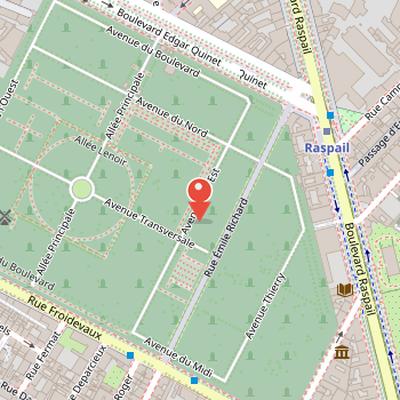
Montparnasse Cemetery, or Le cimetière du Montparnasse, is a cemetery in Paris originally named Cimetière du Sud. Created in 1824 as part of urban planning policies, it was opened outside the Montparnasse barrier, south of the Fermiers généraux enclosure, in Petit-Montrouge, on land once used by three farms. Its boundaries include rue Froidevaux, rue Victor-Schœlcher, boulevard Raspail, boulevard Edgar-Quinet, and rue de la Gaîté. Rue Émile-Richard has crossed the cemetery since 1890, dividing it into two parts. The cemetery contains the graves of many personalities, including politicians, religious figures, thinkers, artists, contributors to technical progress, and explorers. It also includes individual graves reflecting events of the last two centuries, as well as public monuments commemorating the siege of Paris in 1870 and the Commune of 1871. The site also preserves a former flour mill tower, later used as the caretaker’s house, which was classified as a historic monument in 1979.
Nearby Objects
-
 The Kiss 150 m away
 -
 Fondation Cartier 250 m away
 -
 Bobino 400 m away
 -
 Comédie-Italienne 400 m away
 -
 Théâtre Montparnasse 450 m away
History and Layout
Montparnasse Cemetery, known in French as Le cimetiere du Montparnasse, is a cemetery in Paris that was originally named cimetiere du Sud. It was created in 1824 as a result of urban planning policies in the city. The site occupies an area bounded by rue Froidevaux, rue Victor-Schochelcher, boulevard Raspail, boulevard Edgar-Quinet, and rue de la Gaite, with rue Emile-Richard crossing it since 1890. The cemetery contains the graves of many personalities, including politicians, religious figures, thinkers on the human condition, artists, contributors to technical progress, and explorers. It also includes individual graves that reflect events from the last two centuries, as well as public monuments commemorating the 1870 siege of Paris and the 1871 Commune.
Origins and Site History
Montparnasse Cemetery was opened in 1824 outside the Montparnasse barrier, south of the Fermiers generaux enclosure. It is located at Petit-Montrouge, in the territory of the Montrouge commune, and was one of four cemeteries put into service outside the city limits in the first two decades of the 19th century. Its contemporaries were Pere Lachaise Cemetery, opened in 1804 in Charonne, Passy Cemetery, opened in 1820, and Montmartre Cemetery, opened in 1825. The site was established on land that had once been used by three farms, purchased through the initiative of Nicolas Frochot, prefect of the Seine, at the beginning of the 19th century. Frochot also planned a fifth cemetery to the southwest, on the site later occupied by the Gare d Orleans freight station.
The first burial took place on July 25, 1824. At the time of its opening, the cemetery included a tower from a flour mill associated with the Parc de Montsouris and Montparnasse quarters; this mill became the caretaker's house. The mill was classified as a historic monument by order on December 15, 1979. The cemetery area was later altered by the opening of Rue Emile-Richard in 1890, which split the site into two parts and required a redesigned circulation plan for the smaller eastern section. The eastern part also received two monuments linked to the events of 1870 and 1871. In addition, funeral businesses and sculptors such as Francois Rude, Jean-Baptiste Carpeaux, and Antoine Bourdelle worked near the cemetery, reflecting its connection with local funerary and artistic activity.
Northern Entrance and Edgar Quinet
The main entrance to Montparnasse Cemetery is located to the north, on boulevard Edgar Quinet. The boulevard takes its name from Edgar Quinet, a historian and republican politician who was exiled under the Second Empire. He later returned and was elected deputy in 1870. Quinet died before witnessing the definitive establishment of the Republican Regime in France, and he is buried in the center of the cemetery.
Layout and Significance of the Cemetery
The contemporary part of Montparnasse Cemetery is organized in two distinct ways. The main western area, west of rue Emile-Richard, is divided into sections arranged in a spiral numbering order from the central roundabout. The eastern part, east of rue Emile-Richard, is divided into eight divisions numbered from 22 to 30, with no divisions between 15 and 21. Paper maps are available at the main entrance, and the conservation service can help with precise location requests within sub-sections using north-south and east-west indications.
The cemetery also reflects several layers of religious and historical memory. Four sections were temporarily reserved for Israelites, and the southern part of the eastern cemetery contains burials of Jewish personalities, including Captain Dreyfus. Adolphe Cre mieux, who obtained naturalization for Algerian Jews in 1870, is among the notable figures associated with this history. The site includes numerous collective tombs of religious congregations, as well as the Chapel of the Twelve Apostles, north of the central roundabout, which serves as a burial place for priests without families. The individual grave of Rosalie Rendu, a Daughter of Charity of Saint Vincent de Paul beatified in 2003, remains carefully maintained and decorated by grateful faithful.
Montparnasse Cemetery is also a major cultural site, hosting many illustrious individuals from the arts, including poetry, novel, painting, photography, sculpture, philosophy, theater, cinema, song, and satirical drawing. Beyond its funerary role, it is the second largest necropolis within the city limits of Paris and one of the city's largest green spaces, with many trees such as lindens, sophoras, thujas, maples, ashes, and conifers, and a range of bird species that nest there.
Commemorative Tombs and Modern Memory
Montparnasse Cemetery contains a number of commemorative tombs and monuments that reflect political, scientific, military, and civic memory. Among them is a broken column marking the tragic fate of the Four Sergeants of La Rochelle, who were publicly guillotined on July 21, 1822. Another monument is dedicated to Rear Admiral Jules Dumont d'Urville, and the geographical society celebrated his Antarctic explorations and the naming of Adelie Land in 1840, noting that France maintains a permanent base there.
The cemetery also preserves memorials linked to surgery, republican politics, aviation, and public service. Tombs commemorative mention Jacques Lisfranc beginning his surgical career during Napoleon's campaign in Saxony in 1813 and improving knowledge of foot joint anatomy. A republican subscription in 1880 honored Denis Dussoubs, who was shot by troops during the December 2, 1851 coup d'etat; Victor Hugo later recounted the event in L'Histoire d'un crime. The tomb of fire victims was inaugurated in 1883 in memory of Paris firefighters, and an annual commemoration ceremony is held there every All Saints' Day.
Other family and collective memorials appear throughout the cemetery, including the Deschanel family tomb in the 72nd division, marked with the epitaph Aux Deschanel. A tribute by Arts and Crafts School members recalls Claude Goubet's submarine creation in the 1880s, ten years after Jules Verne's Vingt mille lieues sous les mers was published. France expressed gratitude in 1937 to Louis-Gustave Binger for his exploration of the Niger loop and the founding of Ivory Coast; he had been the first administrator of Ivory Coast in 1893.
The cemetery also reflects the losses of World War I through family commemorations. It lacks a dedicated World War I monument, but families preserved the memory of young relatives through photographs. The Danziger sons died at Verdun in 1916 and in the final offensive of 1918, while the Royan brothers died in the 1914 invasion and at the Battle of the Somme in 1916. Later commemorative references also mention Adolphe Pegoud's contributions to airplane flight maneuvers from 1913 to 1915 and the exploits of aviator Maryse Bastié during the aeronautic growth from 1928 to 1936.
Commemorative Tombs and Television History
Some commemorative tombs at Montparnasse Cemetery refer directly to cinema and television history. Henri Langlois's tomb includes cinema decoration and illustrates the foundation of the Cinematheque francaise in 1936. Another commemorative tomb quotes Henri de France as beginning industrial television design in 1931. It also states that he invented France's first color television process, which was used in 1967. These inscriptions and decorations present the cemetery as a place where personal remembrance is linked with specific cultural and technical milestones.
Commemorative Family Tombs
Among the commemorative tombs, the Baur family tomb includes a national tribute to Andre Baur. The inscription identifies him as president of the Union generale des israelines de France for the occupied zone from 1940 to 1944, and notes that the organization aided downgraded Jews under supervision of the Vichy regime. It also records that Andre Baur was deported in 1943 with his wife and four children. Another family memorial commemorates Paul Siry, a Malgre-nous who was forcibly enrolled in the Wehrmacht after the annexation of Alsace-Moselle in 1940. The memorial states that he disappeared on the Russian front in 1943 at the age of 20.
Burials, Memorials, and Notable Stories
Montparnasse Cemetery is associated with several notable memorials and historical references. The tomb of Marguerite Duras is decorated with pens planted in two stacked pots, and the shrub in the upper pot is decorated with bracelets referencing Des Journees entieres dans les arbres, which is identified as a short story from 1954, a play from 1965, and a film from 1977. Bruno Cremer, known as an actor who played commissaire Maigret, is buried next to lawyer Jacques Verges. The cemetery also appears in cultural reference through Georges Brassens, who is buried in Sete and mentioned Montparnasse Cemetery in his song La Ballade des cimetieres. In its history, the cemetery was one of the places targeted by sergeant Francois Bertrand, who carried out exhumations and mutilations of mostly female corpses in French cemeteries and became known as the sergent necrophile or Vampire of Montparnasse. He was arrested after being injured by a booby trap set by municipal authorities inside the cemetery, then sentenced to one year in prison and interned in a psychiatric hospital.