The Kiss is a stone monumental sculpture by Constantin Brâncuși. It belongs to Intro, a series of forty sculptures begun in 1905, and is the most monumental work in that series. The sculpture is a vertical monolith representing two crouching lovers so closely entwined that they appear as one being. Its composition is symmetrical along a vertical line passing between the two heads, busts, and legs. Only the hair and the curve of a breast distinguish the man from the woman.
The first version of The Kiss was carved in stone in 1905. Brâncuși later created several versions by progressively simplifying the forms. The second full-body version was installed in Paris as a funerary monument in Montparnasse Cemetery, serving as the stele and base of the tomb of Tatiana Rachewskaïa, a young student from Kiev who died by suicide in 1910. The work was proposed and installed shortly before the commission and was later forgotten, becoming a secret meeting place for lovers. It is now protected from direct visitor contact.
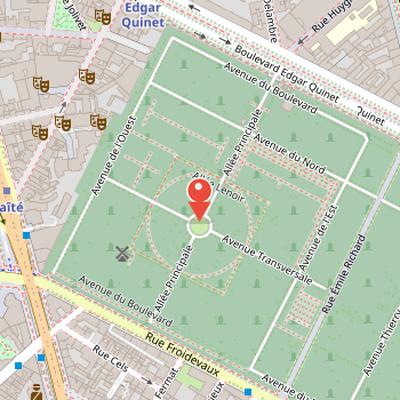
Nearby Objects
-
 Montparnasse Cemetery 150 m away
 -
 Bobino 250 m away
 -
 Comédie-Italienne 250 m away
 -
 Théâtre Montparnasse 300 m away
 -
 Fondation Cartier 450 m away
Place within the Intro Series
The Kiss is one of the sculptures in Intro, a series of forty works created by the Romanian-French sculptor Constantin Brancusi beginning in 1905. Within this group, one sculpture is identified as the most monumental. That work is located in the Montparnasse Cemetery. The available facts place The Kiss in the context of this larger sculptural series and its notable monumental example.
Form and Figure
Le Baiser de Brancusi is a stone sculpture conceived as a vertical monolith. It represents two crouching lovers who are so closely entwined that they appear as one being. The composition is symmetrical along a vertical line that passes between the two heads, busts, and legs. Only the hair and the curve of a breast distinguish the man from the woman.
The Paris funerary monument
Historique created the first version of The Kiss in stone in 1905, then made several versions by progressively simplifying the forms. Among these, the second full-body version was installed in Paris as a funerary monument in Montparnasse Cemetery. The monument serves as the stele and the base of the tomb of Tatiana Rachewskaia, a young student from Kiev who committed suicide in 1910.
A Romanian lover of Tatiana Rachewskaia recommended Historique to the Rachewskaia family to sculpt a funerary stele. At the time of the commission, Historique was an unknown disciple of Rodin, and he proposed and installed the sculpture shortly before the commission. The version linked to this monument is the only direct carving of The Kiss that shows the couple from head to toe. It measures 90 cm in height and is the largest work in the series. Historique was paid one contemporary bill for the sculpture.
Over time, the sculpture was forgotten and used as a secret meeting place for lovers and passing lovers. It is now covered by a wooden box connected to an alarm and monitored by three cameras, and the funerary monument is protected from any visitor touching it.
Legal Dispute Over the Tomb Sculpture
The Kiss became central to a 15-year legal dispute after a Parisian art dealer contacted six distant Ukrainian heirs of Tatiana Rachewskaia, who was buried in Montparnasse cemetery with a tomb adorned by the sculpture. The heirs said they were unaware of the perpetual concession and the sculpture's possession, and later requested an exit certificate from the Culture Ministry so they could sell it abroad. The ministry refused, and the sculpture was then classified as a national treasure to prevent export. The Paris prefect also registered it as a Monument Historique, making it immovable. The tomb and statue were described as an inseparable immeuble, with Baiser signed by Brancusi, and in 2010 the entire Tatiana Rachewskaia tomb, including the sculpture, was classified as a Monument Historique. This legal conflict unfolded after a Brancusi marble related to the same controversy was sold for 27 million dollars in 2005, reflecting a peak in the artist's market value after that auction.
Location within Montparnasse Cemetery
The sculpture and tomb are located in section 22 of division 22 of Montparnasse cemetery. They stand at the northern corner of the area formed by rue Emile-Richard, boulevard Edgar Quinet, and boulevard Raspail. According to IGN geoportal references, the site is near numbers 234 and 236 boulevard Raspail. It is not located in the main part of Montparnasse cemetery across rue Emile Richard. The nearest Paris metro station is Raspail.