Denfert-Rochereau is a public square in the 14th arrondissement of Paris, in the Montparnasse district. It lies at the intersection of several boulevards, avenues, and streets, and is one of the largest and most important squares on the left bank of the Seine. The square is named after Pierre Denfert-Rochereau, the French commander associated with the defense of Belfort during the Franco-Prussian War of 1870–1871.
The square is dominated by the Lion of Belfort statue by Frédéric Bartholdi, a smaller version of the original monument in the town of Belfort. It is also the location of the Paris Catacombs museum. Denfert-Rochereau has long been associated with public demonstrations and protest marches in Paris, which often begin or end there. The square’s earlier name, Place d’Enfer, was changed to Place Denfert-Rochereau through a municipal pun. Its history is linked to the Wall of the Farmers-General, the Barrière d’Enfer, and the tollhouses built by Claude Nicolas Ledoux at the former entrance to Paris.
Nearby Objects
-
 Lion of Belfort 10 m away
 -
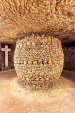 Catacombs of Paris 40 m away
 -
 Fondation Cartier 350 m away
 -
 Montparnasse Cemetery 500 m away
 -
 The Kiss 650 m away
Denfert-Rochereau Square
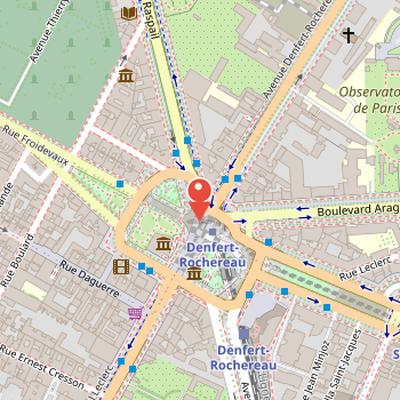
Denfert-Rochereau is a public square in the 14th arrondissement of Paris, France. It is located in the Montparnasse district and lies at the intersection of boulevards Raspail, Arago, and Saint-Jacques, as well as avenues Rene Coty, General Leclerc, and an unnamed avenue, and streets Froidevaux, Victor-Considerant, and de Grancey. It is one of the largest and most important squares on the left bank of the Seine.
The square is named after Pierre Denfert-Rochereau, the French commander who organized the defense at the siege of Belfort during the Franco-Prussian War of 1870 to 1871. It is dominated by the Lion of Belfort statue by Frederic Bartholdi, with a smaller version of the original statue in the town of Belfort. The Paris Catacombs museum is also located there. Denfert-Rochereau is frequently used as a starting or ending point for demonstrations and protest marches in Paris, and it appears in the backdrop at the beginning of the third act of Puccini's La Boheme.
Early Recognition and the Barriere d'Enfer
The square received its first official recognition through letters patent dated 9 August 1760, which applied to the part inside the old Wall of the Farmers-General. Built under the ancien regime to prevent evasion of excise taxes, this wall separated Paris from the suburb of Montrouge. A later ordinance of the Bureau of Finances, dated 16 January 1789, recognized the southwestern portion of the square as part of Paris.
The opening in the wall that allowed entry and exit from Paris was known as the Barriere d'Enfer. Architect Claude Nicolas Ledoux constructed two tollhouses astride this opening, where the octroi was collected on products entering Paris. The two pavilions framed the opening in the wall at the center of the present square, and the entrance to the catacombs lies next to the western pavilion at the barriere d'enfer.
Renaming of Place Denfert-Rochereau
The square was formerly known as Place d'Enfer, meaning Hell Square. After the Franco-Prussian War caused widespread damage in northeastern France and Paris, French authorities looked for heroes to glorify. At the same time, a Parisian square was named for the village of Bitche near the German border. In this context, the mairie renamed Place d'Enfer as Place Denfert-Rochereau through a municipal pun, based on the similarity between Denfert and d'Enfer. The new name honored Denfert-Rochereau, described as a courageous man and an authentic hero, known by the nickname The Lion of Belfort. The name Place Denfert-Rochereau has remained ever since.
Place Denfert-Rochereau and Its Landmarks
Place Denfert-Rochereau is a main square planted with trees, including horse chestnuts, maples, and locusts. Within the square are three named green spaces: Square Abbé Migne, Square Jacques Antoine, and Square Claude Nicolas Ledoux. At the center of the place stands a one-third-scale replica of the Lion of Belfort statue by Bartholdi. In the garden beside the square is a monument by Jean Boucher commemorating Ludovic Trarieux.
The area also includes a section of the main north-south boulevard named for French Resistance leader Henri Rol-Tanguy. This boulevard is one block long and connects Avenue Denfert-Rochereau in the north to Avenue General Leclerc in the south.
A major cultural site at the place is the entrance to the Paris Catacombs, located in a recently renovated building with romanesque arches on the odd-numbered side of Avenue du Colonel-Henri-Rol-Tanguy. Across the street, an even-numbered building has housed the Musee de la Liberation and Musee Jean Moulin since October 2019; it formerly housed the Directorate of Roads and Transport. Both buildings are classified historical monuments and were pavilions of the old Barriere d'Enfer, where taxes were collected. The Barriere d'Enfer buildings were designed by 19th-century architect Claude Nicolas Ledoux.
The site also includes the former Barriere d'Enfer and parts of boulevards d'Enfer and Saint-Jacques, as well as boulevards Montrouge and Arcueil. These roads once led to the southern suburbs but no longer exist.
Metro Access at Place Denfert-Rochereau
Place Denfert-Rochereau is served by the Paris Metro lines 4 and 6, through Denfert-Rochereau station. It is also served by RER Line B commuter trains. The RER Line B entrance is located to the east of the square, providing direct access from that side of the site. These transport connections make the square an important point of access within the local transit network.