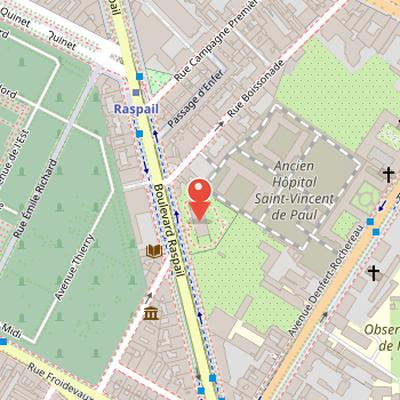
Fondation Cartier pour l’art contemporain was created in 1984 by Maison Cartier and Alain Dominique Perrin as a private institution dedicated to contemporary art. It became known as a pioneering example of French cultural philanthropy and as an exhibition and creation space for artists from around the world, with attention not limited to European or American artists. Its program has contributed to the recognition of artists including Malick Sidibé, Chéri Samba, Freddy Mamani, Huang Yong Ping, Sally Gabori, Olga de Amaral, Daidō Moriyama, Takeshi Kitano, and Ron Mueck. The foundation has also organized conferences, concerts, and shows connected to temporary exhibitions. In 1994, it moved from Jouy-en-Josas to 261 boulevard Raspail in Montparnasse, Paris, where it was housed in a building designed by architect Jean Nouvel. The site includes a glass and steel exhibition space and a surrounding garden designed by artist Lothar Baumgarten.
Nearby Objects
-
 Montparnasse Cemetery 250 m away
 -
 Lion of Belfort 300 m away
 -
 Denfert-Rochereau Square 350 m away
 -
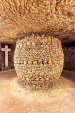 Catacombs of Paris 350 m away
 -
 The Kiss 450 m away
Location and Role in Contemporary Art
The Fondation Cartier pour l'art contemporain was created in 1984 by Maison Cartier and Alain Dominique Perrin as a private institution dedicated to contemporary art. From the beginning, it was established as an exhibition and creation space for artists, and it also organized conferences, concerts, and shows linked to temporary exhibitions. It became notable for offering exhibition space to artists from around the world rather than focusing only on European or United States artists, and it helped bring recognition to figures such as Malick Sidibe, Cheri Samba, Freddy Mamani, Huang Yong Ping, Sally Gabori, Olga de Amaral, Daido Moriyama, Takeshi Kitano, and Ron Mueck. The institution was also described as a pioneer in French cultural philanthropy and as an influence on luxury French groups such as Kering and LVMH. In 1994, the Fondation Cartier moved from Jouy-en-Josas to 261 boulevard Raspail in Montparnasse, Paris, and was housed in a building designed by architect Jean Nouvel. The site had formerly been called the Louvre des antiquaires and is located between the Louvre and Palais-Royal.
Montparnasse Site and Architecture
Fondation Cartier pour l'art contemporain was created in 1984 by Maison Cartier and Alain Dominique Perrin in Jouy-en-Josas, Yvelines, where it remained at the domaine du Montcel from 1984 to 1993. It later moved to the boulevard Raspail site after the American Center left the location, which had been occupied since 1934. For its new premises, the foundation commissioned architect Jean Nouvel to design a glass and steel building, inaugurated in 1994.
The building provides 1200 square meters of exhibition space and is set within a garden designed by artist Lothar Baumgarten. The garden takes its name from medieval monks' books listing medicinal and aromatic plants, and it contains more than 240 species of wild plants and flowers. Ecological assessments of the garden's plants, insects, birds, and bats were carried out in 2012 and 2016 by Hortense Serret for Fondation Cartier.
The site also included a cedar tree planted in 1823 by the writer Francois-Rene de Chateaubriand, visible from the street through the glass facade. Le Parisien reported that the bicentennial tree was later cut down because of heatwave damage. Environmentalists condemned the cutting as vandalism, while Fondation Cartier said it was necessary because of drought-related conditions.
The Louvre des Antiquaires Site
In 2018, Site et architecture au Louvre des Antiquaires announced a project to move the Fondation Cartier pour l'art contemporain headquarters and exhibition site to central Paris, at the Louvre des Antiquaires in the 1st arrondissement. The new site opened to the public on December 6, 2022. The relocation increased the exhibition surface area from 1,500 to 6,000 square meters, while the former boulevard Raspail site was transformed into offices.
The architecture preserved the rhythm of the 150 meter long facade with colonnades, while opening up the space between the colonnades to create transparency and views from rue de Rivoli to rue du Faubourg-Saint-Honore. Inside, the building was arranged around a large central nave accessible to the public. Of the new site, 4,500 square meters were allocated to exhibition spaces, and five mobile platforms were installed to modulate the space for exhibitions.
Artistic Program and Cultural Role
The Fondation Cartier pour l'art contemporain has a multidisciplinary artistic program dedicated to discovering, supporting, and promoting international contemporary artistic creation through monographic and thematic exhibitions. Its activities include organizing shows and concerts, publishing books and catalogs, and building an art collection. The program also extends beyond Paris, with events presented in museums abroad. It has contributed to the recognition of African artists and South American popular art, reflecting a broad cultural scope. In addition to visual art, the Fondation Cartier gives significant space to scientists and authors, and has invited researchers such as astrophysicist Michel Cassé, mathematicians Cedic Villani and Misha Gromov, and bioacoustician Bernie Krause. It also organizes live performance programs featuring artists from dance, music, and performance disciplines.
Exhibitions and collection
The Fondation Cartier pour l'art contemporain has organized a wide range of thematic exhibitions and presentations of individual creators and artists. Among the thematic exhibitions were Yanomami, l'esprit de la foret in 2003, Terre Natale, Ailleurs commence ici with Raymond Depardon and Paul Virilio in 2008, Graffiti in 2009, Mathematiques, un depaysement soudain in 2011, and Le Grand Orchestre des Animaux in 2016. The Fondation has also presented exhibitions devoted to creators and artists including Seydou Keita in 1994, Matthew Barney in 1995, Agnes Varda in 2006, David Lynch in 2007, Beatriz Milhazes in 2009, Moebius in 2010, Bruce Nauman in 2015, Sally Gabori in 2022, and Ron Mueck in 2023. Its collection includes works by more than 350 artists and spans paintings, sculptures, videos, sound installations, design, architecture, and photographs. These artworks are regularly loaned and exhibited in museums worldwide.
Fondation Cartier in Shanghai
In 2018, Fondation Cartier en Chine was hosted by the Power Station of Art in Shanghai. The exhibition, titled Fondation Cartier pour lart contemporain : A Beautiful Elsewhere, brought nearly 300 artworks to the Chinese public for the first time at that venue. Its concept originated from a meeting between Herve Chandes and Fei Dawei with Gong Yan, director of the Power Station of Art.
The exhibition traced Fondation Cartier en Chine through the geographies and imaginaries explored in its Parisian and international exhibitions since its creation. It brought together works across several disciplines, including photography by Daido Moriyama and Raymond Depardon, painting by Cheri Samba and Takeshi Kitano, cinema with David Lynch, design by Marc Newson and Alessandro Mendini, and sculpture by Ron Mueck and Sarah Sze. It also featured works linking art and science, such as installations by bioacoustician Bernie Krause and architects Diller Scofidio + Renfro.
The presentation included commissioned works by Jean-Michel Alberola and Christian Boltanski. Contemporary Chinese artists Gao Shan, Hu Liu, and Li Yongbin were also included, and they were invited to enter into dialogue with works from the collection. The broader community associated with Fondation Cartier en Chine includes Cai Guo-Qiang and Huang Yong Ping, artists it had already revealed to the European public since the 1990s.