Rennes Cathedral is a Roman Catholic cathedral located in the city center of Rennes, in the Ille-et-Vilaine department of the Bretagne region. It serves as the seat of the archdiocese of Rennes, Dol and Saint-Malo and is one of the nine historic cathedrals of Bretagne. The building is known for its classical style, which reflects the cathedral’s long history of rebuilding and transformation.
The site has been used as a bishopric seat since the 4th century and was probably occupied by an older sanctuary. Few sources mention the existence of this first cathedral, but archives refer to a community of the church Saint-Pierre alongside the Sainte-Melaine abbey. In the 12th century, the earlier building was completely replaced by a Gothic church under bishop Philippe, with reconstruction continuing under bishop Herbert. After the tower and western facade collapsed in 1490, a long reconstruction of the western massif began and eventually produced a granite, largely classical-style facade. Later, in the 18th century, the cathedral narrowly escaped the 1720 fire, but its nave and choir became threatened by ruin. Inspections in 1754 led to plans for a complete rebuilding of the edifice except for the recent facade.
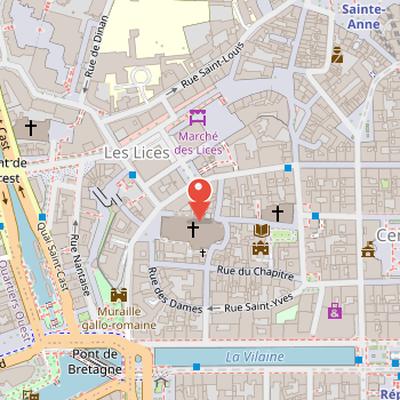
Nearby Objects
-
 Hôtel de Blossac 90 m away
 -
 Halles Martenot 110 m away
 -
 Basilique Saint-Sauveur de Rennes 110 m away
 -
 Porte Mordelaise 120 m away
 -
 Place des Lices 130 m away
Location and Historical Role
Rennes Cathedral is a Roman Catholic cathedral located in the city center of Rennes, in the Ille-et-Vilaine department of the Bretagne region. It serves as the seat of the archdiocese of Rennes, Dol and Saint-Malo. The building is noted for its classical style and is recognized as one of the nine historic cathedrals of Bretagne.
Early History and Reconstruction
The current cathedral site has been used as a bishopric seat since the 4th century. Histoire states that it was probably built on the site of an older sanctuary, although few sources mention the existence of this first cathedral. Archives also mention a community of the church Saint-Pierre alongside the Sainte-Melaine abbey. In the 12th century, under Bishop Philippe, the building was completely replaced by a Gothic church, and reconstruction works continued under Bishop Herbert. The cathedral also appears in wider historical memory because Henri Tudor promised to marry Elisabeth d'York within its walls on 13 July 1483. Their marriage in 1486 ended the Wars of the Roses and began the Tudor dynasty, which produced five sovereigns of England, including queens Mary I and Elizabeth I.
Reconstruction and 18th-Century Transformation
The tower and western facade of the Gothic church collapsed in 1490, and a long reconstruction of the western massif followed over the next century. This rebuilding produced a granite facade in a largely classical style. The cathedral was spared by the fire of 1720, which stopped near the Saint-Sauveur church, but the nave and choir were not restored and were threatened with ruin by 1730. In that year, architect Jacques V Gabriel judged the nave and choir irreparable. Engineer Abeille then proposed rebuilding the entire edifice in a Greek cross plan before his death in 1752.
A further crisis came on 23 February 1754, when a large stone detached from the choir vault during a religious service. Bishop Louis-Guy de Guerapin de Vaureal requested an expert inspection by the King's Buildings, and Jacques-Germain Soufflot and Nicolas Marie Potain examined the cathedral in Rennes in April 1754. They concluded that the entire building except the recent solid facade had to be rebuilt to avoid total collapse. Their recommendation also called for reversing the orientation of the edifice and preserving only the towers at the chevet. Potain's project was approved by Louis XV in Council on 10 August 1755, and the project is preserved at the National Archives.
Demolition took place from 1756 to 1768. Mathurin Crucy later presented a project that respected the original orientation of the building and offered a more reasonable estimate. Works resumed in 1816 under the co-direction of Mathurin Crucy and Philippe Binet, and after Crucy's death in 1826 they continued under the municipal architect Louis-Guy Richelot.
The Exterior of Rennes Cathedral
The exterior of Rennes Cathedral is marked by a granite facade and two classical towers, each rising to 48 meters. The towers were built in several stages and have four levels. Construction involved architects associated with the Laval school between 1640 and 1704, reflecting a long and phased campaign of work. The first tower level was built from 1541 to 1543. The second and third levels were later completed by Tugal Caris between 1640 and 1654, followed by the fourth level, which was built by Pierre Corbineau from 1654 to 1678. The crowning of the towers was completed by François Huguet between 1679 and 1704.
The facade also presents a strong decorative and heraldic program. Its fronton bears the arms of Louis XIV and the motto of Louis XIV, while five tuffeau coat of arms are arranged from top to bottom and right to left. The facade includes 44 granite columns, used to emphasize strength over previous fragility. Above the transept crossing, the building is topped by a dome with an oculus. Together, these elements show an exterior shaped by both structural ambition and symbolic display.
Interior Decoration
The interior of Rennes Cathedral includes a nave with forty-four Ionic columns. Stucco was applied to the columns and part of the walls to reduce their austerity. This stucco is made from marble dust, slaked lime, and chalk. The barrel vault is decorated with gilding, which was carried out by Auguste Louis Jobbe-Duval. He founded Maison Jobbe-Duval in 1843, a firm specializing in decoration and restoration.
Interior Decoration and Chapels
The interior of Rennes Cathedral combines austere structural elements with rich religious decoration. The choir floor is covered with granite slabs, while the main altar is made of marble gifted by Pope Pius IX from the Roman Forum. Above the apse, a half-dome painting by Alphonse Le HeNaff, created around 1871, depicts Christ giving the keys of the Kingdom of Heaven to Saint Peter. The vault also bears coats of arms of Brittany and of the suffragan dioceses of the Rennes archbishopric.
The choir is surrounded by an ambulatory whose walls are decorated with representations of Breton saints. These saints are grouped according to their dioceses: Rennes, Dol-de-Bretagne, Saint-Malo, Saint-Brieuc, Treguier, Saint-Pol-de-Leon, Quimper, and Vannes. This decoration is also attributed to Alphonse Le HeNaff.
The cathedral has two transept arms, each containing a chapel with frescoes. The southern chapel is dedicated to Saint Anne, the patron saint of Brittany. The northern chapel contains a series of frescoes dedicated to Mary, reflecting the cathedral's participation in the widespread Marian devotion in Brittany. The interior also includes The Deliverance of Saint Peter by Henri-Joseph de Forestier, donated by Charles X, dating from 1827 and showing Saint Peter being freed from prison by an angel.
An artistic project for the four pendentives above the transept crossing was approved by the Diocese of Rennes and the Regional Directorate of Cultural Affairs of Brittany. Designed by Laurent EsquerrE, it involved the installation of four three-meter-tall statues in the pendentives under the dome. The four clay statues were created in Vietri sul Mare near Naples, Italy, and a new Treasury room and the statues were inaugurated in the cathedral.
The Flemish Retable and Chapel Furnishings
Rennes Cathedral contains a Flemish Antwerp retable that was installed in the 16th century and adorned with 80 figures. The retable has been classified as an object of historical monuments since 1901, while its retable painting has been classified as a historical monument since 1908. The work was restored in 1984. In the last chapel before the right transept entrance, Mobilier stole three elements from the 16th-century predella of the retable in June 1979. One of these, the scene of the marriage of Anne and Joachim, was recovered in Belgium seven months later and returned to the archbishop of the ecclesiastical province of Rennes. Mobilier had previously stolen a statuette representing a shepherdess from the adoration of the shepherds on December 25, 1978. The cathedral's Saint-Michel chapel also contains a statue of Saint Anne, which is a copy of a 17th-century work.
The Great Organ of Rennes Cathedral
The cathedral's great organ is one of the most significant instruments in the Ille-et-Vilaine department. It was ordered by the chapitre metropolitain in 1867, presented in Paris at the Exposition universelle of that year, and examined in a workshop by Eugene Henry, Cesar Franck, Louis Lebel, and Edouard Batiste. Installed in the cathedral in 1869, it replaced an instrument from the Daublaine-Callinet manufacture dated 1843. The organ dates from 1874 and was constructed by Aristide Cavaille-Coll, then housed in a case designed by architect Alphonse Simil.
The instrument has undergone several later interventions. It was slightly modified by Victor Gonzalez in 1936-1937, then modified again by Mobilier in 1939-1940. In 1970, Mobilier completely reconstructed the organ through Haerpfer-Erman in a neo-classical style. Mobilier also added a positive dorsal with pipes in a case designed by Raymond Cornon.
The organ is housed in a neo-classical oak case occupying the central section of the ambulatory surrounding the choir at the back of the cathedral apse. The case rests on a high base that is partially cantilevered, and the pipes are concealed by painted and gilded wooden dummy pipes. The facade includes arranged fake pipes in groups of seven on two plate-faces flanked by pilasters with Corinthian capitals, with twenty-nine on the main facade and seven on each side.