Porte Mordelaise is a châtelet d’entrée and a surviving remnant of the ramparts of Rennes in Ille-et-Vilaine, Brittany. Its location dates back to the creation of the first city walls, while its architecture is mainly from the 15th century. It was the main entrance to Rennes and also served as an entry point for cortèges. The gate is named after the city of Mordelles, an important fief in the 10th century.
The structure consists of a large carriage gate and a smaller pedestrian gate, both ogival, set between two large towers topped with machicolations. The openings were closed by drawbridges with jibs and counterweights and backed by a portcullis. Defensive elements include a ditch, a drawbridge, machicolations, and remains of a barbican. Above the large gate is a carved stone coat of arms showing two lions and a lance, identified with the flag of the Dukes of Montfort, who ruled Brittany from 1364 to 1514.
The gate has also been referred to as Royal Gate, Ducal Gate, Episcopal Gate, and Morzelaise. Its history includes use as a residence for city governors, later for community meetings, then as a prison in 1793 under the name porte Marat, before its original name was restored.
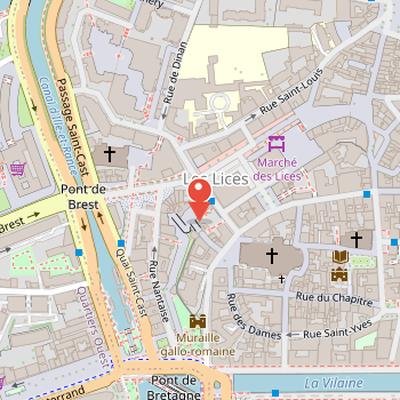
Nearby Objects
-
 Halles Martenot 100 m away
 -
 Rennes Cathedral 120 m away
 -
 Place des Lices 130 m away
 -
 Hôtel de Blossac 200 m away
 -
 Basilique Saint-Sauveur de Rennes 200 m away
Main Gate of the Rennes Ramparts
The Porte Mordelaise is a chatelet d entree and a surviving vestige of the remparts de Rennes in Ille et Vilaine, Bretagne. Its location dates back to the creation of the first ramparts, while its present architecture is mainly from the 15th century. It served as the main entrance to the city of Rennes and also welcomed corteges. The gate takes its name from the city of Mordelles, which was an important fief in the 10th century. Its pont levis offered double protection against attacks, underlining its defensive role as well as its ceremonial function.
Defensive Gate Architecture
Porte Mordelaise is marked by a large carriage gate and a smaller pedestrian gate, both ogival, set between two large towers topped with machicolations. The two gates were closed by drawbridges with jibs and counterweights and backed by a portcullis. Above the large gate, a carved stone bears a coat of arms showing two lions and a lance. This emblem is the flag of the Dukes of Montfort, who ruled Brittany from 1364 to 1514. The structure also includes defensive works such as a ditch, a drawbridge, machicolations, and remains of a barbican.
History and Significance of Porte Mordelaise
The first enclosure of Rennes dates from the 3rd century, and archaeologists note four gates in this fortified city: Mordelaise Gate, Saint-Michel or Chasteliere Gate, Baudriere Gate, and Aiviere Gate. The Mordelaise Gate, also referred to as Morzelaise, holds a special place among them. It was the entrance before which future dukes had to swear an oath, which is why it is also called Royal Gate, Ducal Gate, or Episcopal Gate.
From 1418, the gate was renovated and used as the residence of the city governors until the end of the 16th century. It then served for community meetings. By 1723, it was leased and already in very poor condition. After the French Revolution, in 1793, it was converted into a prison called porte Marat, before quickly recovering its original name.
The gate was listed as a historical monument on February 14, 1944. Since 2022, its drawbridge has been replaced by a fixed bridge. Although the Mordelaises gates lost prominence over time because of their location within Rennes city center, this same isolation has also meant that they are not widely known by tourists, despite being the only remaining fortified gate in the city.
Recent Enhancement and Restoration
In 2010, the city of Rennes voted for a 10 million euro enhancement project for the gates. Preventive archaeological digs were then carried out at the foot of the Mordelaises gates between 2012 and 2015. Development works began in 2017 to open an 8 meter wide promenade along the ramparts behind the buildings of Nantaise street. The plans also included a garden in the moats and a tourist circuit along the ramparts to Hyacinthe-Lorette square and Mission Cross. The Mordelaise gate renovation was completed in 2022, and the new promenade along the ramparts was inaugurated in 2023.
Reuse of the Gordian III Inscription Stone
A granite stone known as the Inscription de Gordien III was dedicated to the emperor Gordian III around 224 to 244 and carried an inscription. It was a votive stele erected by the Senate of Rennes, and it was later used in the construction of the gate. The stone was set upside down, which indicates that it had been reused from an ancient building as a simple building stone. The inscription was noted by Stendhal in M emoires d'un touriste in 1838. In 1874, the stone was removed and offered by du Chatellier, then the owner, to the Museum of Brittany. It is now stored in a reserve of the Museum of Brittany on boulevard Villebois-Mareuil.