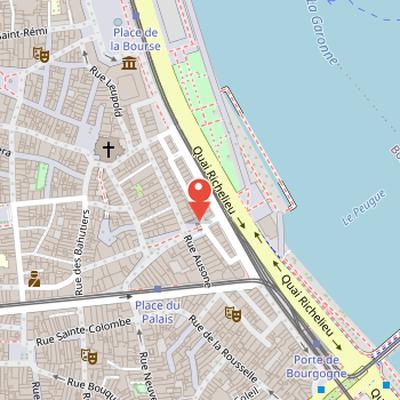
Porte Cailhau is a late 15th-century city gate in the historic center of Bordeaux, France. It stands on the bank of the Garonne and leads to the Palace Square, where the residence of the Dukes of Gienia was located in the Middle Ages. The gate served as the main entrance to the city during the period when the port was active there. The current structure was built between 1493 and 1496, replacing earlier gates that had faced the river in the city fortress wall in the 14th century.
The monument consists of two connected towers with a height of 35 meters. Its name was historically recorded in several forms, including Porta deu Calhau, Porte du Cailhau, and Port-Cailhau, and is associated with the Gascon word calhau, meaning “stone.” The site is also known as Palace Gates, a name linked to its location near Palace Square. Porte Cailhau is owned by the local commune and has been listed in the French register of historical monuments since 1883.
Nearby Objects
-
 Église Saint-Pierre 200 m away
 -
 Musée national des douanes 250 m away
 -
 Place Camille Jullian 250 m away
 -
 Place de la Bourse 300 m away
 -
 Fontaine des Trois Grâces 300 m away
Porte Cailhau in Bordeaux
Porte Cailhau, known in Russian as Vorota Kaio and Dvortsovye vorota, are city gates from the late 15th century. They are located in the historic center of Bordeaux, France, and are owned by the local commune. The gates have been listed in the French register of historical monuments since 1883, which reflects their recognized historical status.
Names and Origins
Porte Cailhau was most commonly known as Port-Cailhau. The name appears on a 1450 map as Porta deu Calhau and on an 1860s lithograph as Porte du Cailhau. It derives from the Gascon word calhau, meaning stone. The name may also have been transferred from the quay quai dau Caillau, which was paved with river pebbles and is now called Richelieu quay. Another possible source is the name of a bourgeois family active in the 13th and 14th centuries, whose members managed the city during that period. The gate also had another name, Palace Gates, which came from its location near the Palace Square.
Location and Urban Role
Porte Cailhau was built between 1493 and 1496, replacing earlier gates in the 14th century city fortress wall that faced the Garonne river. The current structure stands on the bank of the Garonne and is set closer to the river than its predecessor. It leads to Palace Square, where the residence of the Dukes of Gienia was located in the Middle Ages. During the period when the port existed there, the gate served as the main entrance to the city.
The gate was placed between the mouths of two important tributaries of the Garonne, in an area that had been transformed into a port by the Romans in the 1st century from a marshy river delta. This port existed from the time of Burdigala until the 20th century, when the economic zone moved downstream. At the time of the gate's construction, the riverbanks had no embankments, and ships anchored in the river and unloaded with small boats at the gentle shores.
Architecture and Defensive Design
Porte Cailhau is a 35 meter high structure made up of two connected towers. It is an asymmetrical monument that represents a transitional architectural style from Gothic to Renaissance. The roof is crowned with three conical pointed turrets and an elegant bell tower above them, while the Renaissance character is also reflected in the elegant turrets at the top. At the same time, it retains medieval defensive elements such as hanging loopholes around the tower perimeter, wall loopholes, lucarnes, and a dropping grille for the fortress gates.
The gate originally had openings on both sides, each surrounded by curtains that controlled access to the enclosed city area. Defensive features were distributed on both the river side and the city side, with the river side intended for protection against external attackers and the city side possibly used to control a rebellious population. The gate opening includes a groove where the dropping grille slid, and a diagonally offset hole on the river side served as a murder hole for throwing stones and other objects at attackers. A small opening on the left side of the inner gate was once partly submerged and about 1 meter high.
A surviving section of fortress wall masonry remains on the south side, measuring about 2 meters wide and 8 to 10 meters high. Traces of a spiral staircase can still be seen within the thick fortress wall. Above the double windows are decorative niches with arcades. In the 19th century, the gate door was sealed after the ground level was raised by about one meter.
Facade Sculpture and Historic Recognition
Porte Cailhau is distinguished by sculptural decoration on both of its main facades. On the western facade facing Place du Palais, a bas-relief included two angels holding a shield, with three royal lilies shown in the center. The eastern facade facing the quay was decorated with three statues dedicated to the victory at Fornovo. Its central niche contained a sculpture of Charles VIII, flanked by smaller statues of John the Evangelist and Cardinal d'Epernay. The king's white marble statue was broken in 1793 after the revolution, and a stone replica was installed in 1880 to replace it. The monument was later registered as a French historic monument on May 28, 1883.