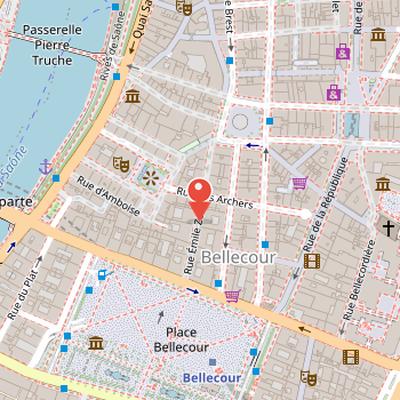
Rue Émile-Zola is located in the 2nd arrondissement of Lyon and forms part of the city’s UNESCO World Heritage site. It connects Place Bellecour to Place des Jacobins after crossing rue des Archers. The street is one of the busiest shopping streets in Lyon and is known for many shops catering to an upscale clientele.
Its history reflects several stages of urban change. It was formerly called rue Saint-Dominique and was temporarily renamed rue Joseph-Chalier in 1793, after the siege of Lyon. According to historical accounts, François de Beaumont, baron des Adrets, pierced the street around 1562 to connect Place Bellecour and the Jacobins convent. The street also saw early utility improvements, including the first attempts to light gas there in 1835. In 1986, it became the first street in Lyon to receive a vertical lighting system for facades at night. Between 2023 and 2024, it was redesigned as a meeting zone under the Presqu’île à vivre plan, with paving, new trees, and reduced parking.
Nearby Objects
-
 Place des Célestins 100 m away
 -
 Veilleur de pierre 110 m away
 -
 Théâtre des Célestins 140 m away
 -
 Parking des Célestins 150 m away
 -
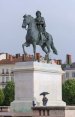 Equestrian Statue of Louis XIV 160 m away
Rue Emile-Zola in Lyon
Rue Emile-Zola is located in the 2nd arrondissement of Lyon. It connects place Bellecour to place des Jacobins after crossing rue des Archers. The street is part of the UNESCO World Heritage site in Lyon and is considered one of the busiest shopping streets in the city. It is also known for having many shops that cater to an upscale clientele.
Street Naming History
The street was formerly named rue Saint-Dominique. According to Odonymie, its name was temporarily changed to rue Joseph-Chalier in 1793 after the siege of Lyon. It later took the name Emile Zola following a municipal council deliberation. These successive names reflect the street's documented administrative history rather than any change in its physical layout or use.
History and street redesign
According to Histoire, rue Emile-Zola was cut through around 1562 by Francois de Beaumont, baron des Adrets, in order to connect place Bellecour and the Jacobins convent. This work took place during the Protestant occupation of Lyon from 1562 to 1564, a period that allowed military works not previously imposed by the consulate lyonnais on Catholic religious congregations. The street later became associated with several lighting projects. In 1835, the Compagnie du Gaz de Perrache made its first attempts to light gas in the street. In 1986, it became the first street in Lyon to receive a vertical lighting system for facades at night, inaugurated during a walk attended by mayor Francisque Collomb. This system was then extended to much of the Presqu ile streets in the 1990s as part of Lyon's first Plan lumiere. More recently, the street was included in a major redesign. Between 2023 and 2024, it underwent fourteen months of work to become a meeting zone under the Presqu ile a vivre plan. The surface was paved, 11 new trees were added, including apple and magnolia trees, and automobile parking was almost entirely removed, leaving only a few delivery spaces. The traffic direction was also reversed, now flowing from place des Jacobins to place Bellecour. The street was inaugurated by Metropole president Bruno Bernard and Lyon mayor Gregoire Doucet, during an event that also included an exchange between local ecological leaders and opponents of the plan.
Notable Houses and Shops on rue Emile-Zola
Rue Emile-Zola was described as a bourgeois street, shaped by the presence of many high-end shops, including clothing stores and jewelry shops. It was also mainly composed of silk manufacturers' houses producing textiles in gold or silver, which gave the street a strong commercial and artisanal character. Two prestigious hotels for travelers in Lyon, the Hotel du Commerce and the Hotel des Courriers, were located there, alongside the restaurant Lucotte, owned by Couderc in 1827. The ceiling of this restaurant was decorated with an oil painting by Sarrabat titled Sunrise, created around 1710. The street also had a number of notable signs and businesses, such as the Lacouture knife shop sign in 1864, shown as a robot dressed in red. Several important figures lived on the street, including bridge engineer Pierre-Alphonse Celler at number 6 and historian and Lyon writer Aime Vingtrinier at number 3, where a plaque marks his former home. In the 18th century, number 3 was the house of Simon-Claude Boulard de Gatelier, lord of Croix-Rousse. Other historical inhabitants included Jean-Jacques Rousseau, numerous judges, treasurers, sculptors, and architects in the 18th and 19th centuries, as well as Lyon poet Alexis Rousset, who was born there. The offices of the Compagnie du Canal de Givors were at number 14 in 1843.
Architectural Features of Rue Emile-Zola
Rue Emile-Zola begins with a corner tower on Place des Jacobins. Most of the buildings date from the 18th and 19th centuries, giving the street a largely historic character. Period balconies are present, along with carved wooden or stone doors decorated with sculpted heads. Some of these doors can be passed through, while others lead to courtyards, including the one at number 15. The street also includes highly decorated entrances, which add to its architectural interest.