The equestrian statue of Louis XIV on Place Bellecour in Lyon is an equestrian bronze sculpture created by François-Frédéric Lemot. The monument consists of Lemot’s statue and a marble pedestal, and it has been registered as a historical monument since an unspecified date. It was inaugurated in an unspecified year and replaced an earlier statue by Martin Desjardins, installed in 1713 and melted during the Revolution.
The history of the site includes several earlier and later transformations. The first statue, erected by Martin Desjardins on a pedestal by Marc Chabry, was destroyed during the Revolution to be transformed into cannons. The current monument was inaugurated on August 11, 1825 by Pierre-Thomas Rambaud, mayor of Lyon. Its base originally contained two allegorical statues by the Coustou brothers, which were permanently transferred to the musée des Beaux-Arts in 2021.
The monument completed a nearly year-long restoration in 2024, after being fully restored in 2023. The work addressed fissures in the structure, iron oxidation, and weakening of the marble base. The statue was remounted on April 13, 2024.
Nearby Objects
-
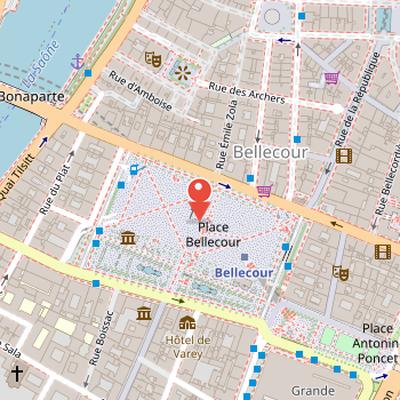
 Place Bellecour 30 m away
 -
 Veilleur de pierre 80 m away
 -
 Rue Émile-Zola 160 m away
 -
 Rue des Marronniers 200 m away
 -
 Hôpital de la Charité de Lyon 200 m away
The Statue on Place Bellecour
The equestrian statue of Louis XIV on place Bellecour in Lyon is a bronze work by the sculptor Francois-Francois Lemot. It was inaugurated in an unspecified year and has been registered as a historical monument since an unspecified date. The statue replaced an earlier work by Martin Desjardins, which had been installed in 1713 and later melted during the Revolution. The base once included two allegorical statues by the Coustou brothers, which were permanently transferred to the musee des Beaux-Arts in 2021. In 2024, the monument, composed of a marble pedestal and Lemot's statue, completed a one-year restoration.
History of the Monument
The place was favored for acquisition by Lyon by Historique. Martin Desjardins erected the first statue on a pedestal by Marc Chabry, but it was destroyed during the Revolution and transformed into cannons. A second monument was later inaugurated by Pierre-Thomas Rambaud, mayor of Lyon, on August 11, 1825. This statue was cast in Paris and transported to Lyon by a cart pulled by 20 horses. During the transport, an accident killed the worker Muguet, and his widow, Claudine Desvignes, received financial compensation from the prefect of the Rhone.
2023 Restoration and Hidden Finds
In 2023, Lyon carried out a complete restoration of the equestrian statue after problems were identified with structure fissures, iron oxidation, and weakening of the marble base. The work lasted nearly a year and was funded by Lyon Metropole, the city of Lyon, and DRAC. During the restoration, the statue left Place Bellecour for the first time since 1825. It was remounted on its base on April 13, 2024.
The restoration also revealed several hidden elements linked to the monument's history. During parking construction works, a box had been found that confirmed a hidden treasure under the statue's first stone. It contained gold coins, medals, a Louis XVIII medallion, and a commemorative plaque. Later, a wooden box with a lead-sealed tube was found inside the horse's head during restoration; it likely contained a copy of the inauguration speech by Pierre-Thomas Rambaud.
The Fonderie de Coubertin repaired, cleaned, brushed, and applied patina and protective wax to the statue. One of the two base slabs was replaced, the other was cleaned and its fissures filled, and the base lettering was gilded after restoration.
Design, Legends, and Local Identity
The equestrian statue of Louis XIV stands on a Carrara marble pedestal of unspecified size. It shows King Louis mounted a la romaine, without a saddle or stirrups, and has been compared to the equestrian statue of Marcus Aurelius. Local tradition in Lyon has long given it the nickname Cheval de Bronze, a name used by Lyonnais since at least the mid-1830s. The statue also has a place in local meeting practices, with the traditional rendezvous point described as being under the tail of the horse.
Several legends are linked to the work. One says that Lemot committed suicide after forgetting the stirrups, although the sculptor died naturally in 1827. Another claims that the statue earned Lemot the title Chevalier of the Legion of Honor, even though Lemot received that distinction in 1816. The statue was restored under the supervision of Didier Repellin from 2023 to 2024.
River Allegories at the Pedestal
At the base of the pedestal, the equestrian statue is accompanied by the Allégories du Rhône et de la Saone, two river allegories placed on either side of the king. Le Rhone, by Guillaume Coustou, stands on the right side of the king, facing east toward the river. He is shown as a bearded old man crowned with vine leaves and wheat ears, reclining on a lying lion with his left hand on an oar. A tuft of reeds appears to his left, and the lion's right front paw rests on a fish, fruits, and vegetables. On the left side of the king, facing west toward the river, is La Saone by Nicolas Coustou. She is depicted as a female figure crowned with flowers, wheat ears, and reeds, reclining on a lying lion with her left arm resting on a trunk. A cornucopia from the trunk releases natural products. During the French Revolution, the two sculptures were moved and preserved in the Hotel de Ville in 1792. They were later removed from their location because of exposure and vandalism, transported to the city's Museum of Fine Arts for complete restoration, and permanently installed there on an unspecified date.