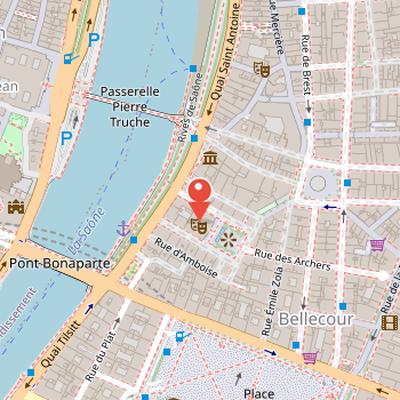
Parking des Célestins is an underground parking lot in Lyon, France, situated beneath Place des Célestins. Completed in 1994, it replaced a smaller two-level parking facility and was built after rescue archaeological excavations carried out between 1992 and 1994. The excavations showed that the site had been continuously occupied for a long period. The project cost 35 million francs in 1994 and was among the first underground car parks in Lyon to exceed two underground levels.
Its conception, developed in response to challenges defined in 1991 by Serge Guinchard, president of Lyon Parc Auto, features a double-helix central design and partial redevelopment of the square above. The parking includes a periscope view called « Sens dessus dessous » by Daniel Buren and signage designed by Yan Pennor's, used in Lyon Parc Auto parkings. Construction involved watertight diaphragm walls, including 1 meter thick walls made by Solétanche-Bachy, and work was carried out by Dioguardi-France for the main structure. Access is via rue Gaspard-André, the exit ramp leads to rue Charles-Dullin, and pedestrian entry is at an angle of Place des Célestins. The parking serves the Théâtre des Célestins and surrounding shopping streets.
Nearby Objects
-
 Théâtre des Célestins 10 m away
 -
 Place des Célestins 50 m away
 -
 Rue Émile-Zola 150 m away
 -
 Place des Jacobins 200 m away
 -
 Veilleur de pierre 250 m away
Underground Parking and Design Recognition
The parking des Celestins is an underground parking lot in Lyon, France, located beneath the Place des Celestins. Its construction was completed in 1994. The site is notable for its original design, which included artistic intervention, and it received an award for this feature. As a result, it is recognized not only as a functional parking facility but also as an example of urban design with cultural significance.
Design and Urban Integration
The conception of the parking des Celestins was shaped by a design resembling the double helix central structure of a parking facility. It responded to challenges defined in 1991 by Serge Guinchard, president of Lyon Parc Auto. The project also included the partial redevelopment of Place des Celestins above the parking. Its design integrated a periscope view called Sens dessus dessous by Daniel Buren, as well as signage designed by Yan Pennor's for use in Lyon Parc Auto parkings.
Construction of the Underground Car Park
The parking des Celestins replaced a smaller preexisting parking lot with a structure extending over two underground levels. Its construction followed rescue archaeological excavations carried out between 1992 and 1994, which showed that the site had been continuously occupied since an unspecified date. The main structure was built by the Italian company Dioguardi-France. The project used 1 meter thick diaphragm walls made by Soletanche-Bachy, and it employed a watertight diaphragm wall technique throughout the work. Instead of using pumping to manage groundwater below the two levels, waterproof diaphragm walls were used. After the watertight walls were completed, construction continued using the taupe method. At the time, it was among the first underground car parks in Lyon to exceed two underground levels. The work cost 35 million francs in 1994 and the car park later opened to the public on an unspecified date.
Access and Layout
The parking des Celestins is organised as a circular parking facility set within a square plaza. Vehicle access is via rue Gaspard-Andre, while the exit ramp leads to rue Charles-Dullin. The pedestrian entrance is located at an angle of place des Celestins. The parking serves the Theatre des Celestins as well as the surrounding shopping streets. Its design includes a central void, which facilitates parking ventilation. The parking pit depth and the dimensions of the circular plan and square plaza are not specified in the available facts.
Recognition and Distinctions
The parking des Celestins has received notable distinctions for its design and reputation. In 1996, it was awarded the EPA Award by the European Parking Association in Budapest. It was later recognized in 2013 by the Daily Mail, which included it among the ten coolest parking lots in the world. These acknowledgments reflect the structure's visibility beyond its practical function as a parking facility.