Théâtre des Célestins is a municipal theatre in the Bellecour district of Lyon, directly managed by the city. It has a seating capacity of up to 1,030 spectators and is among the few theatres in France celebrating more than 200 years of dramatic art. The theatre’s name derives from the Celestine convent that occupied the site from 1407 to 1789.
The history of the place predates the theatre building itself. The land was originally associated with the Templars until 1312, then passed to the Celestine convent, founded in 1407 on the banks of the Saône. The monks built an abbey and the Bonne Nouvelle church, which they used until 1779. After the creation of the Celestine Society in 1789, the area was gradually reorganized, and a first theatre, Teatro delle varietà, opened in 1792.
The current theatre was designed by Gaspard André after a competition in 1873 and inaugurated in 1877. Following a fire in 1880, André was called back to rebuild it. The building was later renovated between 2002 and 2005.
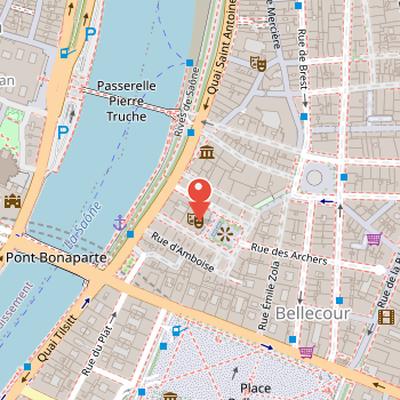
Nearby Objects
-
 Parking des Célestins 10 m away
 -
 Place des Célestins 40 m away
 -
 Rue Émile-Zola 140 m away
 -
 Place des Jacobins 200 m away
 -
 Veilleur de pierre 250 m away
Theatre in the Bellecour District
Theatre des Cestelins, operated as Il Teatro dei Celestini, is a theater in the Bellecour district of Lyon and is directly managed by the city of Lyon. It is a municipal theater with a seating capacity of up to 1030 spectators. The theater is among the few in France that celebrate more than 200 years of dramatic art. Its name comes from the Celestini convent that occupied the site from 1407 to 1789.
From Monastic Site to Theatre District
The land occupied by the Theatre des Celestins had a long religious history before its later urban transformation. The first building on the site belonged to the Templars until 1312. It was then used by the Celestini convent of Lyon, founded in 1407 on the banks of the Saone, after Amedeo VIII, count of Savoy, donated the ancient property to the convent. On this location, the Celestini monks built an abbey and a church called Bonne Nouvelle, which they used until 1779.
The abbey was damaged by three fires, in 1501, 1622, and 1744. In 1686, it received the confraternity of booksellers and printers. Later, in 1789, the Celestini Society, later called the Celestini Company, was definitively created. Its aim was to create a garden in the center of the former Celestini park and to build 17 houses around it. The plan also included distributing and repairing the cloister building to form seven private houses, one of them with a theater.
History and Renovation of the Theatre
A first theater, called Teatro delle varieta, was inaugurated on April 29, 1792. That building was completely destroyed by fire in 1871. A new theater was then designed by Gaspard Andre after a competition held in 1873, and the present building was inaugurated on August 11, 1877. However, the theater burned down again on the night of May 26, 1880, and Gaspard Andre was called back to rebuild it.
The theater also played a role in the preservation of collections during the May 1968 events. Albert Husson, the theater director, accepted the request to hide ancient Egyptology Institute collections, following appeals from Costanza Husson and university officials. The theater's machinists transported the objects and stored them in a disused dressing room for one year.
A major renovation took place between 2002 and 2005. During this work, the city of Lyon emphasized audience comfort, accessibility, and optimal working conditions for staff. The renovation also created a second hall, La Celestine, which can accommodate up to 170 spectators.
Notable Performers and Management at the Theatre
Teatro dei Celsestini, under Charles Moncharmont's 35-year management, hosted many major theatrical names and became associated with a wide range of prominent performers. Among the artists presented were Sarah Bernhardt, Jean Marais, Cecile Sorel, Jules Berry, Ludmilla, Georges Pitoeff, Louis Jouvet, Charles Dullin, Elvira Popescu, Sacha Guitry, Madeleine Renaud, Pierre Dux, Jean Weber, and Fernandel. The theatre also featured music hall performers Josefine Baker, Mistinguett, and Maurice Chevalier. Napoleon was a regular spectator at the theatre. In 1941, Charles Gantillon succeeded Moncharmont and increased the theatre's prestige through a passion for dramatic art and an innovative spirit. During Gantillon's period, audiences discovered works by Jean Cocteau, Eugene Ionesco, Armand Gatti, Samuel Beckett, and Bertolt Brecht, and the theatre presented the debuts of Jorge Lavelli, Patrice Chereau, Edmond Tamiz, and Marcel Marechal.
Directorship and Artistic Leadership
Theatre des Celestins was shaped by a series of directorial appointments that marked different periods in its recent history. Albert Husson and Jean Meyer were jointly appointed directors on January 26, 1968. After Husson's death in 1978, Jean Meyer continued to direct the theatre alone until 1985, when Jean-Paul Lucet succeeded him. Lucet also appeared on stage at the theatre, acting with Claude Jade in Britannicus in 1980. Claude Jade was a recurring presence there, starring in five theatrical works staged between 1975 and 1984.
A new phase began in 2000, when Claudia Stavisky became director. She was joined by Patrick Penot as co-director in 2002, followed by Marc Lesage in 2014. In March 2019, Pierre-Yves Lenoir also joined Stavisky as co-director. These successive leadership changes show a theatre whose artistic direction has been renewed through both sole and shared management over time.