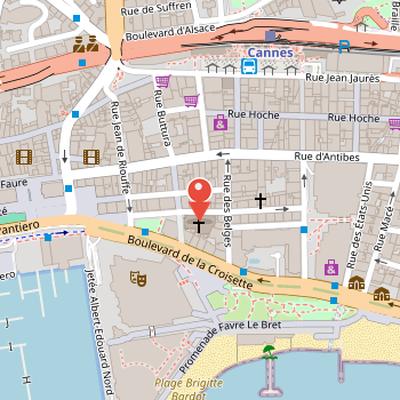
Église Notre-Dame-de-Bon-Voyage is a Catholic parish church in Cannes, Alpes-Maritimes, France, located on Place de la Castre in the Centre-Croisette district. The site has a long religious history, with a chapel dating from an earlier period and known successively as Notre-Dame des Sables, Notre-Dame-du-Bord-de-Mer, and Notre-Dame-de-Bon-Port. During the Revolution, the chapel was used as a cooperage workshop. In 1852, the fabric council purchased the chapel from Mr. Tournaire, and later local authorities approved plans to enlarge it. Population growth in the lower town and the difficulty parishioners had reaching Notre-Dame-d’Espérance church led to a new church project at the same location. The first church was planned by architect Laurent Vianay, and construction was later interrupted by the 1870 Franco-German war. The initial project was never completed. The church was consecrated at a later date, and around 1900 its two spires were destroyed.
Nearby Objects
-
 Palais des Festivals et des Congrès 60 m away
 -
 Municipal Casino of Cannes 100 m away
 -
 Marché Forville 550 m away
 -
 Église Notre-Dame-de-l'Espérance 700 m away
 -
 Musée des Explorations du Monde 700 m away
Location and Dedication
The Church of Notre-Dame-de-Bon-Voyage is a Catholic parish church in Cannes, in the Alpes-Maritimes department of France. It is dedicated to Notre-Dame de Bon-Voyage and stands on Place de la Castre in the Centre-Croisette district. Its setting places it within an urban area of Cannes, where it serves as a parish church with a clearly identified religious dedication.
From Chapel to Parish Church
The site of Notre-Dame-de-Bon-Voyage has a chapel dating from an unspecified period. Over time, it changed names several times, first being called Notre-Dame des Sables, then Notre-Dame-du-Bord-de-Mer, and later Notre-Dame-de-Bon-Port. During the Revolution, the chapel was used as a cooperage workshop. In 1852, the fabric council decided to buy the chapel from Mr. Tournaire, and this purchase was approved by the municipal council. In 1865, after the County of Nice joined France and the Grasse district was removed from the Var department to create Alpes-Maritimes, the lower town saw population growth and parishioners had difficulty reaching Notre-Dame-dEsperance church. A petition was then submitted to enlarge the chapel. The municipal council decided to allocate a yearly subsidy for 20 years for the enlargement, but one month later the fabric council chose instead to build a new church on the chapel site. It also bought land around the chapel from Mr. Tournaire. A decree later authorized the construction of Notre-Dame-de-Bon-Voyage church, and the fabric council requested a government subsidy for the project.
Construction and Later Alterations
Notre-Dame-de-Bon-Voyage church was constructed following the plans of architect Laurent Vianay. Its development was shaped by earlier disruptions: the 1870 Franco-German war interrupted the construction of Historique's church project, and the initial church project was never completed. Bernard Bauer preached a charity sermon for the church construction, and Joseph Zongo Ondedei, bishop of Frejus, blessed the first stone. The church was later consecrated, and the municipal council expressed the wish to make it a parish.
The building continued to evolve in the 20th century. In 1920, the organ loft was reinforced according to Laurent Vianay's plans, and in 1924 the north door was widened by the municipality. Around 1900, the two church spires were destroyed. More recent work included restoration between 2018 and 2019, beginning with the interior and then the exterior. Cannes city later received the departmental Heritage Ribbons award for this restoration.
The church also has a marked connection to local memory through a plaque placed on the north exterior wall noting Napoleon I's first bivouac site after his escape from Elba. A chapel associated with Historique was destroyed, and in 1873 the Chataignier stream was covered between La Croisette and place Notre-Dame on rue Buttura, reflecting wider changes in the surrounding area.
The Organ Tradition at Notre-Dame-de-Bon-Voyage
At Notre-Dame-de-Bon-Voyage church in Cannes, Orgue was appointed organist and master of chapel on the recommendation of Charles-Marie Widor. From 1898, he organized concerts with choristers, and his activity also extended to painting and dramatic art, leading to the creation of the Union artistique in 1900. Orgue then became artistic director of this association, linking the church to a wider local artistic life.
A new organ made by the Marseille organ builders Felix and Henry Vignolo was inaugurated in 1901. Its composition was revised in 1963 by Pierre Cheron, and the instrument was reconstructed in 2008 by the organ-building company Muhleisen. The organ has four keyboards and 65 registers. In addition, a choir organ built by Yves Cabourdin was installed in 1978 and inaugurated for the centenary of the church's consecration. This choir organ was later sold in 1998 to the mayor of Rignac for installation in Saint-Pierre church in Rignac.
Organ concerts at the church are also organized by the Association des amis de l'orgue de Cannes, underlining the continuing musical role of the site.
Stained Glass Program
The church's stained glass forms an important part of its interior decoration. In the north transept cross arm, the windows represent the Lapidation of Saint Stephen. In the south transept cross arm, they depict the martyrdom of Abbot Saint Porcaire II and 500 monks of Lerin Abbey around 731; these windows were created by Charles-Francois Champigneulle between December 1878 and March 1879. The choir windows, which were broken, were later replaced by windows from the stained glass painting company Maumejean. These replacement windows show scenes from the life of the Holy Family.