The Musée des Explorations du Monde is located at Place de la Castre, on the summit of Suquet hill overlooking the bay of Cannes. It is housed inside the ruins of the medieval castle of the monks of the Abbey of Lerino, a complex that is one of the rare surviving testimonies of the Middle Ages in Cannes. Built from the 11th century onward by the monks of Lerino, the site originally developed as a monastery on a quadrangular plan with a turret fortress, a defensive enclosure, a housing block, a chapel, and a square watchtower in the central courtyard.
The castle was intended for the abbots of Lerino and later passed through several changes of use and ownership. The municipality of Cannes purchased the complex in 1919 to house the city museum, which was then officially established. Classified as a Musée de France, the museum contains collections belonging to the city of Cannes, including primitive arts from the Himalaya-Tibet region, the Arctic, pre-Columbian America, and Oceania, as well as Mediterranean antiquities, musical instruments from Asia, Africa, Oceania, and America, and paintings from the 17th and 18th centuries, together with 19th-century landscape works by painters from Provence.
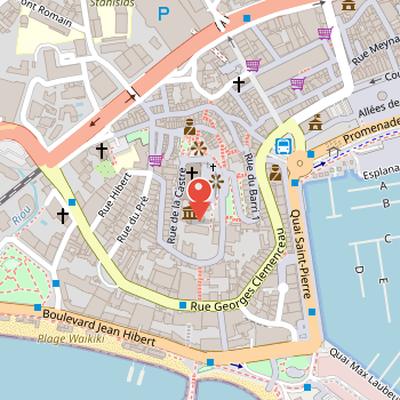
Nearby Objects
-
 Église Notre-Dame-de-l'Espérance 60 m away
 -
 Marché Forville 250 m away
 -
 Palais des Festivals et des Congrès 650 m away
 -
 Municipal Casino of Cannes 650 m away
 -
 Église Notre-Dame-de-Bon-Voyage 700 m away
Collections in the Castle Ruins
The Musee des Explorations du Monde is located at Place de la Castre, on the summit of Suquet hill, inside the ruins of the medieval castle of the monks of the Abbey of Lerino. It is classified as a Musee de France and holds collections belonging to the city of Cannes.
Its holdings include primitive arts from the Himalaya-Tibet region, the Arctic, pre-Columbian America, and Oceania, as well as Mediterranean antiquities. The museum also exhibits musical instruments from Asia, Africa, Oceania, and America. In addition, its collections include notable 19th-century landscape paintings by minor painters from Provence, along with some 17th-century and 18th-century canvases.
Medieval Origins and Museum Setting
The Musee des Explorations du Monde is located on the top of the hill of Suquet, overlooking the bay of Cannes. Its complex of buildings is one of the rare surviving testimonies of the Middle Ages in Cannes. Built from the 11th century at the initiative of the monks of Lerino, it reflects the long presence of that monastic community, which had settled on the island of S. Honorat from the 5th century in their famous abbey. The site originated as a monastery and was later developed on a quadrangular plan resembling a turret fortress. Its defensive enclosure included a housing block and a chapel, while the central courtyard contained a square watchtower tall enough to serve as a lookout. Intended for the princes of the Church, the abbots of Lerino and lords of much of the region, the castle of Cannes displayed architectural power dominating the coastal landscape. By the end of the 16th century it was already damaged, and in 1700 it was partially demolished by order of the bishop of Grasse. During the Revolution it was sold as national property to the Hibert family, who used it as a residence until 1878. It was then rented to the ceramics manufactory La faiencerie d art du Mont-Chevalier, before the Municipality of Cannes purchased it in 1919 to house the city museum and officially established the museum after the acquisition. The tower and the chapel of S. Anna form, with the church of Notre Dame de l Esperance, a monumental complex classified as a Monumento storico di Francia by decree on 28 July 1937. Visitors reach the museum by crossing a large garden rich in Mediterranean shrubs and herbaceous species, crowned by large stone pines. After the exhibition rooms, they enter the inner courtyard, where the watchtower of the ancient castle rises. The tower has 109 steps and offers a 360 degree panoramic view from the sea to the surrounding hills.
Origins and Development of the Collections
The collections originated with the first museum in Cannes, which was located in the town hall in 1877. Their foundation was formed by an important donation to the city from Baron Tinco Martinus Lycklama a Nijeholt that same year, including two distinct gifts from him. The collections were soon expanded by various donations related to painting, notably including a donation by Alfonso di Rothschild. Over more than a century, they were regularly enriched through acquisitions and significant deposits, including from the Louvre Museum. For a long period, the collections were housed in the old Cannes Town Hall before being progressively transferred to the Chateau de La Castre starting in 1920. Today, the exhibition criteria divide the artistic and cultural heritage into four groups of works.
The Development of Landscape Painting
The section traces how nature was represented differently across past eras and civilizations before landscape painting became a specific genre. It notes landscape elements in ancient Roman frescoes, symbolic landscapes in medieval miniatures, and urban and peri-urban landscapes in the Renaissance. In earlier classic painting periods, landscape often served as a background for historical or religious scenes, while in the 17th century plains, forests, hills, seas, and rivers appeared mainly in secondary roles. By the end of the 18th century, landscape art had become a distinct genre, inspired by the Dutch and Flemish schools.
A key phase began in France in 1817 with the creation of a prix de Rome for paesaggio storico. Around the same time, Les Elements de perspective pratique a lusage des artistes became an important reference text for landscape artists. It recommended working en plein air and studying fragments of landscape such as rocks, trees, or clouds. Artists often began with pencil sketches made from nature, added color notes, and then developed the paintings in the studio. They also reconstructed landscapes from memory, combining realistic details with imagined places.
The text also describes how 19th century travelers used new travel guides to seek elevated viewpoints that enhanced the beauty of a territory, and how landscape painters sometimes proposed panoramic views. The exhibited works include pieces by minor 19th century Cannes masters, with picturesque coastal motifs, and compositions by Joseph Contini and Adolphe Fioupou, who are presented as observing tree vegetation and rock walls in detail while arranging isolated or combined natural elements into careful compositions.
Marine Painting and Cannes Views
The gallery of images brings together several paintings connected to the Cannes area and to the broader development of marine painting. It includes Adolphe Fioupou's L'Estereel, Edouard Cremieux's La Corniche, Fortune Viguier's Paesaggio provenzale, Ernest Buttura's Il fortino dell'isola di S.Margherita and La ricucitura delle reti, and Felix Ziem's Un trabucco a Venezia. The gallery notes that 19th-century Cannes painters such as Fioupou, Contini, and Buttura composed small paintings of the surroundings of Cannes. Their works depict views of Suquet hill, La Croisette promenade, and the boat docks, while also evoking a golden sunset atmosphere and Mediterranean vegetation. In these images, Cannes appears as a gateway to the East.
The gallery also places these paintings within the history of marine painting. Before 1800, French marine painting followed Academy canons and served royal propaganda, with naval battles and ports represented on large canvases for castle galleries. After 1830, marine painting was influenced by Dutch painting and came to show greater interest in the natural environment and human presence. It also shifted toward smaller formats and paid close attention to water reflections, skies, and clouds, while boats and coastal figures became picturesque elements of marine landscapes. Ernest Buttura, identified as a distinguished painter in the marine genre, is represented within this context.
Painting Techniques and Modern Landscape in the Collection
The Galleria d'immagini presents a sequence of artistic approaches that trace the evolution of landscape painting in the 1800s and early 20th century. It notes that painters left the studio to work en plein air and represented the landscape without idealizing what they saw. In doing so, they abandoned themes typical of the great painting of the era, such as heroic scenes and invented landscapes of Greece or ancient Rome. The gallery also places this change in the context of the origin of photography in 1829, explaining that painters sought to distinguish painting from photography and to express more than an instant reality.
Within this development, the impressionists are shown as following the pioneers of the Barbizon School by placing their easel directly in the chosen landscape. They sought objectivity and ignored the historical, anecdotal, romantic, or moral interpretations favored by earlier painters. The gallery highlights their use of light colors, pure color taken directly from the tube, fractionated brushstrokes, and superimposed colors without mixing. This technique is presented as directing painting toward modern expression. Alfred Casile from Marseille is cited as an example of this style through a Normandy landscape, while Georges Seurat and Paul Signac are described as marking their era through the impressionist movement.
The collection also includes post-impressionist or divisionist work, such as a 1907 landscape by Georges Ribemont-Dessaignes. The artwork is described as dividing space into three overlapping bands, linked by two long trees in the foreground, with fractionated brushstroke on the band representing the sea. The gallery then turns to the Fauves, active from 1905 to 1910, including Maurice de Vlaminck and Andre Derain. Their painting was based on instinct and used bright, pure colors on large surfaces. Artists from Southern France at the start of the 20th century adopted this style without its original provocative spirit. The museum represents this tendency through works by Jean-Baptiste Olive, Edouard Cremieux, and Edouard Ducros, alongside works by Adolphe Fioupou, Ernest Buttura, Charles Labor, and Henri Harpignies.
Ethnographic Collections Across the World
The ethnographic holdings present a varied set of collections drawn from several world regions. One section is devoted to Himalayan and Tibetan popular art, described as a unique collection in France. It includes objects inspired by Tibetan Buddhism and tribal shamanism rituals, as well as masks, female hairstyles, ex-votos, and votive figurines from Ladakh, Arunachal Pradesh, Nepal, Tibet, and Bhutan.
Another group of objects consists of about sixty Inuit items from Canada, Alaska, and Greenland. These include daily objects, fishing and hunting tools, and ice glasses, along with small carved ivory figurines representing daily activities and religious habits.
The collection also presents around fifty pre-Columbian ceramics and stone sculptures from Mexican, Central American, Andean, and Peruvian civilizations. Among these are notable mola grain containers shaped like jaguars from Costa Rica, a female statuette from the Chancay culture, and a Mochica portrait vase.
A further 124 Oceanian objects were collected by Edmond de Ginoux de la Coche. These were acquired during stays in Tahiti and the Marquesas Islands in 1843-45 and 1848. The Oceanian displays include Polynesian and Melanesian weapons arranged in a panoply, funerary effigies from Vanuatu, and a canoe prow from the Trobriand Islands, New Guinea, placed in the central space of the second Pacific peoples room.
The Historical Route in the Tour de l'Abbe
The parcours historique is installed in the lower room of the tour de l'Abbe and presents artifacts from ancient Mediterranean civilizations in glass cases. Its display spans almost 5000 years of art, from Sumerian clay tablets to Christian lead sarcophagi dating to the 4th century. Part of the collection comes from Baron Lycklama's holdings, formed during his travels in the Near East, and it also includes the most precious objects from Jacqueline Damien's donation to the French State in 1992. The geographical range of the objects is broad, with pieces from Persia and its capital Tehran, from ruins on the Tigris in present-day Iraq, from Turkey and Constantinople, from Syria with Damascus and Palmyra, from Palestine with Jerusalem and Bethlehem, and from the island of Cyprus. Among the notable works are sculpted heads from the Cypriot civilization, the Egyptian offering table, the gold funerary mask of Sidon in Lebanon, and paleochristian lead sarcophagi. The collection also contains five sarcophagi in total, three paleochristian, one Egyptian, and one Etruscan, a group that evokes ancient funerary practices.
Musiche del Mondo in the Chapel of S. Anna
Strumenti musicali del mondo has a permanent exhibition called Musiche del mondo, located in the 12th-century chapel of S. Anna. The exhibition contains more than 350 non-European musical instruments. Its collection includes African harp-lutes, rain drums from Southeast Asia, bamboo nasal flutes from the Marquesas Islands, conch shells from the Marquesas Islands, and sounding vessels from South America. The setting in an historic chapel gives the display a distinct architectural context, while the collection presents a wide range of musical traditions from different regions of the world.
The Museum Collection and Its Origins
The museum was founded from an important collection donated by the people associated with the history of the Musee de la Castre, who moved to Cannes and gave their personal museum to the city. Its holdings were later enriched by the collection of Edmond de Ginoux de la Coche. He stayed twice in Polynesia and the Marquesas Islands in 1843 and 1848, traveled to live among indigenous people to study them, and returned to Europe with cultural artifacts and pre-Columbian archaeological pieces. Another major source was his thirteen-month journey in the central Arctic from 1938 to 1939, during which he collected almost 450 objects from encounters in the Arctic. The museum also purchased 29 objects in 1973 and received part of the collections of Rene Damien from Jacqueline Damien. Rene Damien's collection included paintings, rare books, and antiquities focused on metallurgy.