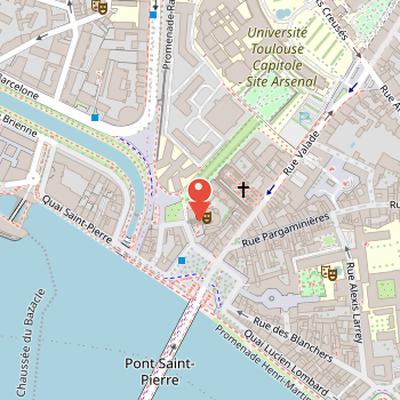
Église Saint-Pierre des Cuisines is a church building in Toulouse, on rue de la Boule next to place Saint-Pierre. It is described as the oldest church in southwest France and was built on an ancient Gallo-Roman necropolis from the 4th century. The church contains an archaeological crypt showing remains of a 4th-century paleochristian basilica and a pre-Romanesque church. Classified as a historic monument since 1977, it is placed under the responsibility of the musée Saint-Raymond in Toulouse.
The history of the site includes its use as a priory, later transformed into a college by abbot Bernard de Montaigut of Moissac. It was given to Moissac abbey by the Count of Toulouse in the 10th century, and the name Saint-Pierre-des-Cuisines is linked to earlier forms such as Coquinis and Coquins. From the 12th century, it became a public gathering place, and several acts concerning the commune of Toulouse were recognized there. Today, the church also houses an auditorium with 400 seats for the conservatoire à rayonnement régional de Toulouse.
Nearby Objects
-
 Place Saint-Pierre 10 m away
 -
 Saint-Pierre des Chartreux Church 80 m away
 -
 Palace of the Visigoth Kings 150 m away
 -
 Toulouse Regional Conservatory 250 m away
 -
 Monastery of the Jacobins 400 m away
Historic Site and Current Use
Eglise Saint-Pierre des Cuisines is described as the oldest church in the southwest of France. It is located on rue de la Boule, next to place Saint-Pierre in Toulouse, and was built on an ancient Gallo-Roman necropolis dating from the 4th century. The building has been classified as a historic monument since 1977 and is placed under the responsibility of the musee Saint-Raymond in Toulouse. It also houses an auditorium with 400 seats for the conservatoire a rayonnement regional de Toulouse.
From Monastic Priory to Civic Gathering Place
Eglise Saint-Pierre des Cuisines stands on a necropolis, like the basilica Saint-Sernin, and its archaeological crypt preserves remains of a 4th-century paleochristian basilica as well as a pre-Romanesque church. The site was given to the abbey of Moissac by the Count of Toulouse in the 10th century, and in the 11th century Count Guillaume IV allowed the Benedictines of Moissac to take possession of the church. Its name is linked to a francized form of Coquinis, meaning small artisans, while another tradition recalls fishermen of the region who once dedicated a priory to Saint Peter. When the church passed to Moissac, the name Coquins was used by Guilhem IV for the building.
Originally a priory, the church was later transformed into a college by abbot Bernard de Montaigut of Moissac. Between this period and the later entrusting of the college to the Chartreux monks of Toulouse, the church received a new nave and a new choir. Five centuries after Bernard de Montaigut, the college was entrusted to the Chartreux monks, and in 1569 monks expelled from the Charterhouse of Castres settled in the old college of Moissac abbey. A further exchange took place on February 25, 1616, when Moissac abbey exchanged the Saint-Pierre priory for the Villardonnel priory with the Chartreux monks. Pope Paul V ratified the exchange on February 19, 1617, and vicar general Pierre de Villette issued the papal bull sanctioning the union of Saint-Pierre priory to the Toulouse Charterhouse. After this union, Chartreux monks settled next to the church.
From the 12th century, Saint-Pierre des Cuisines also became a public gathering place. Count Raymond V recognized the privileges of the Toulouse commune led by the capitouls there in 1189, and this recognition was renewed by Count Raymond VI in 1195 and by Count Raymond VII in 1222. Simon de Montfort signed the Toulouse surrender at the church, and the counts of Toulouse gathered the people there. The City Customs were officially promulgated at the church in 1286.
Decline and Repairs in the 18th Century
By the 18th century, Saint-Pierre des Cuisines was suffering from neglect, with Chartreux monks failing to maintain the church and parish priests complaining about its condition. On April 22, 1758, part of the ceiling collapsed because of dilapidation. The church then remained closed during repairs, and the Capuchin fathers lent their chapel for services. Further restorations were carried out in the sanctuary in 1779, and the bell tower required repair in 1788. By the time of the Revolution, the old church was still in a dilapidated state.
Suppression of Religious Communities
According to Histoire, the Constituent Assembly pronounced the abolition of monastic vows on February 13, 1790. On the same date, it also suppressed religious congregations. These measures marked an important change in the status of religious life.
From Sacred Site to Civic Use
During the French Revolution, the monastery and Carthusian property were confiscated and sold as national assets. The church itself was sequestrated and removed from worship. A decree of the Constituent Assembly on August 29, 1791 reorganized the Saint-Pierre parish and transferred its seat to the Jacobins church, which was renamed Saint-Thomas d'Aquin, while the Carthusian chapel became an annex oratory. A Legislative decree of May 12, 1792 then elevated this annex to the main church under the Saint-Pierre name, and the preacher's church was designated as a secondary chapel. Saint-Pierre-des-Cuisines was deconsecrated and its cemetery appraised on July 26, 1792, before the cemetery was auctioned on September 5, 1796.
In 1793, authorities requisitioned buildings from evacuated religious congregations, and an arsenal was installed in the Carthusian enclosure and Capuchin garden. Saint-Pierre-des-Cuisines church and the old Capuchin house became part of the Grand parc des Armees des Pyrenees. The church was converted into a cannon foundry for part of 1794, then used as a drill hall from 1816 and later as a storage depot until the Arsenal was suppressed in 1965. After the parish was transferred to the Carthusian church renamed Saint-Pierre-des-Chartreux, the land freed by the military was given to the law faculty in 1966, and a social sciences university campus was established on this land on December 23, 1970.
The old church was registered as a historic monument in 1977 and has been owned by the city of Toulouse since 1982. It later became an auditorium for the Toulouse regional conservatory, helped by its proximity, while the surrounding buildings were used as a dance school affiliated with the conservatory.